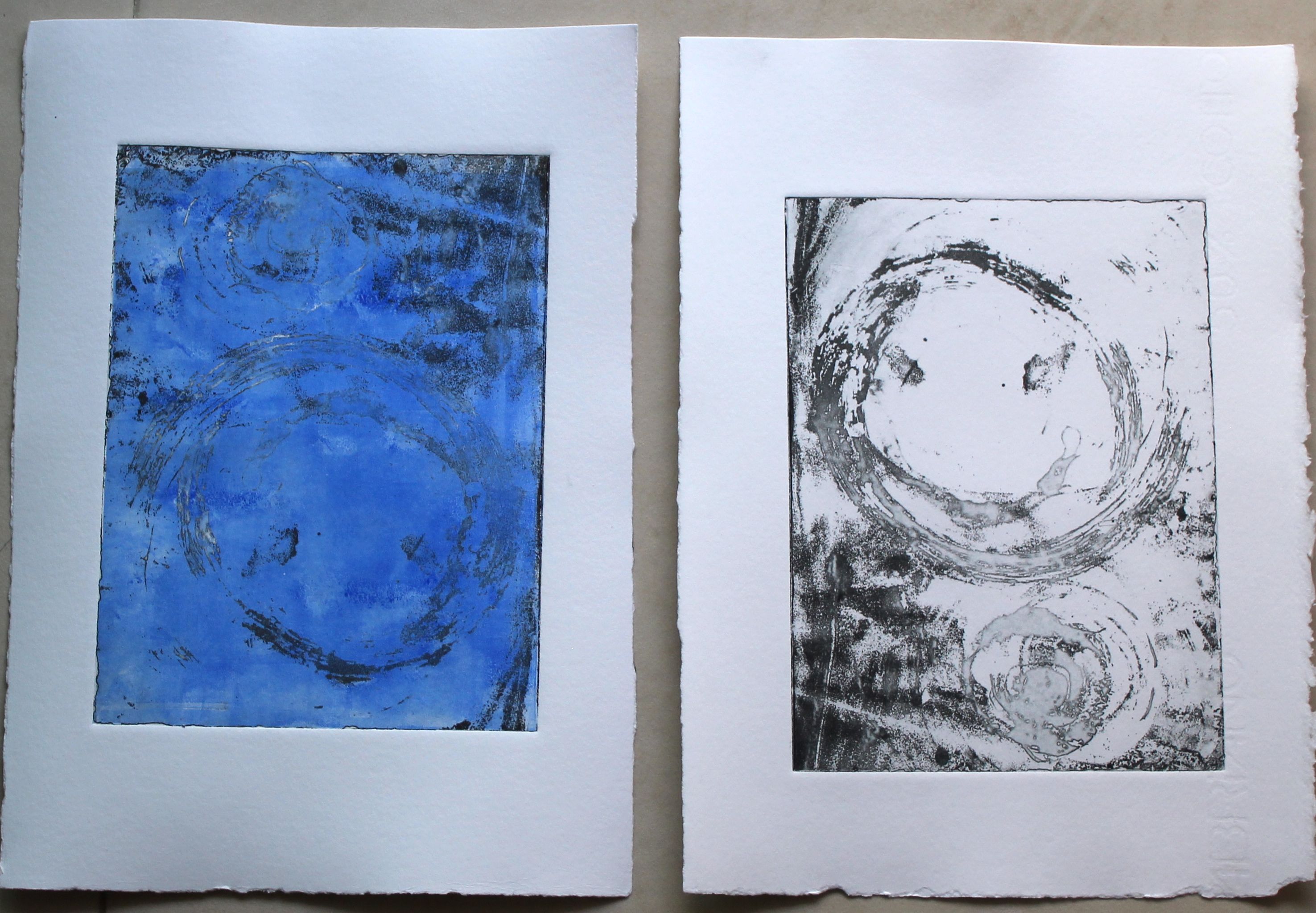
Event Horizon by Antony Gormley | Event Horizon

Research

http://www.eventhorizon.hk/en

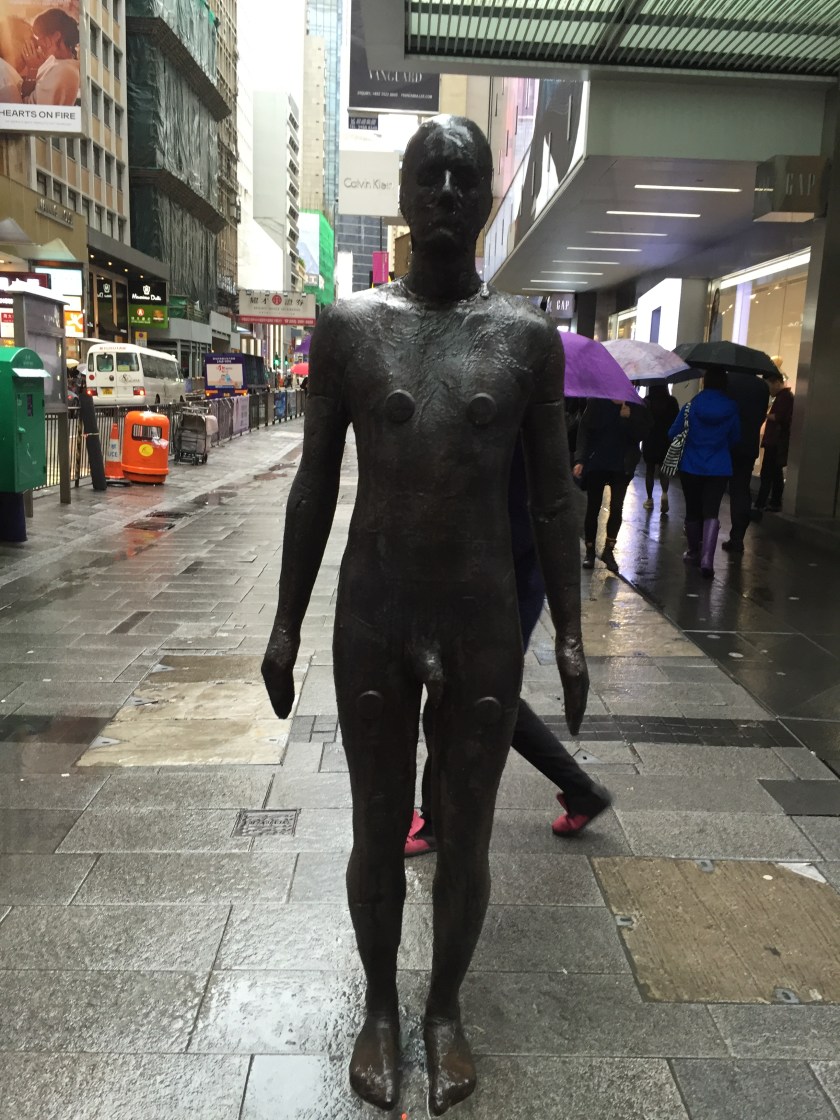
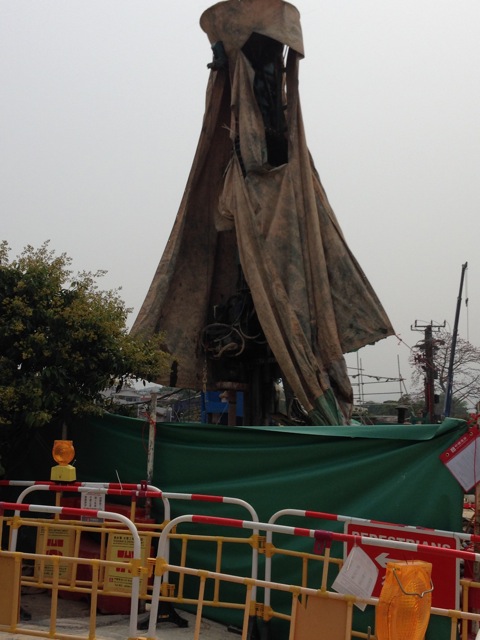
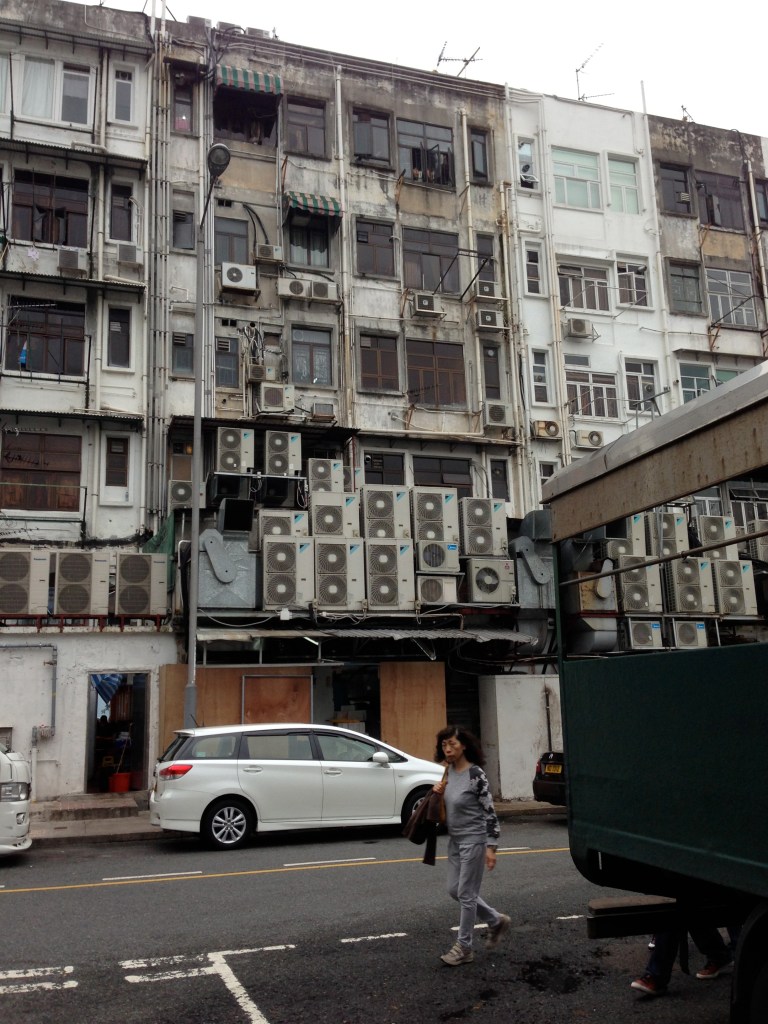
This installation, unusual in Hong Kong in that the art is not for sale, was a brilliant idea. Asking Hong Kong people to look up is in itself fantastic, and making people consider their place in space and time, even better.

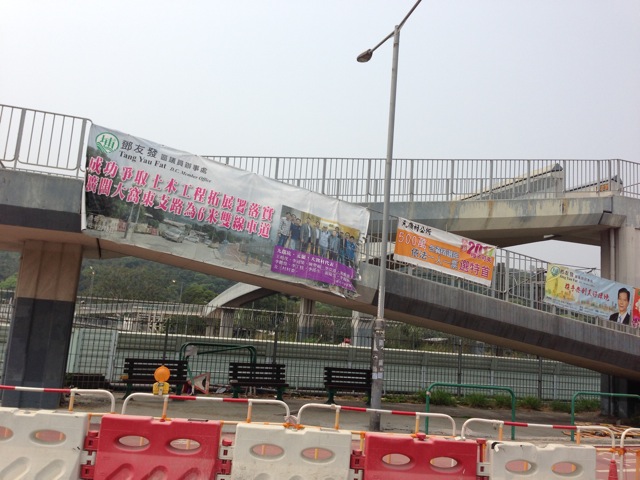
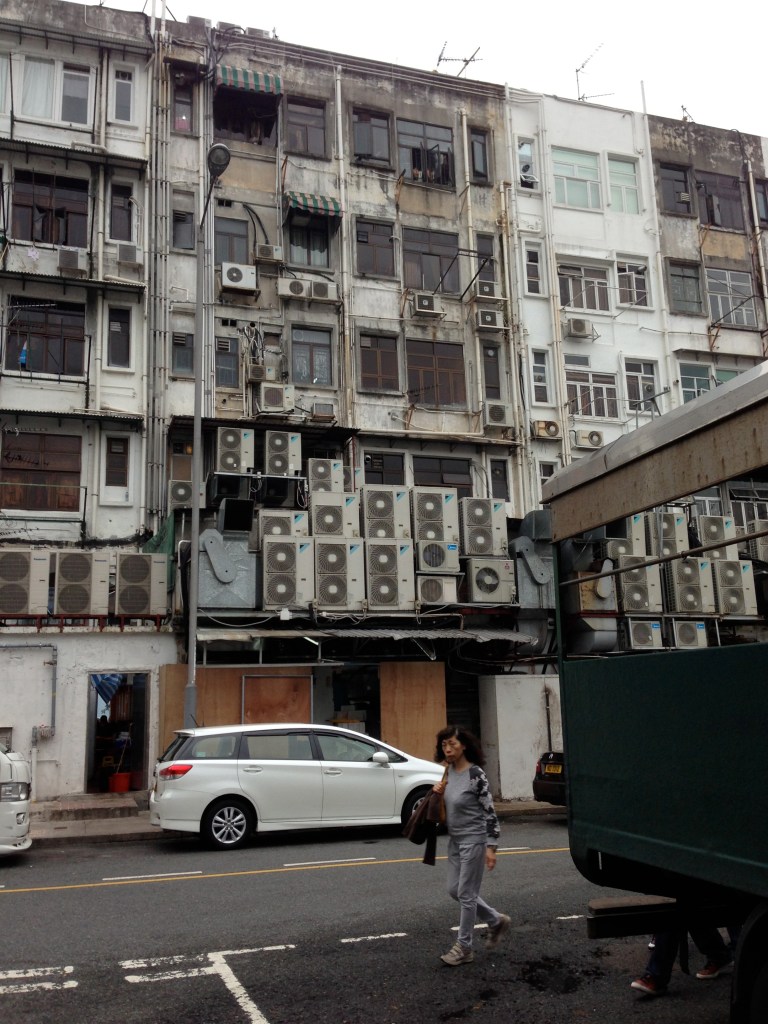
This type of art draws my attention to the importance of the site, of the way it interacts with people and place, and the way it forces engagement. There were two statues at ground level, one in a very busy location, right in the middle of a pavement, and it must have been collided with countless times by people on mobile phones. Many probably mumbled “excuse me”  and moved on, making a point, despite their not perceiving it, of how  we in a busy city make other people objects, obstacles. The single most annoying thing for most of us in this city is a person walking at the wrong pace on a pavement, as our lives are all about movement, doing, going. This installation invited us, in fact challenged us instead to be.

img_4524

Chiaroscuro: Final Project: Not Black and White and not final…

Assignment 3

This was an outline of something I planned, didn’t actually do. That was an experiment: write it and it will come. It didn’t.

This final project tried to bring together practical experiments, personal experience and theoretical ideas about reality, truth and perception.

The following are notes on ideas. Increasingly, I found myself having my ideas in verbal form, rather than visual, sketched, experimented with, and I think this has been a major flaw in my work process.

NOTES FOR AN UNCOMPLETED PROJECT:
The processes used were intaglio, using copper plates, and involing photopolymer and etching in ferric chloride and in sodium persulfate. The two techniques in themselves suggest different approaches to representation, one, the duplication of an image using light and and single or multiple exposures, the other, the more process-driven, physical, experiential. The first technique is described by the verb “capture”, and brings to mind the action of glancing, catching a glimpse, a momentary insight or point in time. The other, as is suggested in the metaphoric phrase, “etched by experience”, suggests something honed over time, handled, considered and reworked.

The idea behind the different pieces was intertextuality, or Baudrillard’s “hyper-realism”, the condition by which “reality ..founders in hyperrealism, the meticulous reduplication of the real, preferably through another, reproductive medium” – each element would make reference to a text or type of text in order to challenge the text’s claim to represent a truth.

I wanted to use printmaking as a subject, as well as a technique, therefore reference duplication, reproduction, separation.

The starting point for this piece was the painting of “David with the head of Goliath” by Caravaggio, in the Prado, Madrid. The links to modern day events involving beheadings by ISIS could not be avoided, and thus to an engagement with ideas of heroes/villains, right/wrong and the construction of reality through images.

https://www.museodelprado.es/en/the-collection/art-work/david-with-the-head-of-goliath/c3895900-73d4-4257-97fb-240e3aaf0402

Prints and Practice

Here are some of the images and plates produced along the way in thinking this through. The plates of David and Goliath  went through several stages.

Caravaggio’s painting

The painting has been x-rayed, reportedly showing that an earlier version stressed much more the physical pain of the victim, and suggesting that this may have been changed to please the patron, to avoid it being too graphic. This reminds us of the audience for images, for whom representations must be manipulated. As it is, the portrayal of the two characters seems to me to favour neither one over the other. David is shown as youthful, and his profile, in shadow, is that of a classically proportioned ideal, with his high bridged nose, graceful facial features and delicately curling hair. His muscular body and indications of physical strength and poise suggest athleticism, rather than a homely shepherd boy. Goliath, on the other hand, is not significantly larger- therefore not a mythical “giant” as the Bible version tells. He is clearly older though, and with a face in death that looks more sad than pained: his eyes are open, and strangely bright, and although they do not look back at the spectator, they come closer than David’s, which are focussed on the task at hand, and therefore Goliath’s might actually invite somewhat more empathy.The head has presumably now been severed from the body, although the process is clean and bloodless, and the positioning of the head seems to be for compositional value, creating a strong diagonal, rather than for an authenticity. David is unstained by the whole process.The light shines on his body in a way that stresses his physical form, and on Goliath in a way that stresses his life in death, and seems to play no symbolic role of highlighting good over evil. Of course, the principal technique to be noted here is the use of chiaroscuro, as a method of creating an illusion of solid forms and three dimensions as the darkness recedes and the highlights construct highly plausible contours of flesh.

As a painting in the “history”genre, Caravaggio’s work can be seen as a “dramatisation” of a traditional tale, an imaginative recasting of the plot, starring a young Greek hero and a middle aged man, his victim. By showing us a moment in time, one that is apocryphal, we are invited to see this as a naturalistic event rather than an allegory, and thus to give credence to the literal truth of the Bible. The role of the light is to reveal, to play on the forms, and to make us feel we could touch the cloth and the skin.

On the other hand, my reading of it would say it is the triumph of youth over age, rather than good over evil, and it is only the application of intertextuality, knowing the story, that would make it otherwise.

Context is all. How different would our reading be of such a scene today. Images of beheadings, meant to be as graphic as possible, to make us look at the face of victims, to hear their screams and feel their pain, and be told, this is what we want to do to you too, are diabolical. Video, as the chosen medium, is used to make us feel present, to leave us in no doubt that what we are watching is real, but becomes surreal, subject as it is to taboos on what we should be able to witness. We are confused by the deviant use of the media, which we expect to serve us up illusions.


Part 1:

Contesting historical narrative

The image was to have been printed multiple times onto pages of a. The Bible and b. The Trial, by Kafka. Here’s the thinking behind it. (The trouble with me is if I write it down and justify it, I’ve already as good as made it.)

Repetition was to be used as a reference to how historical narratives are created, as well as a self-conscious use of the printing process as a commentary on two printed texts.

The pages were to be roughly printed and perforated at the corner, and hung on a hook which might remind people of how newspaper is torn and used for toilet paper. This links to the idea of “yesterday’s news” being no longer of interest, to the speed at which we digest news and move on, and our low level consumption of repeated “human interest” narratives.

The choice of the Bible was partly because of the transparency of the paper, its fitness of purpose (either its intended one or the one suggested above) and its ability to confer “authorised version” status on a story, which then becomes reified and contested in equal measure, depending on the audience.

The Trial was selected as a piece of modernist literature which in itself challenges ideas of historical narrative and literary convention, with its lack of narrative structure, absence of heroism, or of cathartic conclusion. The order of the text is one that was constructed by a friend of the author, as the original manuscript was simply a collection of unconnected chapters.

Both texts deal with the concept of justice, the first constructing a moral universe of sin and redemption, the second a world in which crime is arbitrarily defined and punishment administered with no seeming relation to laws.

In the biblical context, the authorised version of the story tells us that right defeats might, that the meek will prevail. A new “reading” of the image could be of the son killing the father, the death of God, the ending of authority.

The work then, would attempt to appropriate the well-known image, and the well-known story, and problematise their politics of representation, their values, their use of signifying practices of composition and narrative.

But how to actually print? These pages could not be soaked, and the print would likely hide the image.

I like some of the ideas here, and will keep thinking of how to make them work visually.

Part 2

The Relic

A copper plate, burnished and framed

This was to be a “relic” of the process of making the images, and as such could be perceived to have higher value, as possessing the cache of originality. The frame would reference this idea, making an allusion to an icon, and also calling to mind the reverence the church  hold for relics, and even the magical powers it attributes to them, despite their being rather mundane objects in themselves. The copper plate has an intrinsic “value” as a mined metal, and one for which workers suffer a great deal, so it has both a material and human cost. The way the multiple etchings have eaten away at this particular plate gives it the look of a worn copper coin.


This one can be achieved by making a pastiche icon, a painted frame, contrasting the real and the unreal.

I haven’t done the framing, and am now less sure of the quality of this idea. It seems like something that would look lazy.

Part 3 The Gaze

This one I have followed through, but only partially.

The grid as non-narrative, silent.

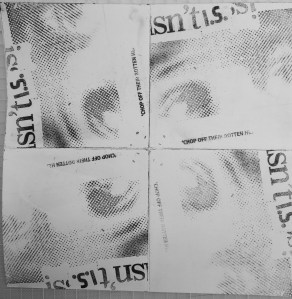
This section references newspapers, and how we bear witness to and report events. The gaze here is a constructed, shallow thing, made up of dots, so that light and shade are merely a pattern. The text is disjointed, making a play on words “is” “Isn’t” and IS. There is a further text, in capitals, “Chop off their rotten heads” which references the central image of the beheading.

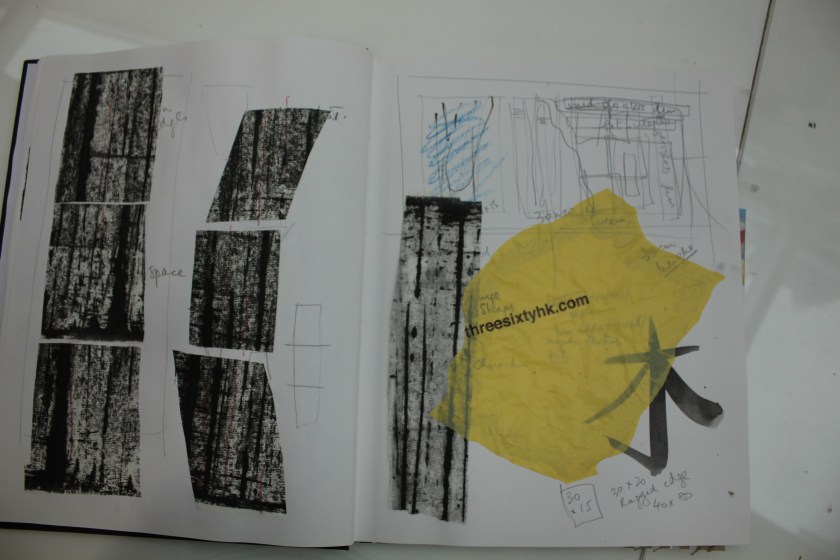
I originally intended to create something that looked much more like a newspaper, including pictures and columns. The text element was to be in broken columns, in my own writing, using words taken from diaries from the time of making these images.

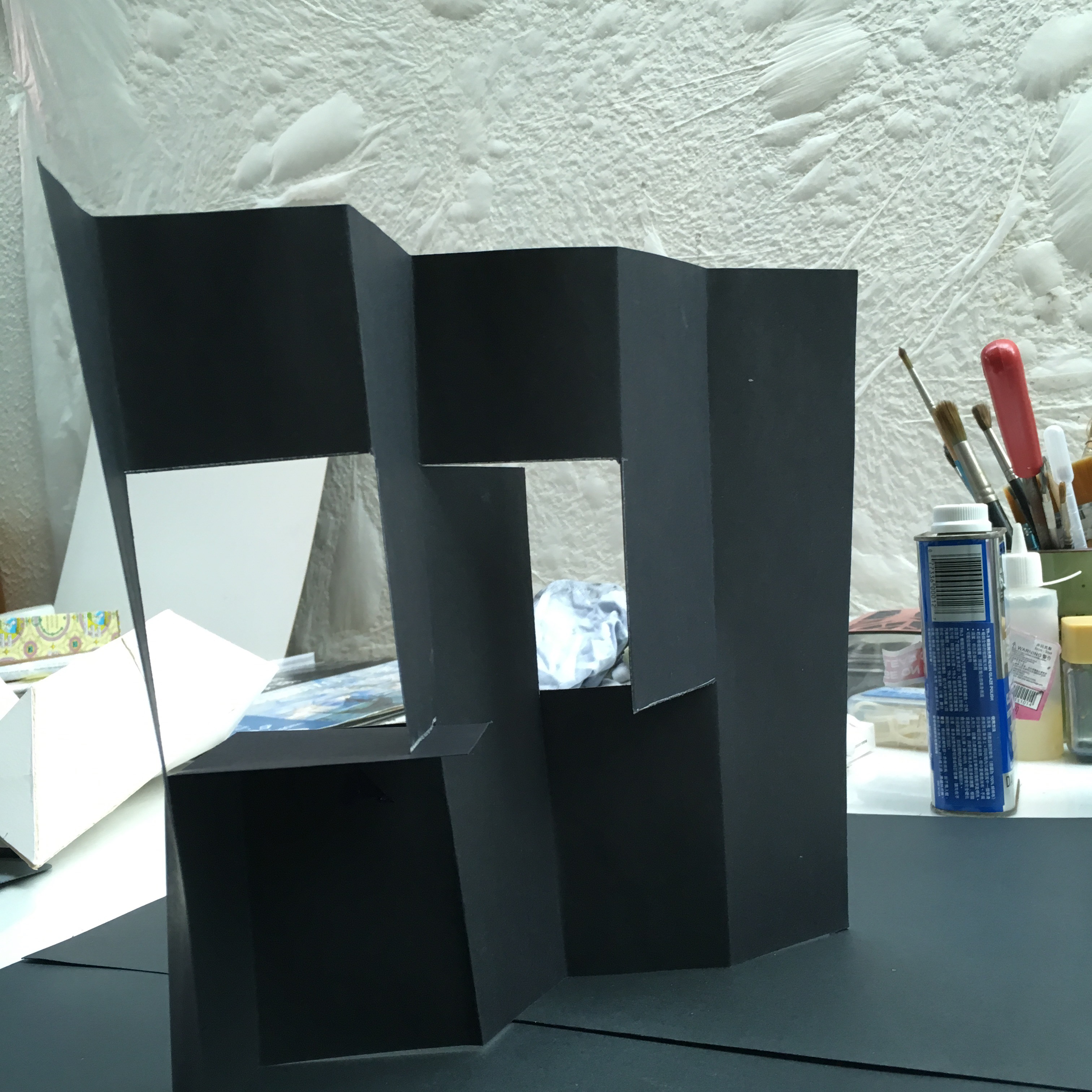
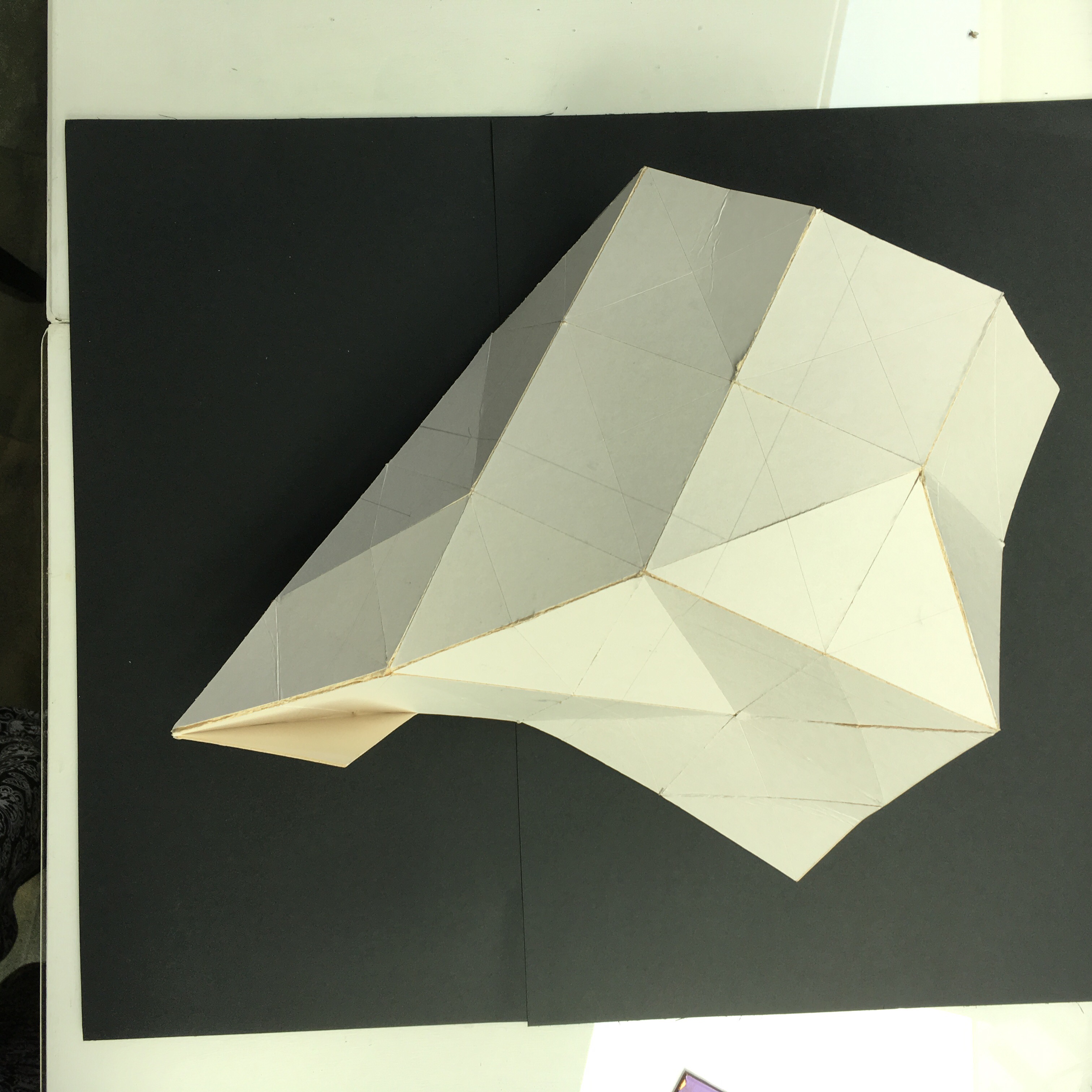
On the other hand, there was still a right/ left top/bottom orientation involved in a grid. It still tends towards Narrative. So I wondered about making it a more sculptural object. Following the ideas explored in work by Fionnuala MacGowan  (In Printmaking Today, Summer 2015- sculptural forms made with print) I could explore the idea of making 3-d shapes, “facets” to reflect the multi-faceted nature of truth- our distorted perspectives on it. There is no sense or single view.

Here’s some thinking about how this might be presented:

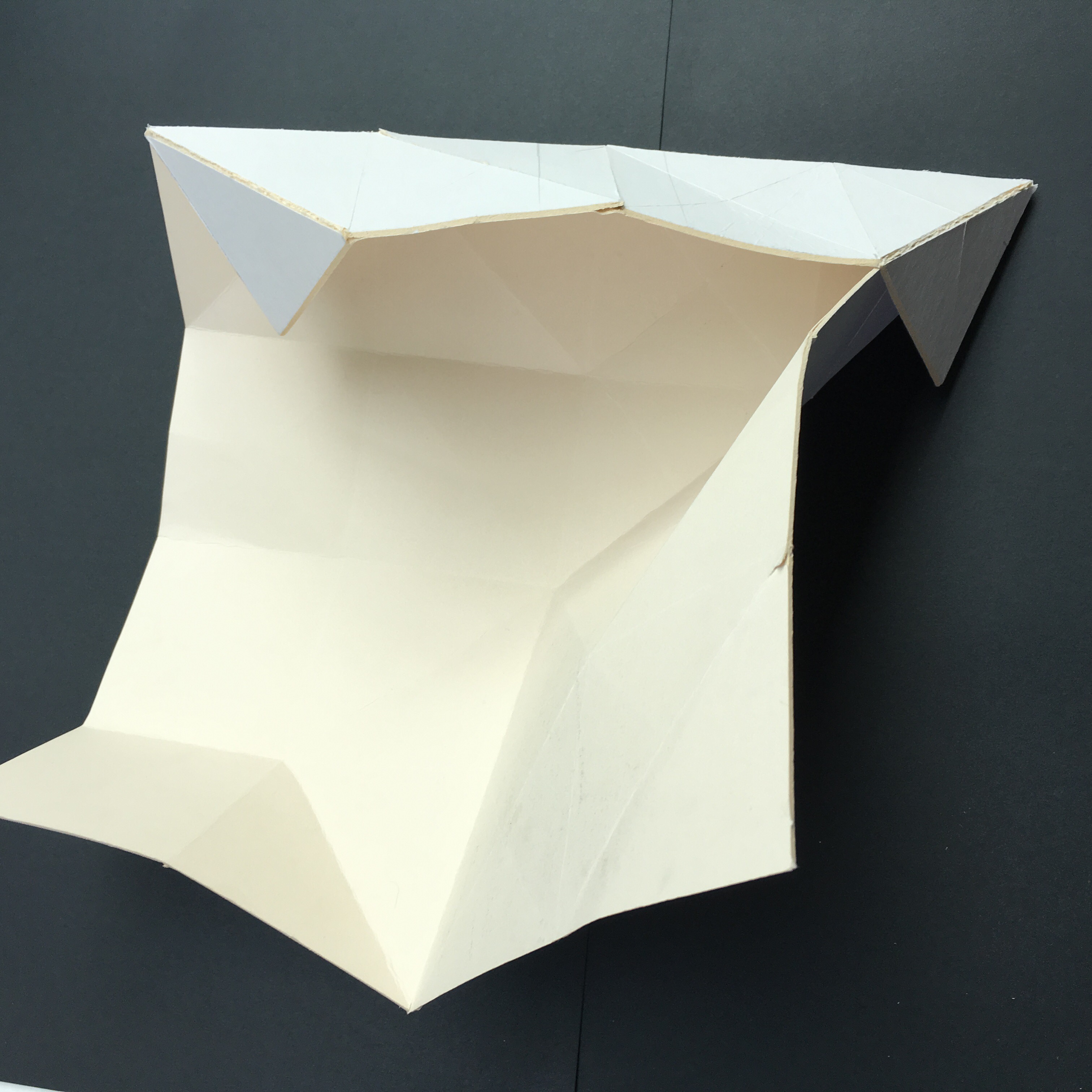
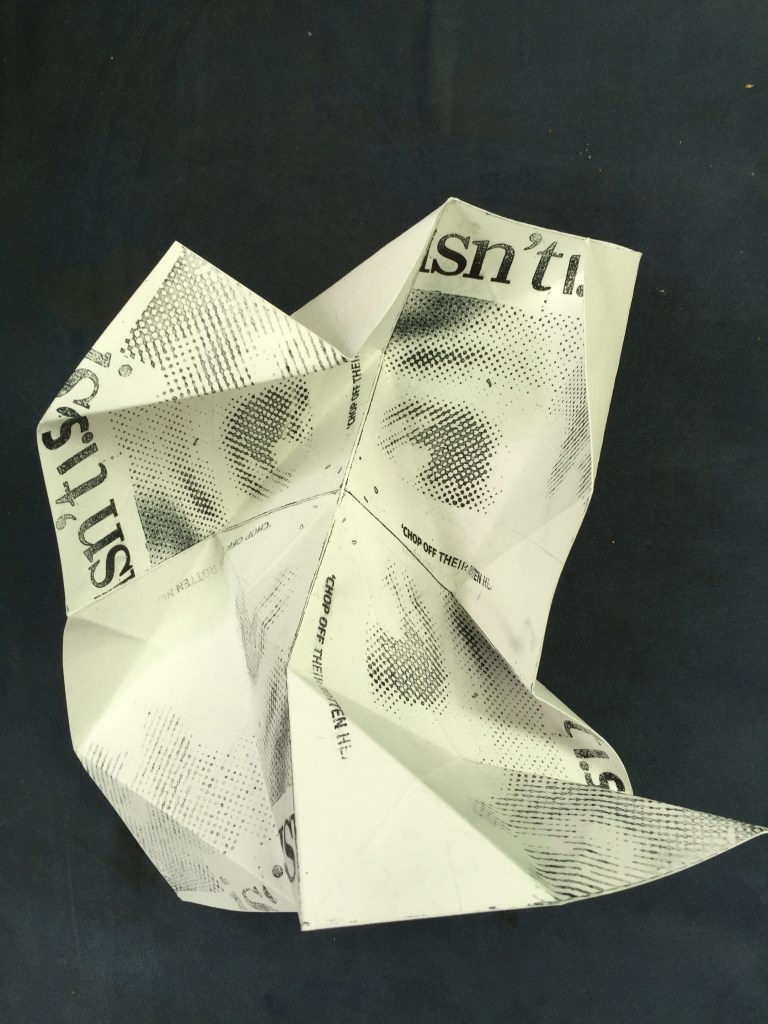
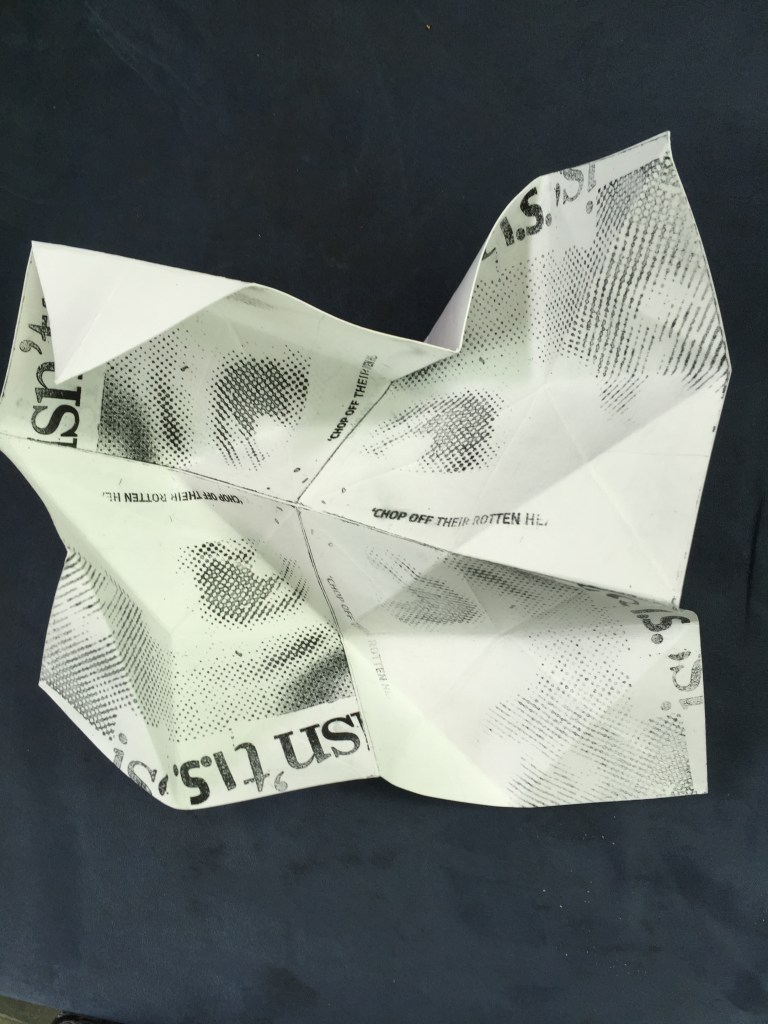
And here is a small model of what it could look like. These are prints on Fabriano paper- I did more as multiples, intending a bigger piece but the registration went wrong in the press, so I ended up cutting it down. It could maybe work, scaled up.

The diagonal grid folds are good because they can be twisted to fit several shapes, which reflects the nature of reported “truth”.

This isn’t there yet, but is an idea with potential. I’m seeing discarded newspapers in this shape- yesterday’s news. The way the eyes are sitting almost makes a distorted face, with no mouth. How cool it would be to take a movable shape and recast it as a fixed one like Marc Quinn’s Frozen Wave.

Is isnt

Photopolymer multiples

image

Facets

image

Facets


Assignment 2 Abstraction

Reflective Commentary

Non- rational abstraction: trusting to intuition could give rise to several processes and outcomes. You could let the materials work, and be the amanuensis. You could maybe succeed in not having to think in words. But could it be a purely automatic process? Unlikely. You make choices at all stages. You just might not acknowledge the reasons for those choices. You might be channeling memories, maybe referencing other people’s work without trying or being aware. You might produce work that provides insight into unconscious motivations and concerns, like dreams. You might just do what’s easiest. Or maybe bits of all of these.

Science has given us ways of thinking and knowing that are held to be superior to mere intuition, or to faith or emotion. Since the Enlightenment, reason has been the highest level of thought, the way of thinking and arguing that defeats all others. On the other hand, in recent years, the practice of mindfulness and the influence of Buddhism among educated Westerners has posed some credible alternatives to the mere superstition and credulity still evident in certain parts, all of them challenging the supremacy of reason.

“The History of the Inevitable warfare between Science and Theology” is a 19th century book title- I don’t remember by whom, and I haven’t read it- but I liked the title. It was one that leapt out because it suggested itself as a title that fit this series of images. The images came first and the title came afterwards, but clearly it echoed the thoughts I had been having along the way. This is a kind of interplay between reason and intuition, between the objective and subjective, the things that can be explained and the things that are harder to understand, that are personal, deeply emotional, and which you obsess about even when there seems no point, because you think there is an explanation for them, or a solution to them, or a cure for them or an escape from them. In the past religion would have provided all of these.

The instruction to work in abstract, to eschew representation, to avoid the limitations of one object = real/ iconic significance, opens the doors to multiple suggestion, interpretation, and ambiguity. It also creates problems of finding a stimulus, and working with observation or concepts, or emotions, or whatever. What it seems to suggest first to me is the exploration of formal properties of things, the lines, the shapes, and therefore techniques of whatever medium we are going to be using. In this assignment I have been struggling with the tensions of mastering craft- in this case also science- of photopolymer, of chemicals- all things which are quite new to me- and making meaning. I have not sketched, or barely at all. The work has all been in my head, and has been jumbling around with a lot of powerful emotions just lately.

The main focus of this assignment for me has been to experiment with new techniques. At times, that has meant that the work has been about process and it has lacked any emotional heft. But out of that has emerged some pieces that reflect themes and emotions that have been dominating this time, and these pieces make sense to me. The theme of the moon, and the idea of influence, gravitational pull, and the feminine principle, links for me with the strong emotional issues I have had to deal with recently about my mother and about myself as a mother whose only child just recently got married. The themes that emerge here are of orbits, splitting, floating away, loss and the emptiness of space. I think these are the feelings that have subconsciously shaped the images I have made.

I started by considering the meaning of abstraction, looking back to historical developments and identifying rational and intuitive approaches: the former I then pursued as abstraction by distance, the latter I broke down into gestural, and process approaches. In exploring process approaches I experimented with different materials and the processes that naturally go with them, exploring how to degrade, damage or decompose the materials. My chosen artist for the parallel project, Xu Bing, is undoubtedly an influence here, as his series of woodcuts “5 series of repetitions” is an inspirational use of process in reduction printing.  I was interested in making process match meaning, as he has done.

At the same time, my personal reading and practical research were talking me into the realms of science- with new processes involving chemicals, metals, photopolymers and light sources. This was all very new and presented a number of practical problems of access to resources, as well as opportunities to practice. It has meant that this assignment has been a long time on the go, very fragmented and interrupted by life events. These life events have fed into the emotional meanings that I’ve made though- by going for an intuitive approach, I believe that themes and understandings have emerged that reflect key events of my life recently. A powerful theme has emerged, linking me, my mother and my son, and these have metamorphosed into topical images of the moon, which at the time I first designed these plates, was both full and being eclipsed. The final image, of degeneration, is very poignant for me, and I am considering combining the print with the plate itself- a beautiful thing when it starts to tarnish and grow verdigris- but as a reminder of both the deception of images, and the process of irretrievable loss. The blank space on my final scroll may be inspired by Xu Bing, but anyway, emptiness is a factor to be included here.

Technically, two new processes in particular have inspired me in this assignment. The first is cyanotype printing- which is simple but beautiful, and I love the irony whereby the light of the sun creates such cold moon-like blues. An added irony is their sometimes impermanence. Something I need to research a bit more. That was particularly apt with my “Herschel 1Q84” cyanotype, where “a new planet” swam into my “ken” and soon afterwards disappeared again, making it a special moment. Doubly apt that Herschel developed this cyanotype process too. I have experimented with large scale printing on cloth, and am interested in developing something more along these lines- a mixed media approach perhaps, for Assignment 3, using this sun-printing process involving nothing but light and shade, as my take on “chiaroscuro”.

The second technique is copperplate etching using ferric chloride. (I have another chemical in the house which also might be a non-toxic etchant, and still need to try it out). I have focussed on the aquatint process, as I like the depth and granulation, and multiple shades of grey. Obviously, I am very much a novice at this, and have not explored the creative potential very far, as I’m still very focussed on the “how”.  But I feel that I have taken an important step forward. When I started I was playing with monoprints, printing at home, and nothing much more. I now have the ability to work in many more ways, have a press (albeit in the wrong country) and feel fired up to move on to more professional ways of working.


Chiaroscuro: Light and Shade: Collaborative Project on Cyanotypes

Assignment 3


This slideshow requires JavaScript.

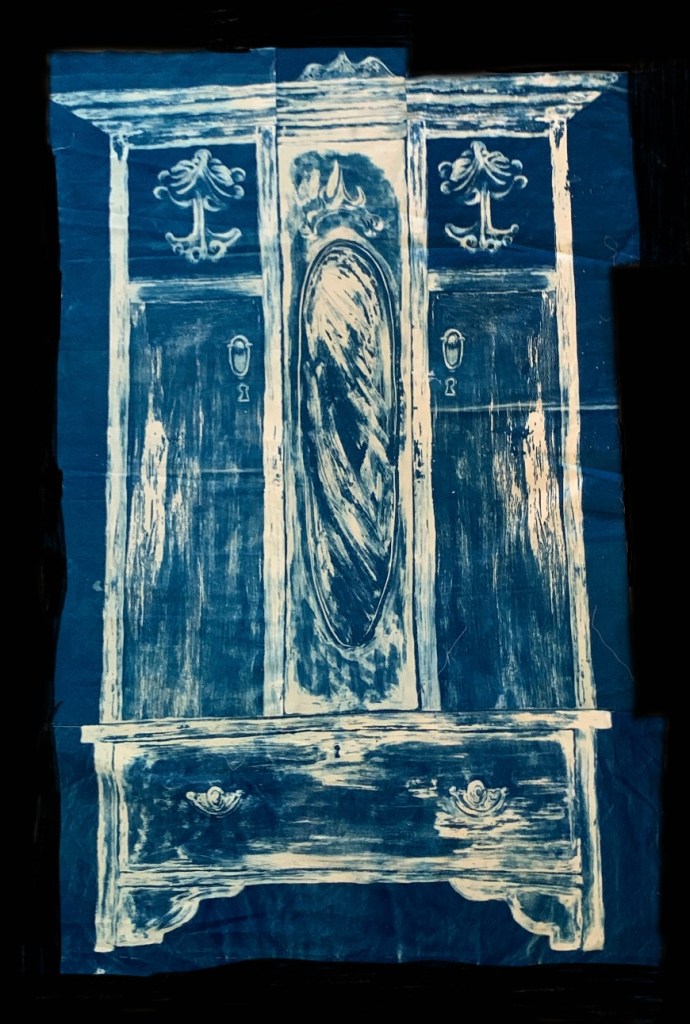
This was a project done with students at school, using Cyanotype printing to create banners on cloth. The idea here was to create life-size images, using the students themselves, and any props or 2-D shapes they chose to create, to represent themselves. It involved mixing large amounts of the solution, and spraying it in a darkened room, leaving to to dry overnight, then keeping it out of the light until time to use. All of this was quite difficult in a school. The students then had to plan their part of the banner and cooperate with each other to create the image. It was a learning experience for all, finding out how long it took for the image to form- not long as it turned out, as the sun was strong- the difference it made using 3-D shapes, the effects of shadows, and what effects could be created by incorporating movement. The first attempts had a lot of crease marks, so gradually we built up team skills whereby each person had to take a role in: unfolding the cloth, shading the exposed cloth with umbrellas, helping participant-subjects position themselves and their props, stretching the cloth tight, moving props where required, then rolling up the cloth as each section was completed. The cloth was then rolled into a black bag by me, rushed to the art room where I had a vat of vinegar waiting, then rinsed in running water until the water ran clear, then stretched out to dry. A lot of fun! Also very effective banners which decorated the school science block, celebrating the collusion of art and science.

Robert Rauschenberg and Suzanne Weil Cyanotypes

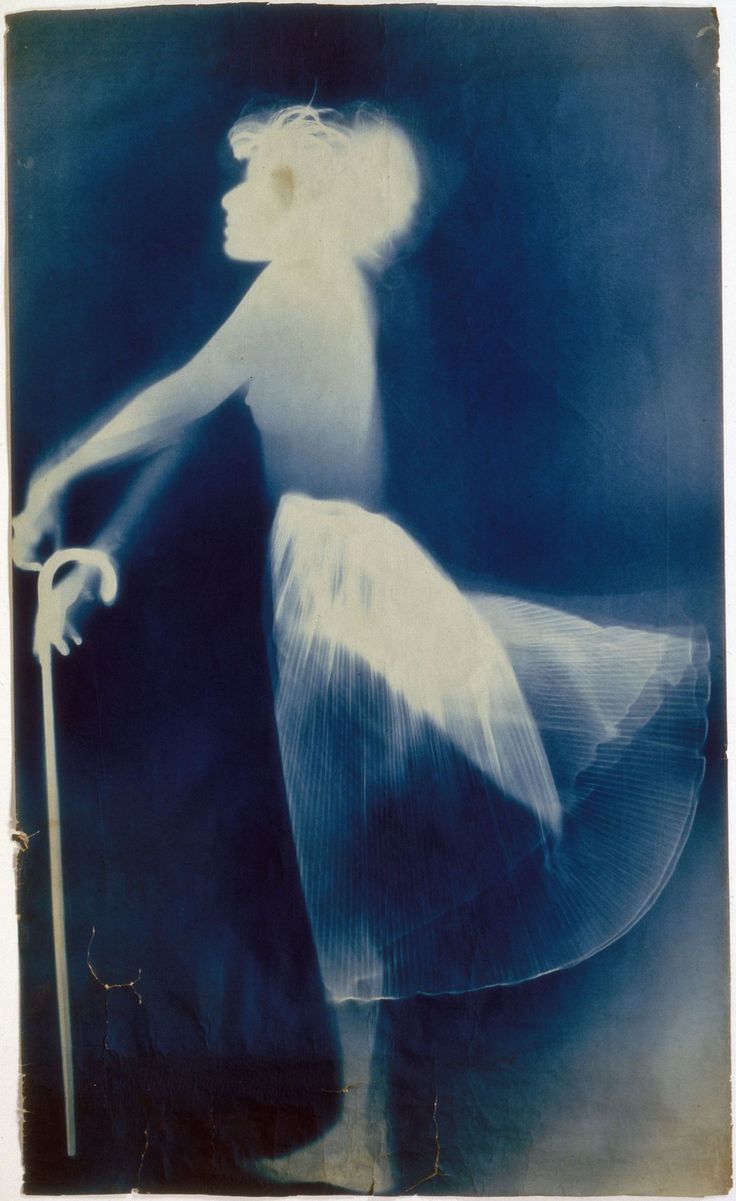
Since completing this project I have come across this article in Art Forum about the experiments Rauschenberg and Weil did in the 1950s using cyanotypes, and the human body. They seem to have used paper, developed on the bathroom wall, and a sun lamp, inside. They seem to have been able to make multiple exposures in this way. I particularly like the use of diaphanous materials in the image below, and the effect achieved of exposing clothes first before the body. It creates a surreal effect of layers and artifice.


image

Rauschenberg and Weil cyanotype

Assignment 2 Final : The History of the Inevitable Warfare between Science and Theology

Assignment 2

Non- rational abstraction: trusting to intuition could give rise to several processes and outcomes. You could let the materials work, and be the amanuensis. You could maybe succeed in not having to think in words. But could it be a purely automatic process? Unlikely. You make choices at all stages. You just might not acknowledge the reasons for those choices. You might be channeling memories, maybe referencing other people’s work without trying or being aware. You might produce work that provides insight into unconscious motivations and concerns, like dreams. You might just do what’s easiest. Or maybe bits of all of these.

Science has given us ways of thinking and knowing that are held to be superior to mere intuition, or to faith or emotion. Since the Enlightenment, reason has been the highest level of thought, the way of thinking and arguing that defeats all others. On the other hand, in recent years, the practice of mindfulness and the influence of Buddhism among educated Westerners has posed some credible alternatives to the mere superstition and credulity still evident in certain parts, all of them challenging the supremacy of reason.

The title above was one I read – it’s the title of a book, I don’t remember by whom, and I haven’t read it- but I liked the title. It was one that leapt out because it suggested itself as a title that fit this series of images. The images came first and the title came afterwards, but clearly it echoed the thoughts I had been having along the way. This is a kind of interplay between reason and intuition, between the objective and subjective, the things that can be explained and the things that are harder to understand, that are personal, deeply emotional, and which you obsess about even when there seems no point, because you think there is an explanation for them, or a solution to them, or a cure for them or an escape from them. In the past religion would have provided all of these.

The instruction to work in abstract, to eschew representation, to avoid the limitations of one object = real/ iconic significance, opens the doors to multiple suggestion, interpretation, and ambiguity. It also creates problems of finding a stimulus, and working with observation or concepts, or emotions, or whatever. What it seems to suggest first to me is the exploration of formal properties of things, the lines, the shapes, and therefore techniques of whatever medium we are going to be using. In this assignment I have been struggling with the tensions of mastering craft- in this case also science- of photopolymer, of chemicals- all things which are quite new to me- and making meaning. I have not sketched, or barely at all. The work has all been in my head, and has been jumbling around with a lot of powerful emotions just lately.

The main focus of this assignment for me has been to experiment with new techniques. At times, that has meant that the work has been about process and it has lacked any emotional heft. But out of that has emerged some pieces that reflect themes and emotions that have been dominating this time, and these pieces make sense to me. The theme of the moon, and the idea of influence, gravitational pull, and the feminine principle, links for me with the strong emotional issues I have had to deal with recently about my mother and about myself as a mother whose only child just recently got married. The themes that emerge here are of orbits, splitting, floating away, loss and the emptiness of space. I think these are the feelings that have subconsciously shaped the images I have made.

This has taken a long time, and I was tempted several times to stop and submit things that were mere exercises. But I’m now glad that I persisted until I made something with meaning.

  1. Copper plate etching: Two moons

Process

This started as a photopolymer plate. It had been given a digital aquatint layer then a handpainted negative was exposed. It was quite successful but I wanted to refine it, so decided to turn it into an actual etching.

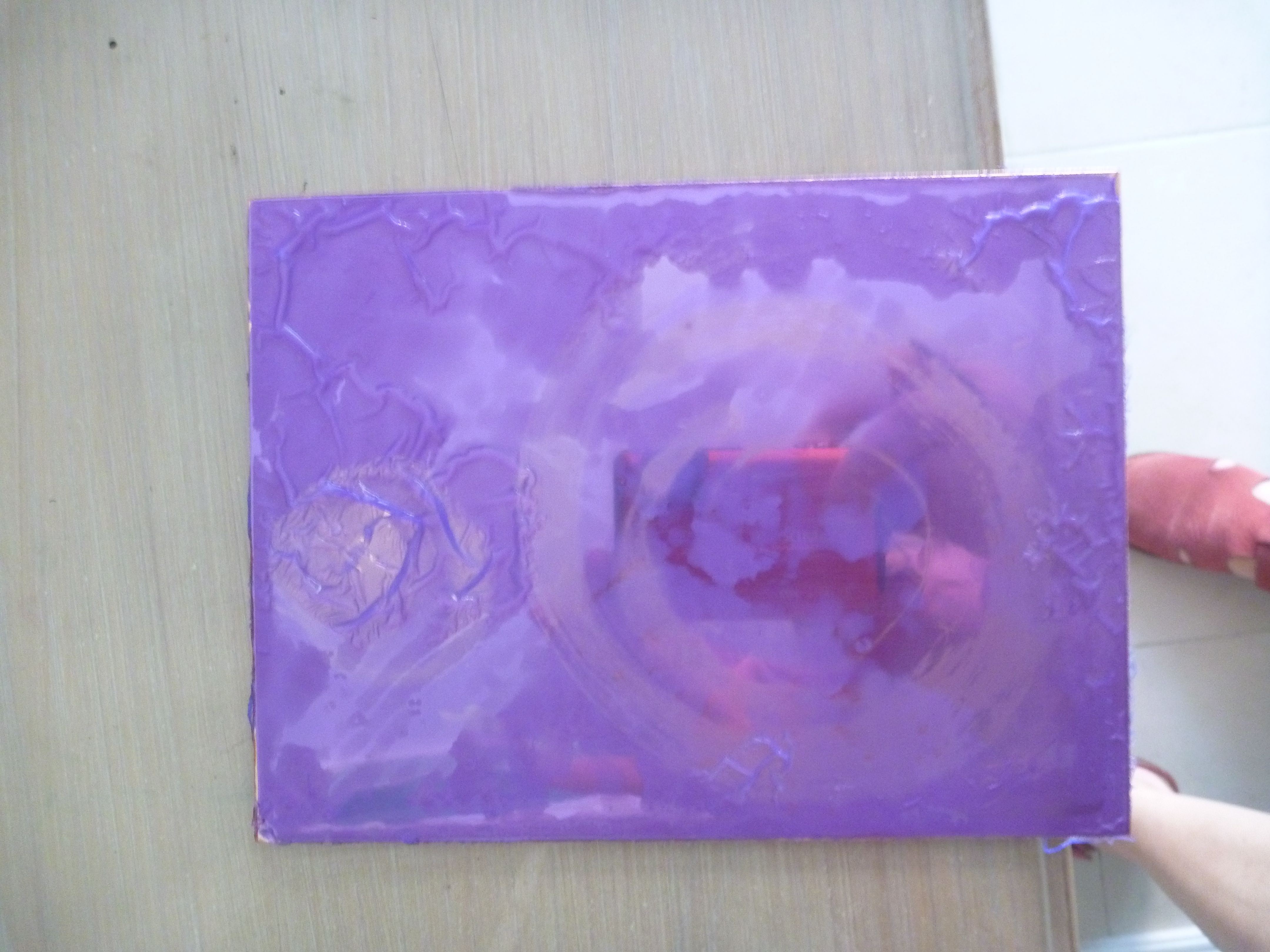
This involved removing the grey tone areas of the plate and leaving only bare copper, with the rest left as a mask. The image below shows the plate with the grey tones made with photopolymer still on the plate.

P1040593

Now with the grey tones removed, what remains will function as a mask.

P1040594

Then, I sprayed on an aquatint layer of acrylic ink using an air brush.

At this point it seemed that the ferric chloride was becoming slow, so I changed it for a fresh batch, and assumed that the fast times that had been the case last time would be the same again. Using different stop-outs; Lascaux ink, litho pencil, diluted Lascaux, acrylic pen, I did exposures of 30 seconds, 1 minute, 2 minutes, 5 minutes and 20 minutes.

This is the plate in a bath of caustic soda, removing the layers. The photopolymer floats off easily. The aquatint and Lascaux needed an application of Mystrol to remove them.

IMG_3902

The final plate looks promising as it seems to have a range of tones. I hope I didn’t stop out to drastically. I won’t know until I get to the press.

IMG_3906

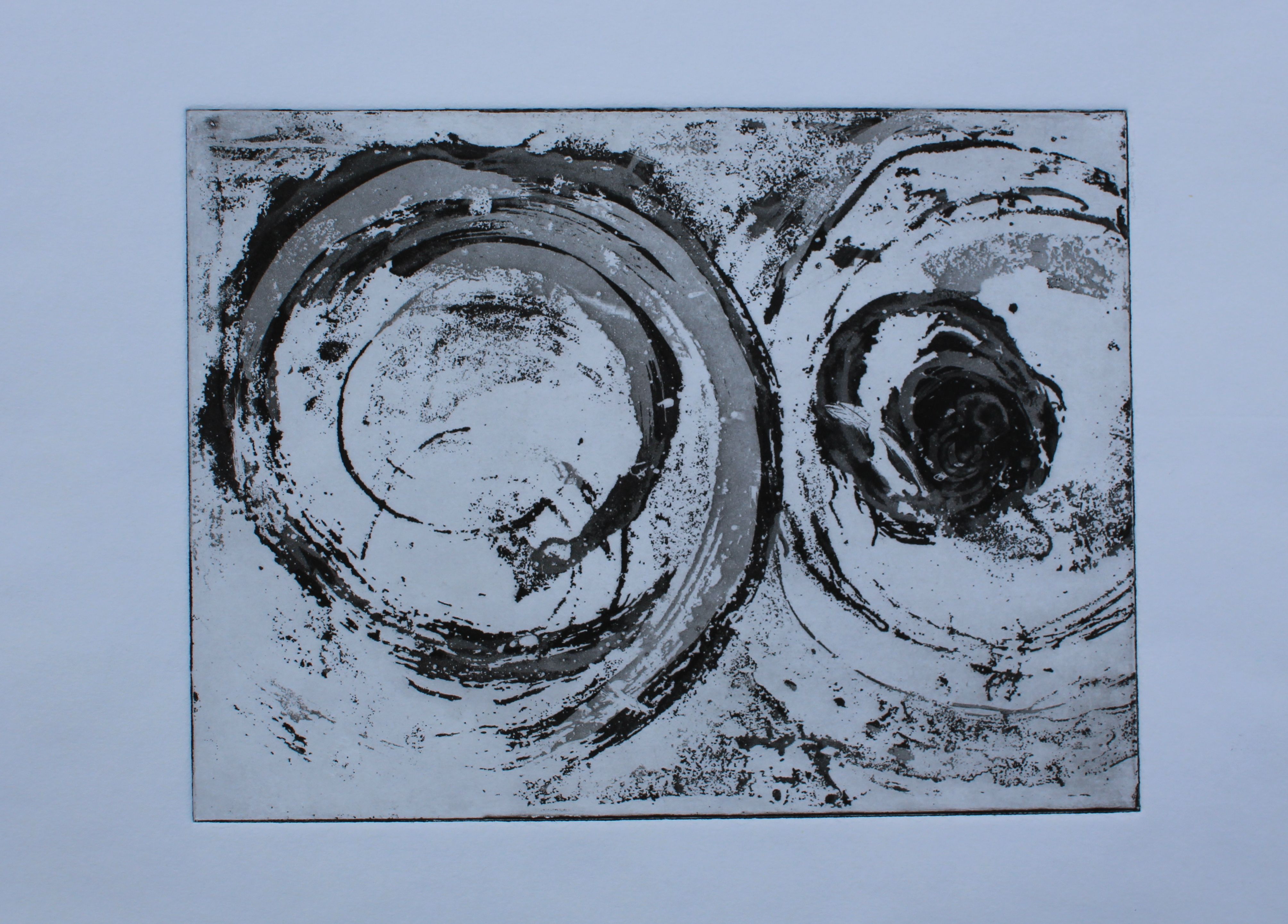
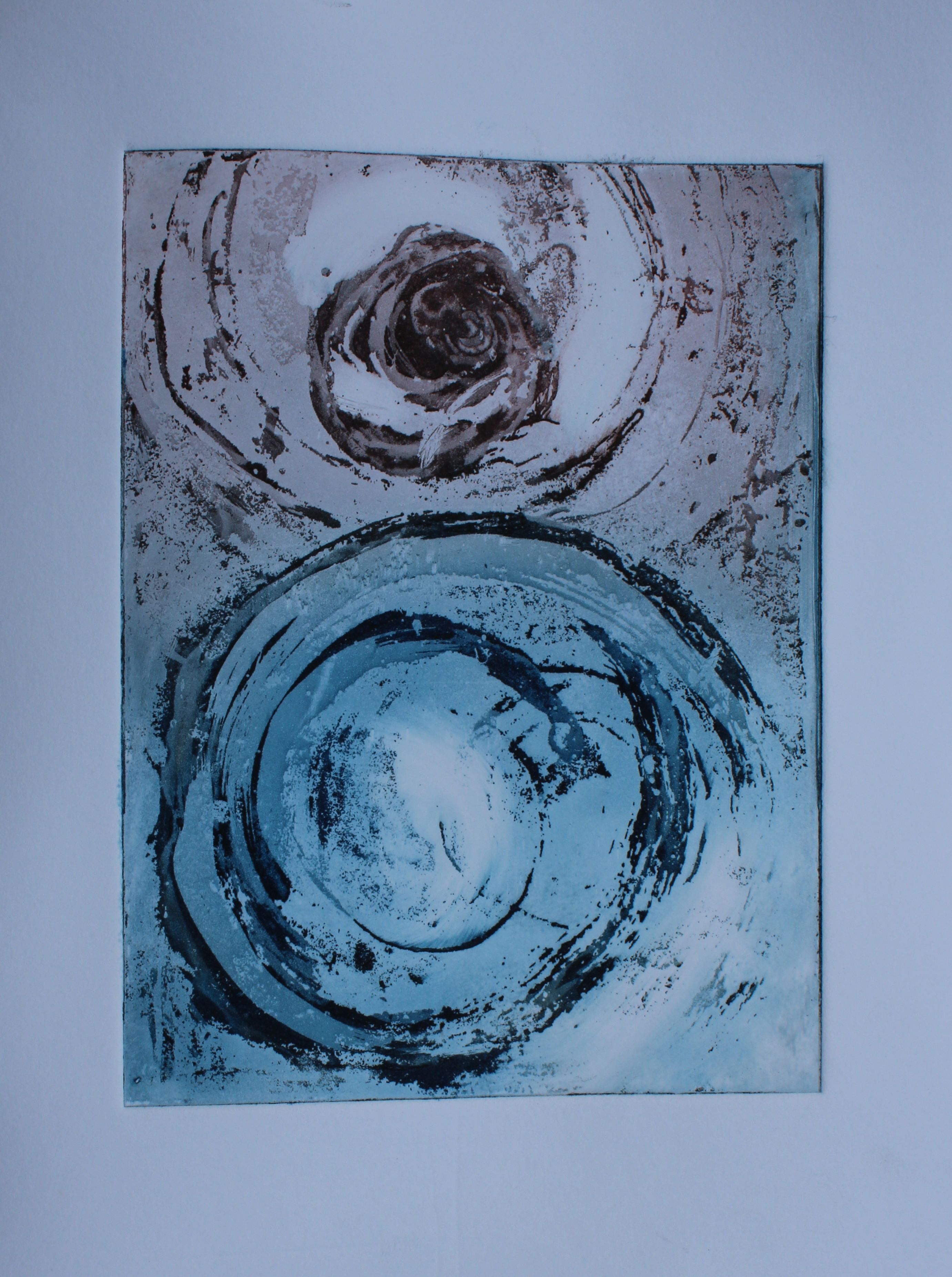
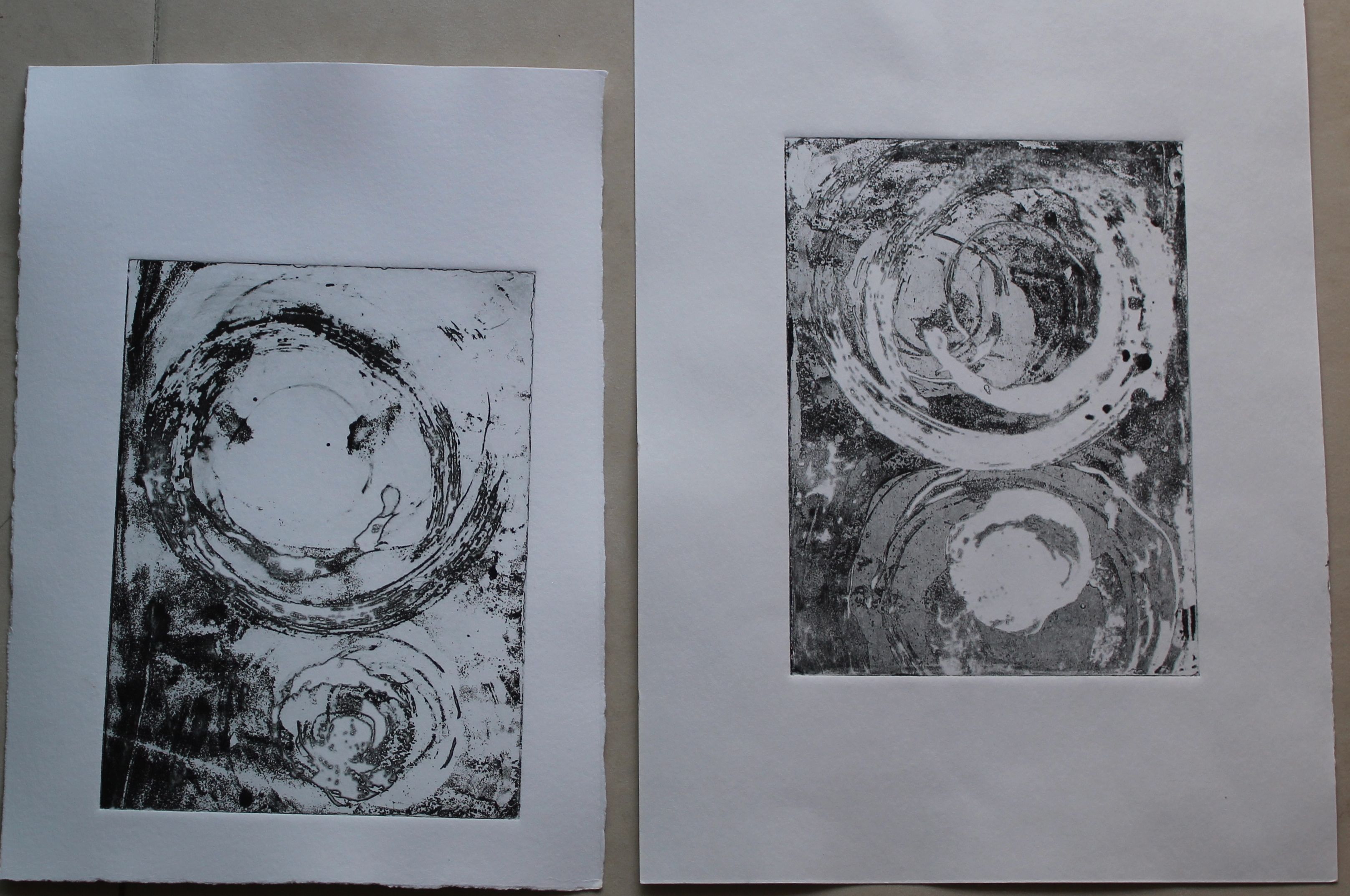
This plate reflects the theme of separation, of splitting, and references the two moons of Murakami’s 1Q84, which signal a split which has taken place between two worlds.

Technically I was after reproducing the darks, lights and greys of the original negative. Although the photopolymer plate earlier had printed something I liked, the blacks and whites were inverted due to open biting, probably due in turn to the digital aquatint screen not being accurately exposed.

The photopolymer version

The photopolymer version

These were the components of the negative:

IMG_3774

This was the first black and white print:

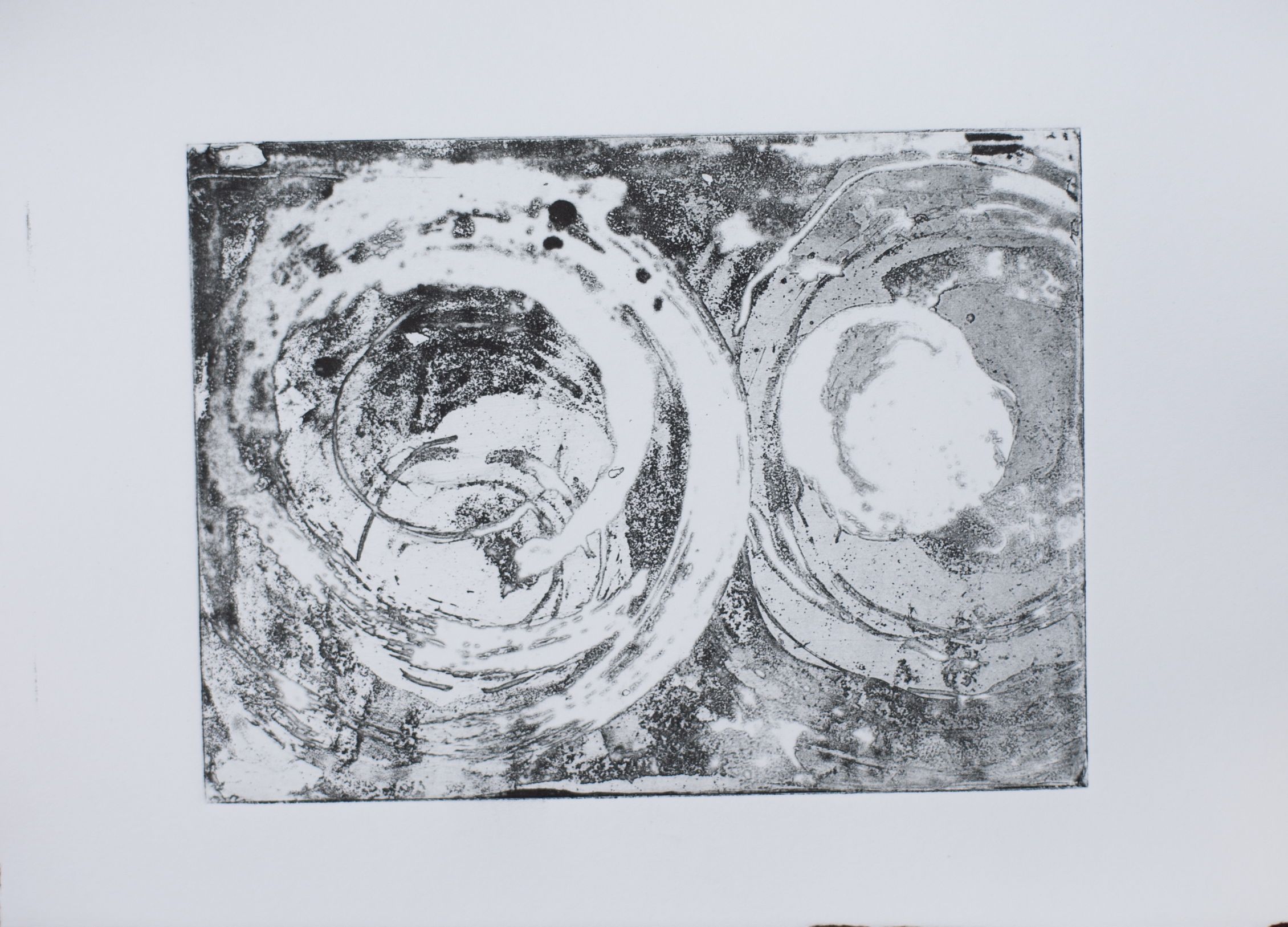
IMG_3914

It is a little broken up, but that may be due to my first dip in ferric chloride not being long enough- 30 second. Or the aquatint screen was too thick. But the blacks, whites and greys are correct, so it’s a technical achievement of a sort. The balcks are velvety. I had brought along some carborundum in case they weren’t, but that’s not a problem. It’s the light greys I need to work on.

I experimented with colour, viscosity printing,  and selective wiping:


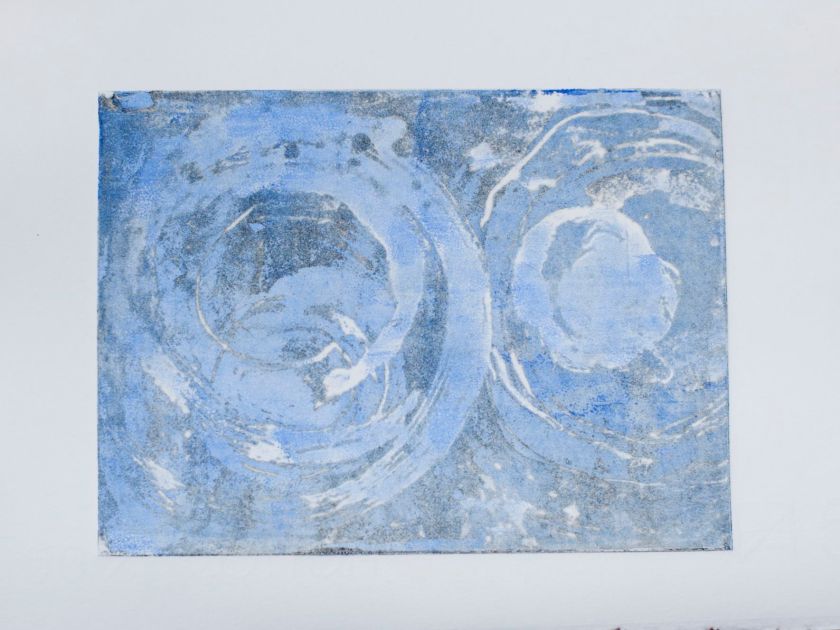
This is the final version. It’s inked with Charbonnel water-based oils, sepia + red, sepia + blue, thinned with wash oil and transparent laker, and wiped selectively. The two colours, warm and cool, highlight the theme of separation.

Two moons, copperplate etching on Fabriano paper. image size 16 x 20 cm

Two moons, copperplate etching on Fabriano paper. image size 16 x 20 cm

2. Cyanotype: Moonflowers

Well, that one was done, I thought: I had a nice image I liked. But shit happens. It faded. I tried to re-expose it  and add more vinegar, but it got messed up. So I tried to re-create it. Of course it wasn’t possible to get it the same- that particular angle of the sun the strength of UV, maybe even the water- our heavily chlorinated water may make this whole enterprise dodgy.

IMG_3773

1Q84 Herschel cyanotype

This one, with its wonderful reference to the poem by Keats about the newly discovered planet, and to William Herschel, is now no more.

Trying again:

IMG_3895

IMG_3894

So, these came out nice and dark, but lack the interest of the original. I was noticing that I hadn’t got a real white, so hadn’t maintained the blocking out in a single place or long enough, in my fascination with moving the shapes around to get different tones. But the accident with the first picture had inadvertently shown me that a separate image could be made with the vinegar, by pouring and running it. I was also interested in movement, but wondered if I could pour/ sprinkle sand/ salt as well, while moving some of the fixed shapes, but leaving some of them long enough to get a clean white.

I stil wanted to use circles, interspersed with lines, but left out the framed negative this time. Instead I prepared a container of salt, a tin of loose tea, and a bottle of vinegar. I gathered a collection of circles of different sizes and opacity.

The result seems to be a version of the “Sunflowers” painting, and subsequent print I did a while back.P1040082

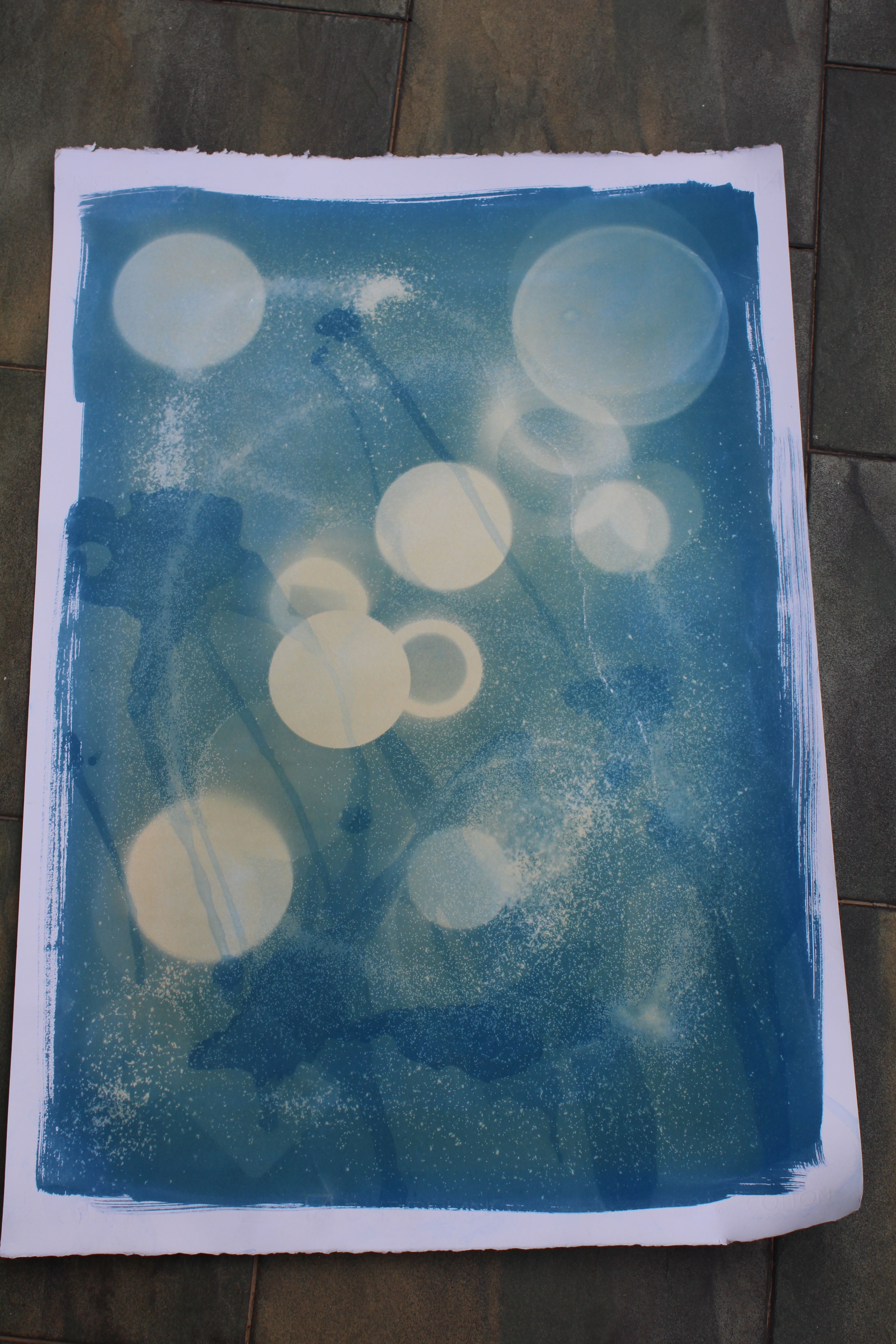
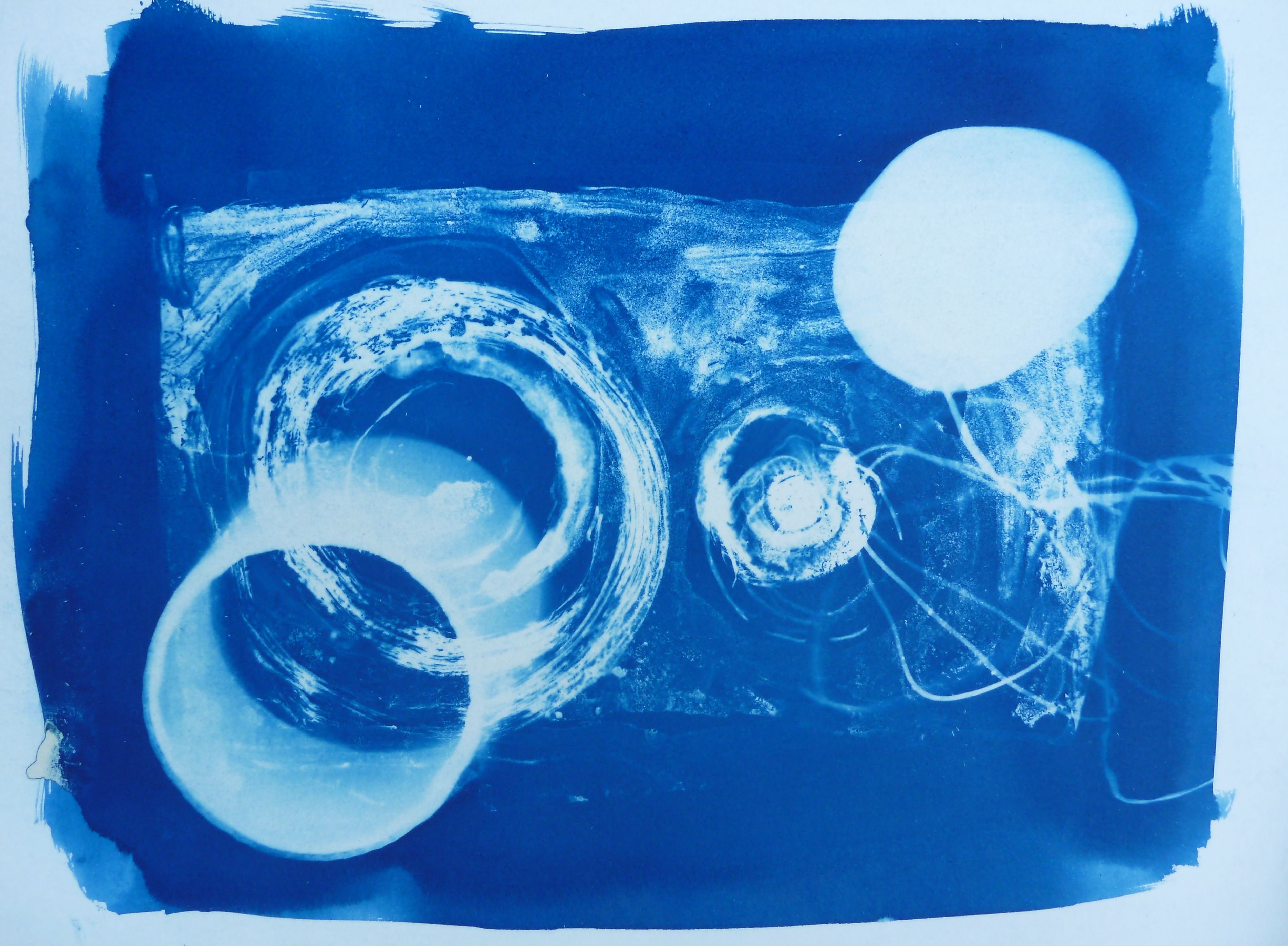
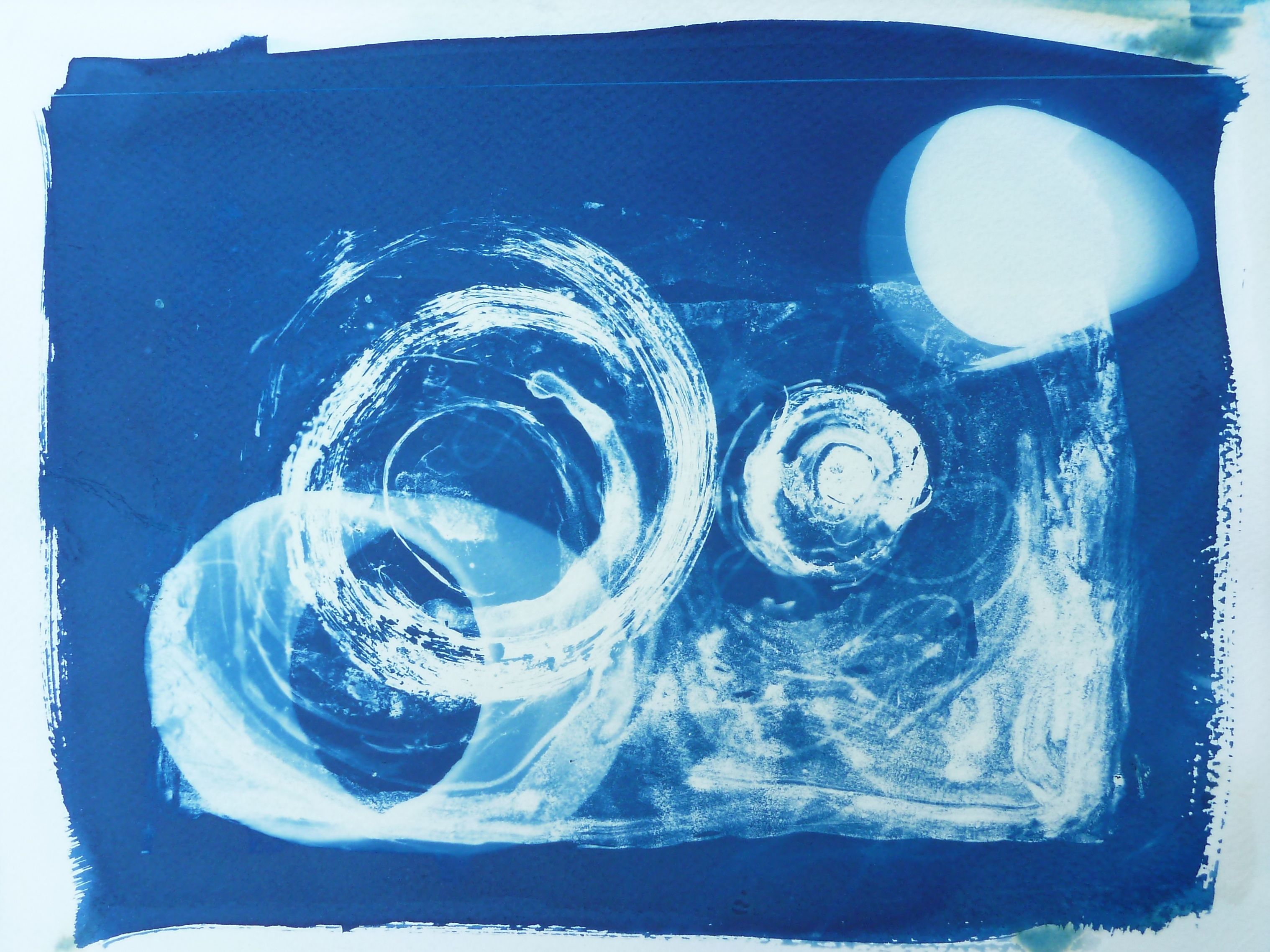
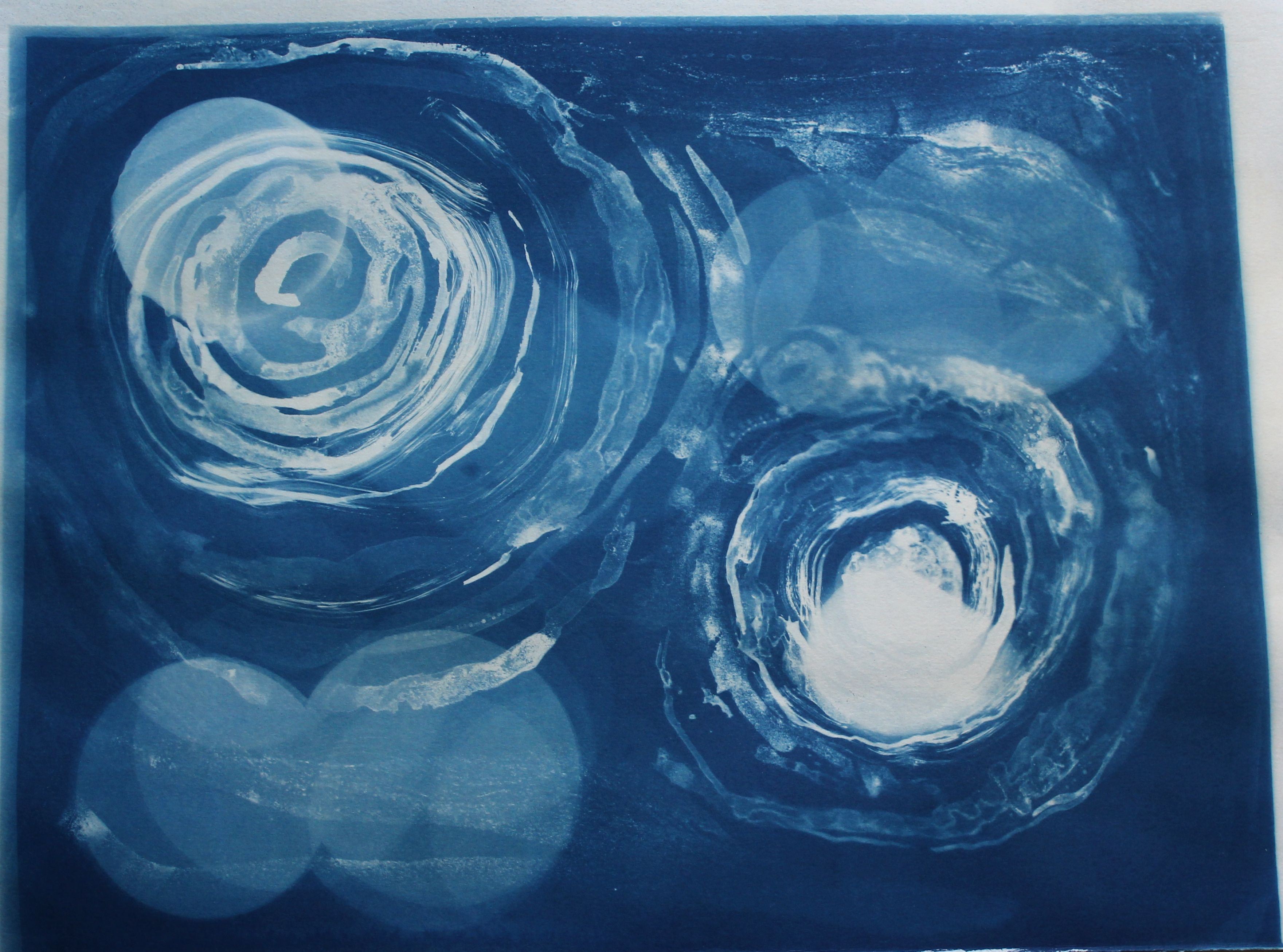
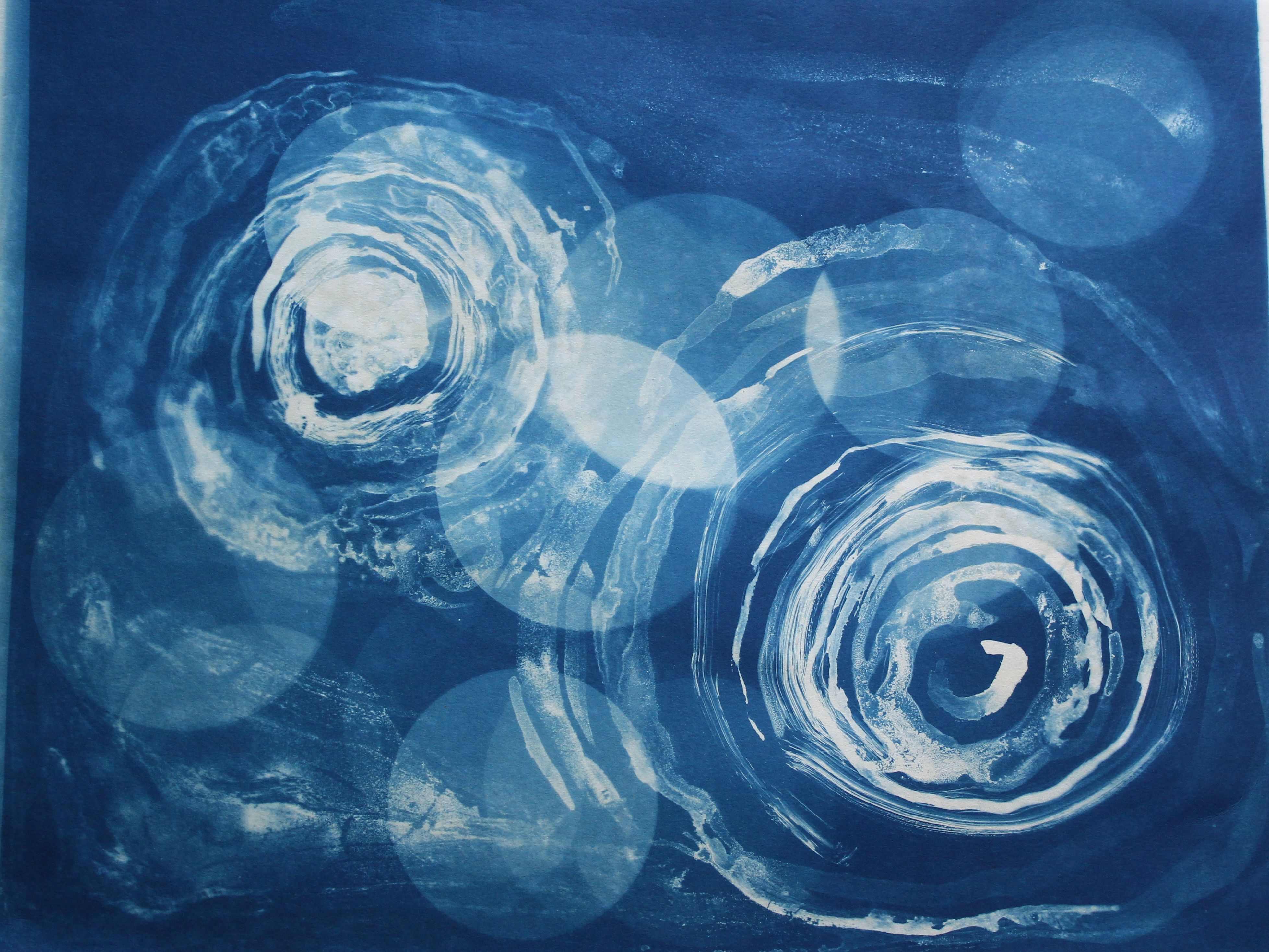
The juxtaposition of geometric and gestural (from the vinegar) the solid and the shadowy, and the fine grains works well, I think. The blue and the moon shapes make them contrast with the original sunflowers, and they are like a sad version. Turning towards the moon will not result in growth as it provides no nourishment. That is also ironically referenced in the medium used here, the sun exposure.

IMG_3904

Moonflowers, cyanotype on Fabriano paper, 50cm x 70cm

3. Forgetting

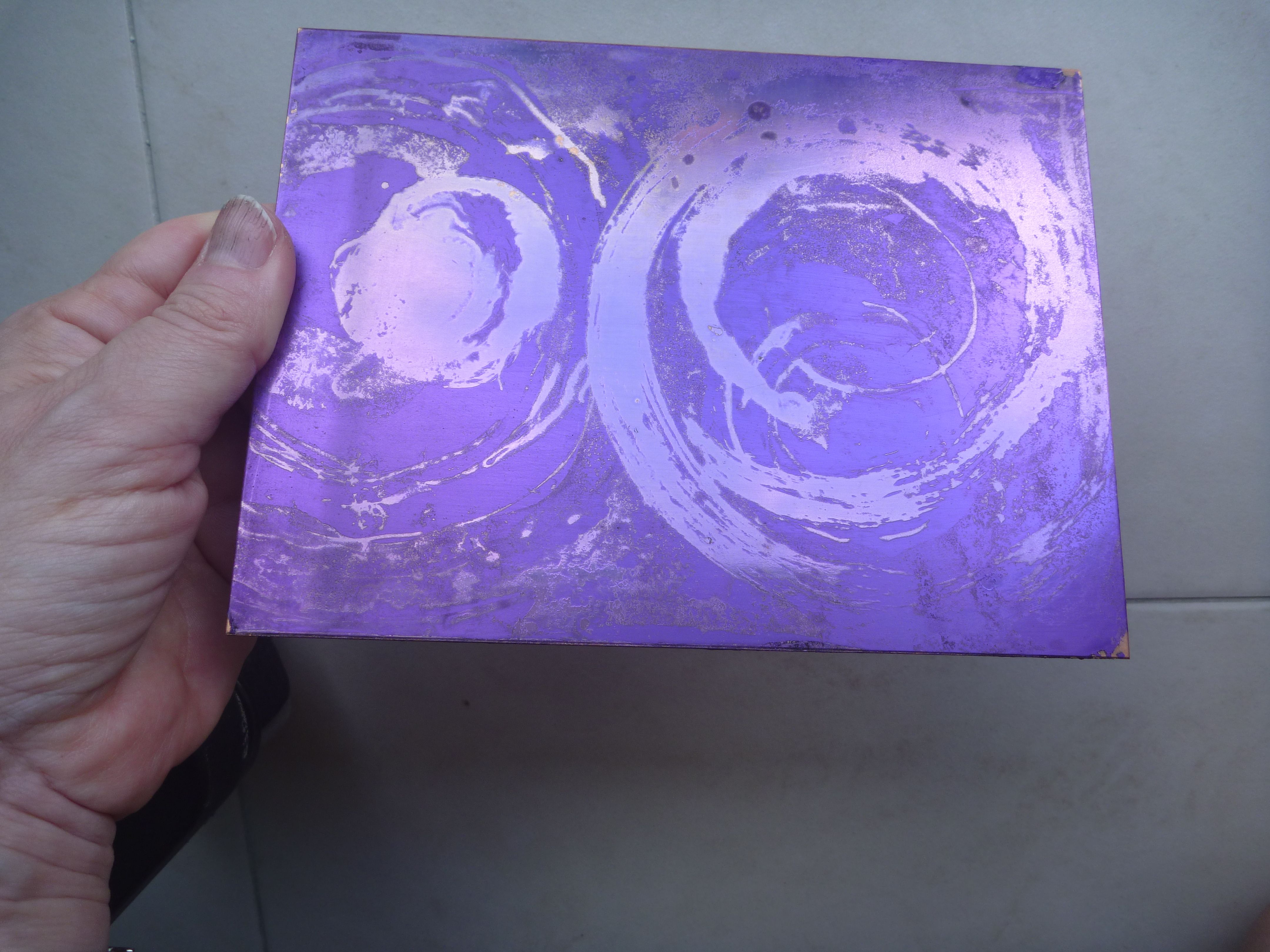
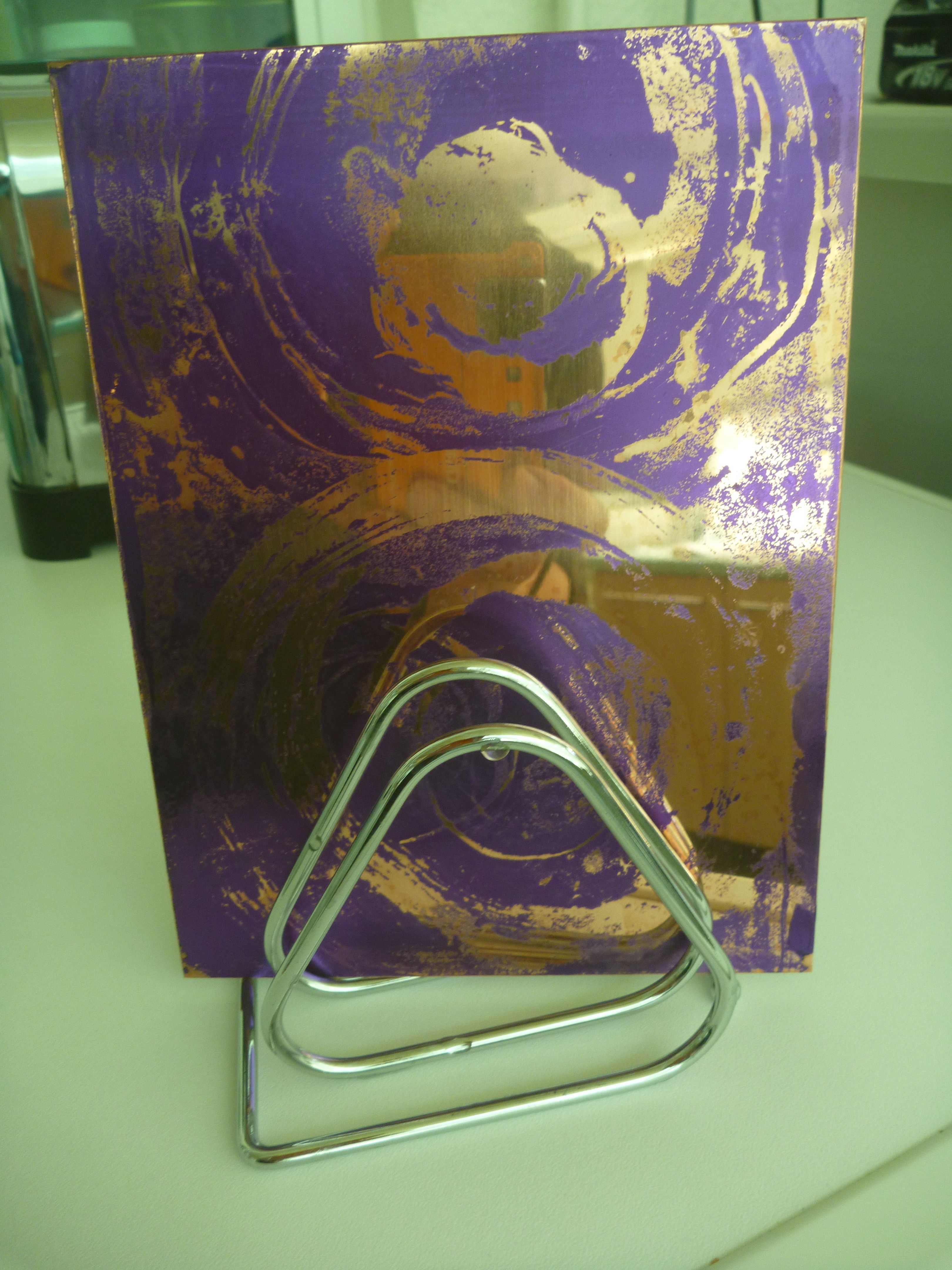
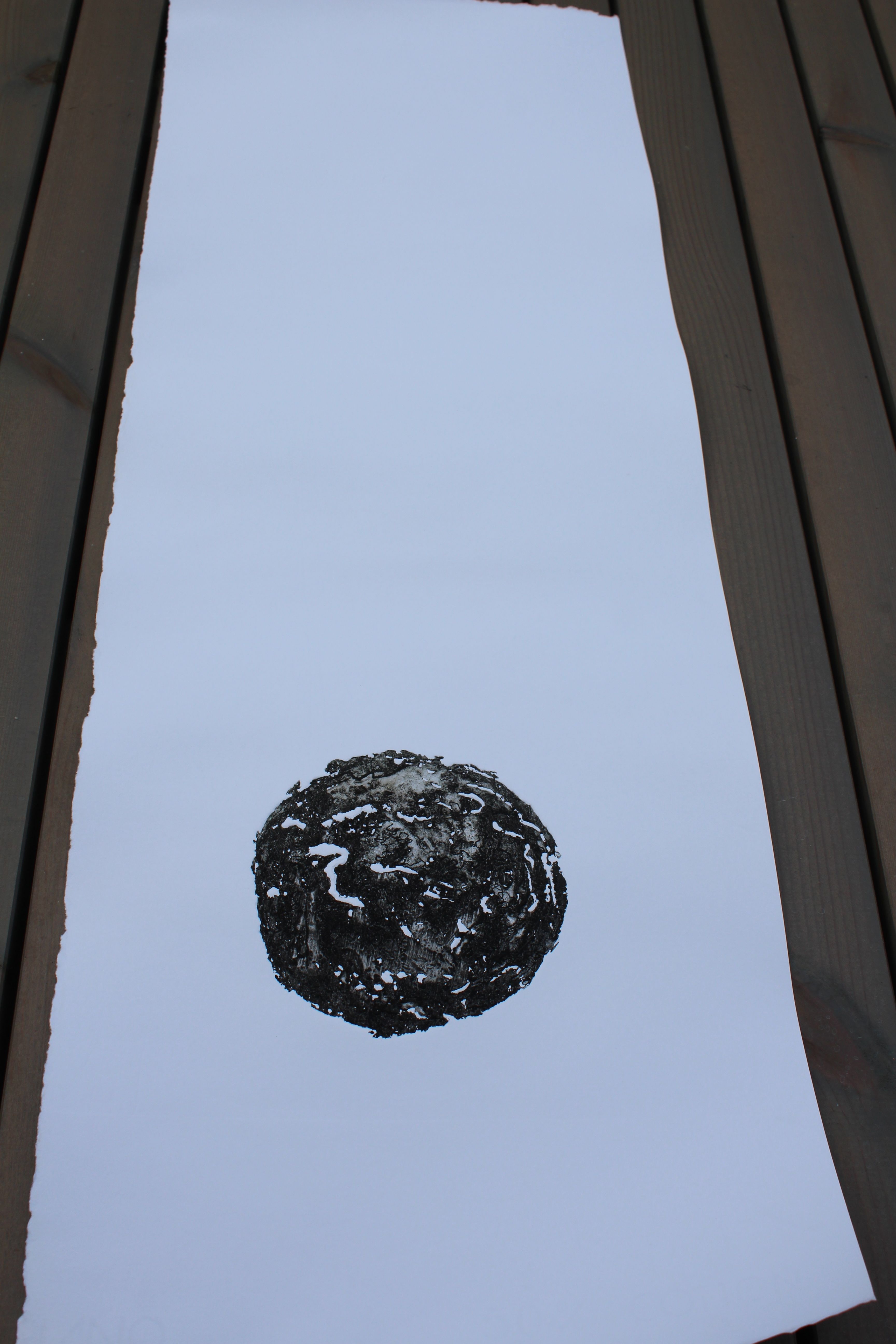
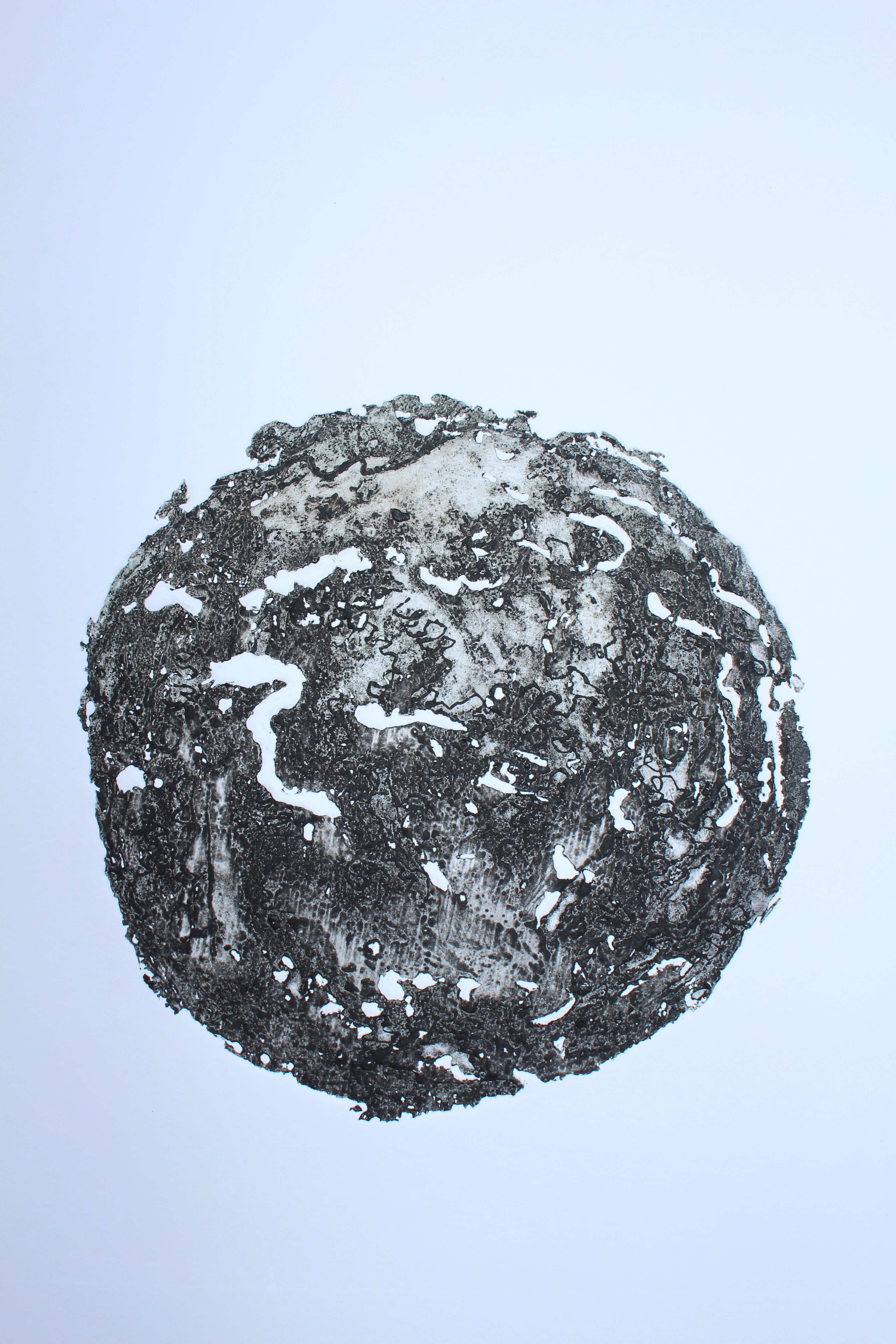
Finally this plate is degraded and lace-like. It has taken days of soaking in Ferric Chloride, etching with a needle, cutting with a Dremel, sandpapering.

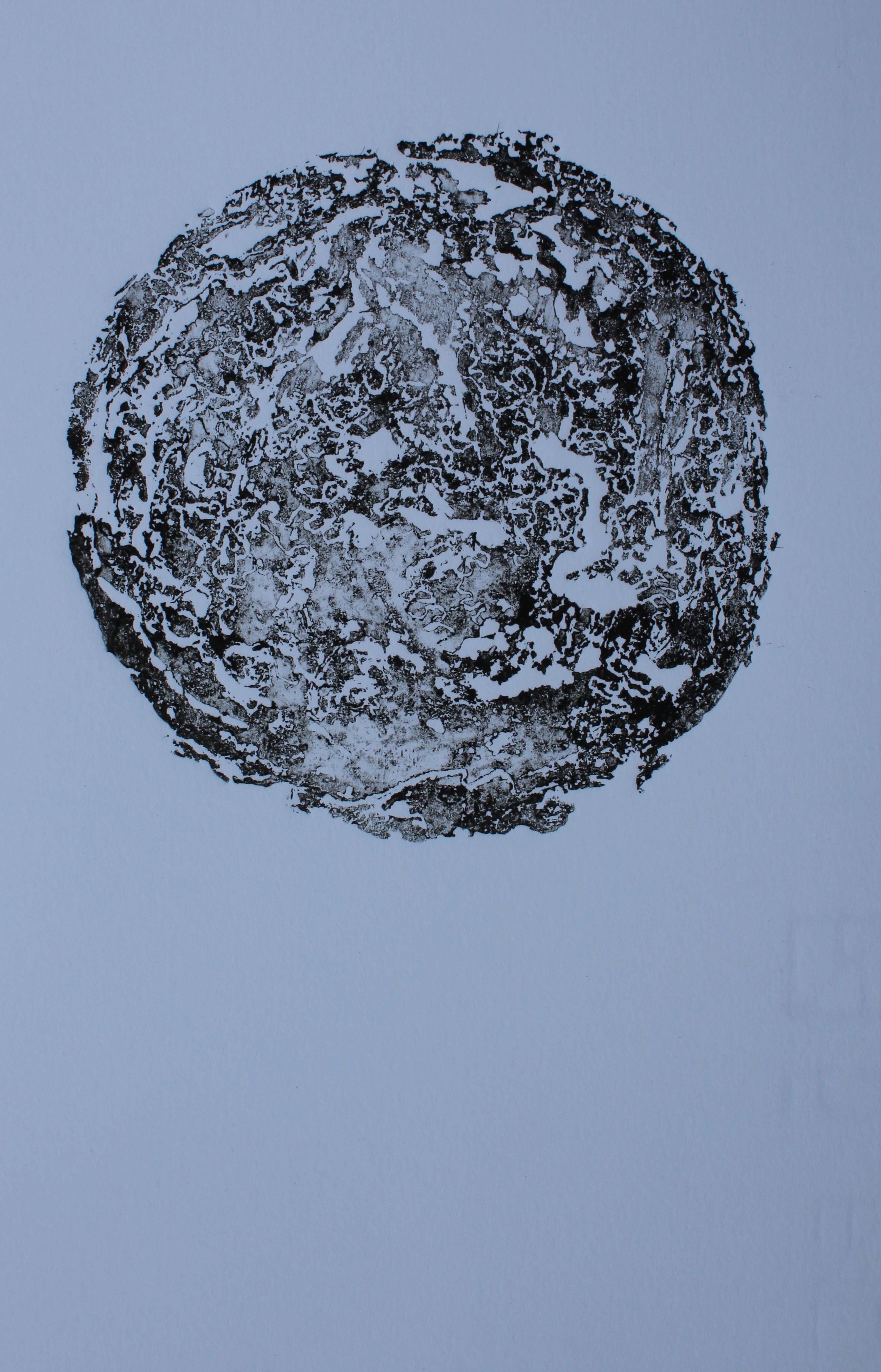
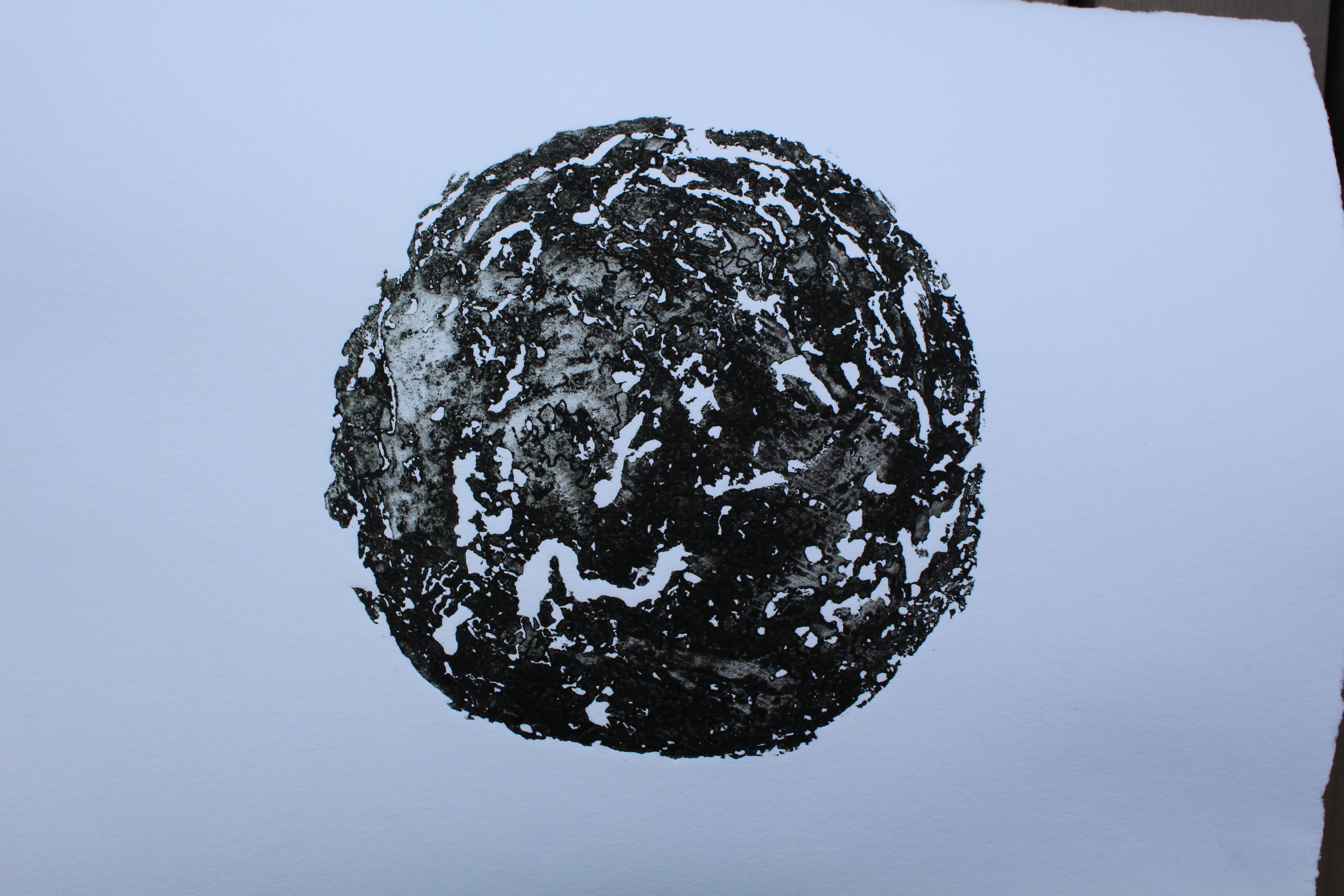
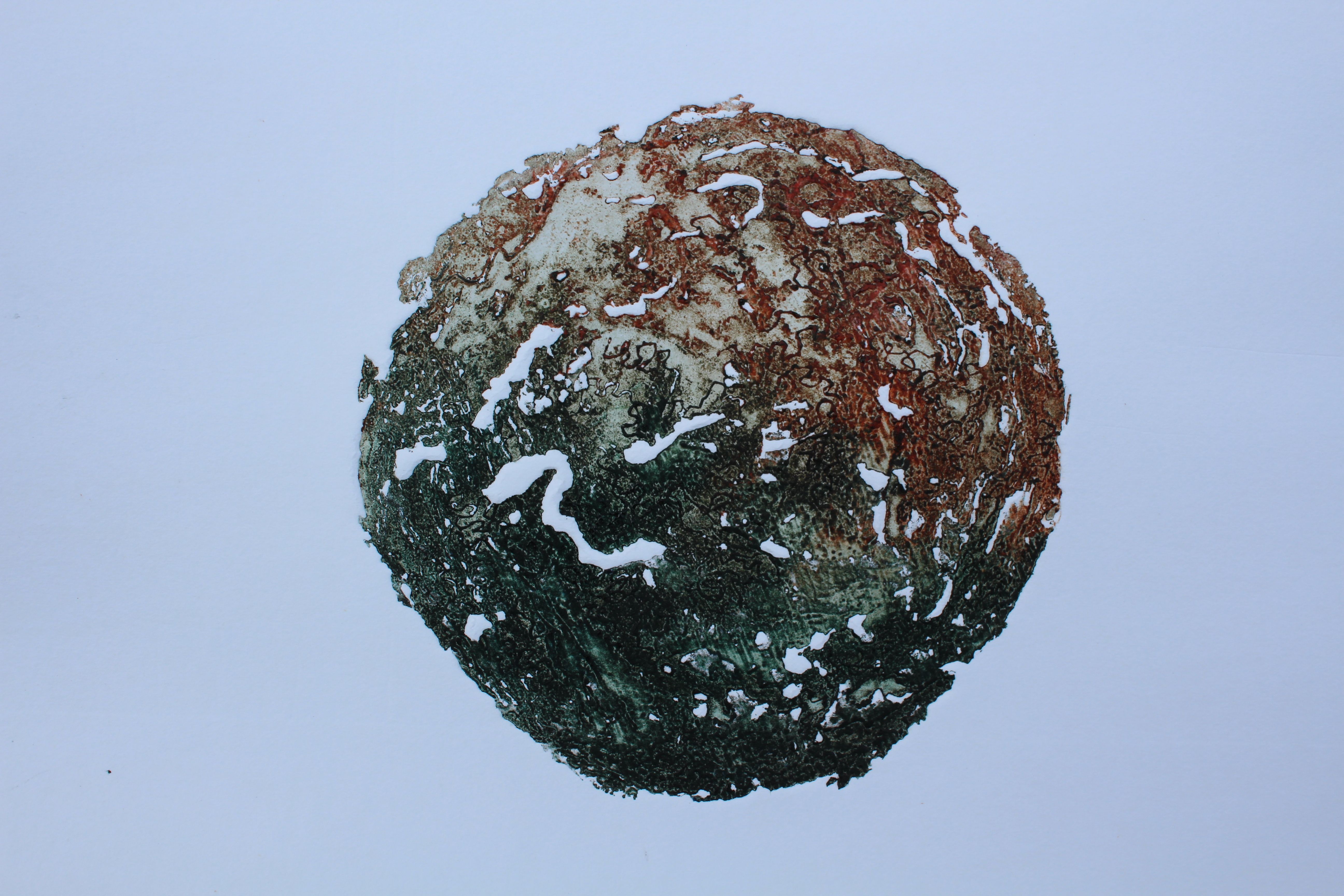
The similarity between the shape and the texture and a brain makes me think of my mother, suffering from dementia, and sadly aware of the fact that she is forgetting things and people. The process here seems to have mirrored that process of loss, of erosion of the identity. The thing that is left is now quite fragile. I will print it on its own, rather than juxtapose it with a contrast- the actual contrast is with how it was, and that is now irretrievably lost.

This was difficult to ink- I used the thinner Akua inks at first for a black and white version. The first one came out quite delicate but lacking a focal point.

IMG_3916

So, for the next one, I decided to wipe the ink with actual sandpaper on the smoother areas where there should be highlights.

IMG_3919

This was better.

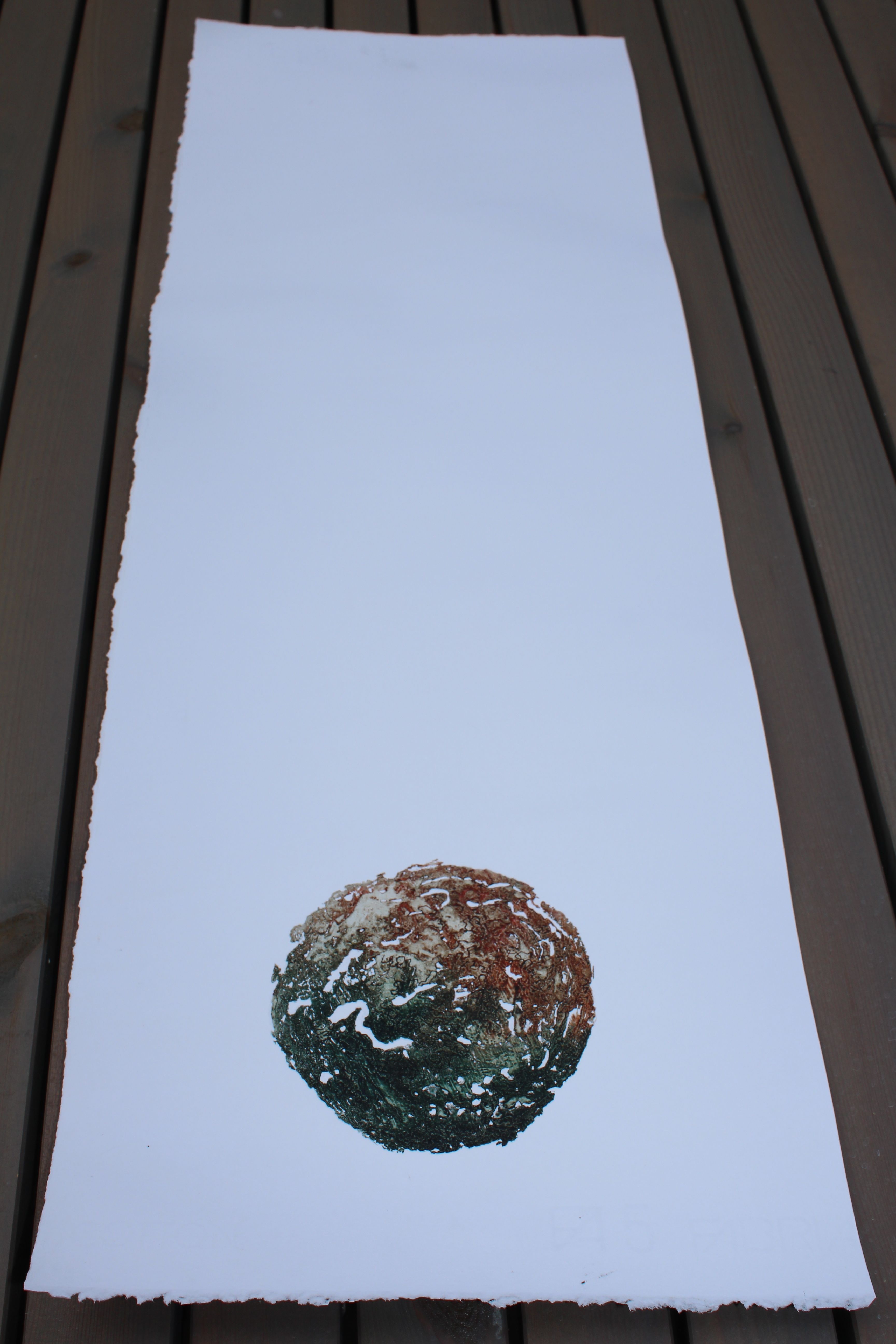
I decided to put this on a scroll, with the shape at the bottom, and to add a little bit of warmth, with a slight rubbing of Sanguine in the highlighted area.

IMG_3920

I then used more colour- blue/ grey and sanguine, this time just rubbed on a la poupee, to avoid too much build up of ink in the crevices.. This gave a much softer image. The downward etches of the ferric chloride are visible (etched in a vertical tank) .

IMG_3921


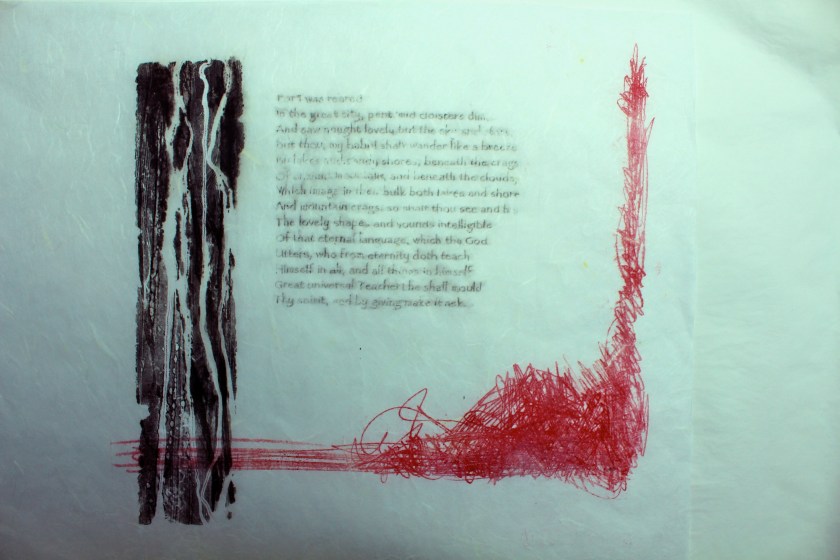
For the final print, I used a scroll, and decided to colour the plate with colours that suggested the original copper, when it’s shiny and when it’s tarnished, warm and cool colours. I might even add the original plate to the printed image, as a comment on image and reality, something that will link to the theme.

I have named it “Forgetting”, which is an allusion to my mother’s condition, but also an echo of Wordsworth, “Sleep is but a dream and a forgetting” which creates a gentle and reassuring image of sleep, and by extension death. It is particularly poignant in the case of dementia, which in so many ways is the early death of self. The blank space is necessary here. It is empty on the one hand, but also provides space to breathe, a space for sleep and calm, which is a reassuring counterpoint to harsher image of destruction.


Forgetting: copperplate on Fabriano paper scroll.

Forgetting: copperplate on Fabriano paper scroll.

Close up of the printed area:

Close up

Close up

Reflective Commentary

I started by considering the meaning of abstraction, looking back to historical developments and identifying rational and intuitive approaches: the former I then pursued as abstraction by distance, the latter I broke down into gestural, and process approaches. In exploring process approaches I experimented with different materials and the processes that naturally go with them, exploring how to degrade, damage or decompose the materials. My chosen artist for the parallel project, Xu Bing, is undoubtedly an influence here, as his series of woodcuts “5 series of repetitions” is an inspirational use of process in reduction printing.  I was interested in making process match meaning, as he has done.

At the same time, my personal reading and practical research were talking me into the realms of science- with new processes involving chemicals, metals, photopolymers and light sources. This was all very new and presented a number of practical problems of access to resources, as well as opportunities to practice. It has meant that this assignment has been a long time on the go, very fragmented and interrupted by life events. These life events have fed into the emotional meanings that I’ve made though- by going for an intuitive approach, I believe that themes and understandings have emerged that reflect key events of my life recently. A powerful theme has emerged, linking me, my mother and my son, and these have metamorphosed into topical images of the moon, which at the time I first designed these plates, was both full and being eclipsed. The final image, of degeneration, is very poignant for me, and I am considering combining the print with the plate itself- a beautiful thing when it starts to tarnish and grow verdigris- but as a reminder of both the deception of images, and the process of irretrievable loss. The blank space on my final scroll may be inspired by Xu Bing, but anyway, emptiness is a factor to be included here.

Technically, two new processes in particular have inspired me in this assignment. The first is cyanotype printing- which is simple but beautiful, and I love the irony whereby the light of the sun creates such cold moon-like blues. An added irony is their sometimes impermanence. Something I need to research a bit more. Outside this assignment, I have experimented with large scale printing on cloth, and am interested in developing something more along these lines- a mixed media approach perhaps.

The second is copperplate etching using ferric chloride. (I have another chemical in the house which also might be a non-toxic etchant, and still need to try it out). I have focussed on the aquatint process, as I like the depth and granulation, and multiple shades of grey. Obviously, I am very much a novice at this, and have not explored the creative potential very far, as I’m still very focussed on the “how”.  But I feel that I have taken an important step forward. When I started I was playing with monoprints, printing at home, and nothing much more. I now have the ability to work in many more ways, have a press (albeit in the wrong country) and feel fired up to move on to more professional ways of working.


Assignment 2: Abstraction: towards the final pieces: Moons

Assignment 2

Moon. Topical, symbolic, geometric, poetic, totemic.

My plan for my final piece is to create three images relating to the Moon. At the time of posting it is Mid Autumn, or moon festival, and there is an an eclipse and a large harvest moon. This was the same time of year last year that I worked on Mixed Media projects using light, Blue Moon. This links also to the work I’ve been doing a bit ahead of myself, in the Chiaroscuro unit, looking at 19th century photography.

I also reference Coleridge – Frost at Midnight- again, with that exquisite final line:

Quietly shining to the quiet moon.

Thirdly, I have been reading Murakami’s 1Q84 and was inspired by the notion of the two moons in that story, the appearance of the moons seeming to signal that the characters have entered an alternative or parallel inverse. But these moons are like Coleridge’s, quietly shining, and it takes some time for the protagonists to notice them.

At a basic level though, this permits me to work with simple spiral or circular shapes, to use textures, line and movement to explore the narrative and pictorial possibilities.

Photopolymer

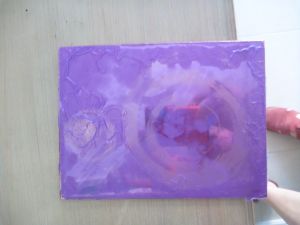
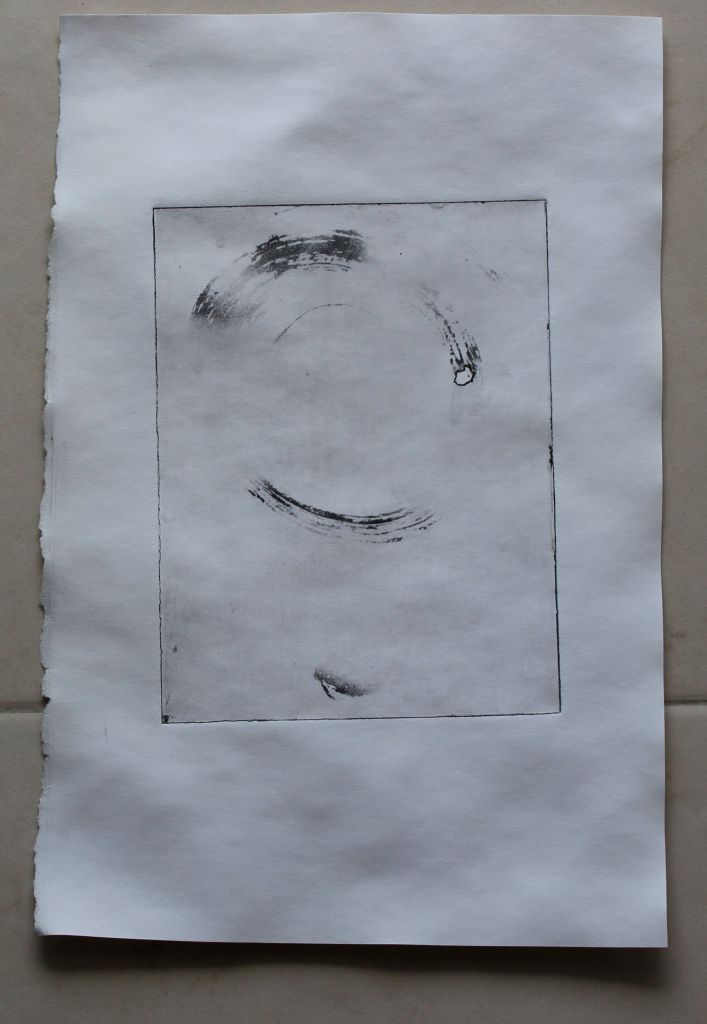
I was going to try to produce a tonal, painterly image using photopolymer- using the aquatint screen that I just got. There seems to be a problem though- maybe my timings are way out using the sun, rather than an exposure unit, or maybe it’s the photopolymer film that’s reacting to the climate- but the film won’t stick- I have tried several times, and this was the best, but when developing, it just peeled off altogether in one part of this image- and the rest is not exposed enough anyway.
P1040545

IMG_3857


Cyanotype

When I couldn’t get the photopolymer to work, I turned to a simpler way of using sun exposure: cyanotype. There’s already a nice link to the “Blue Moon” theme.

The Alternative Photography website is a great source of info for this.

http://www.alternativephotography.com/wp/processes/cyanotype/preparing-the-canvas-cloth-paper-and-natural-fibre-fabrics-for-cyanotypes

Now that I have found a source of chemicals, am all set to go with this and ferric chloride etching.

The first practical problem was the lack of anywhere lightproof in my house- this was also the difficulty with the photopolymer – we have too many windows, and all the wrong kind of lightbulbs, but I managed to black out a bit of space to dry the papers.

I soon found that the UV fluctuated a lot, and that the best images were from the really bright sun- and interesting effects when the sun was bright but slanting and casting sideways shadows.

I experimented with real objects: flat, and standing, painterly marks (using film), writing on tracing paper (it develops and then disappears again, but reappears when developed again, and pressed objects in glass.

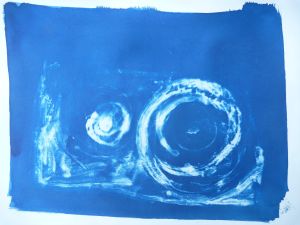
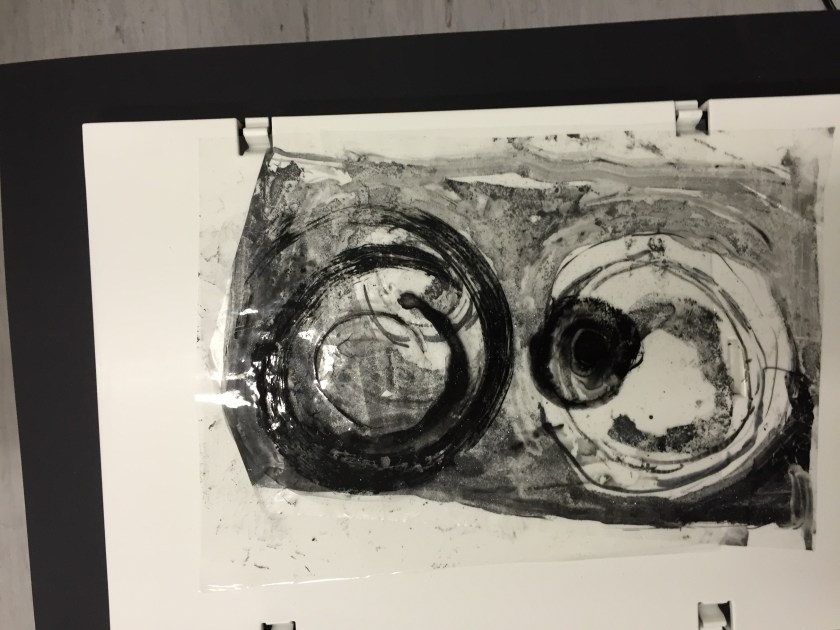
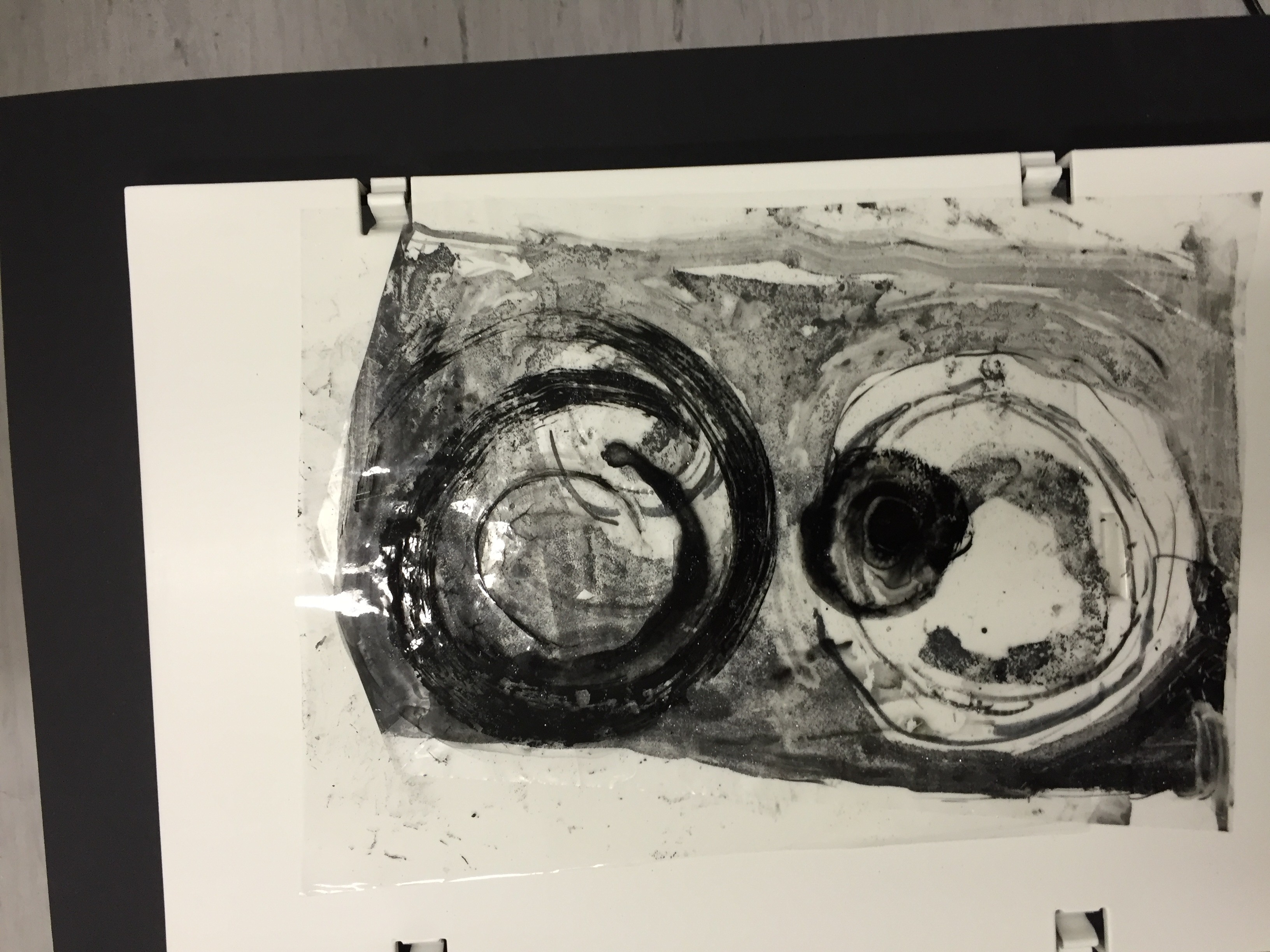
I used the same negative- an ink wash on film- that I had tried to expose on the photopolymer film: the two moons image.
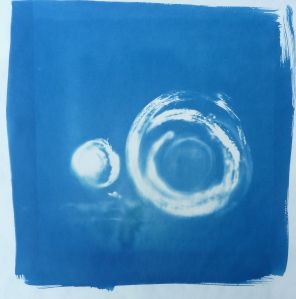
two moons

Two moons: ink and wash on film

Two moons: ink and wash on plastic, with carborundum powder
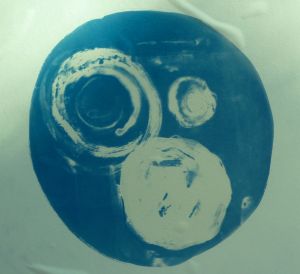
Two moons: ink and wash on plastic, with carborundum powder

P1040581

three moons with carborundum

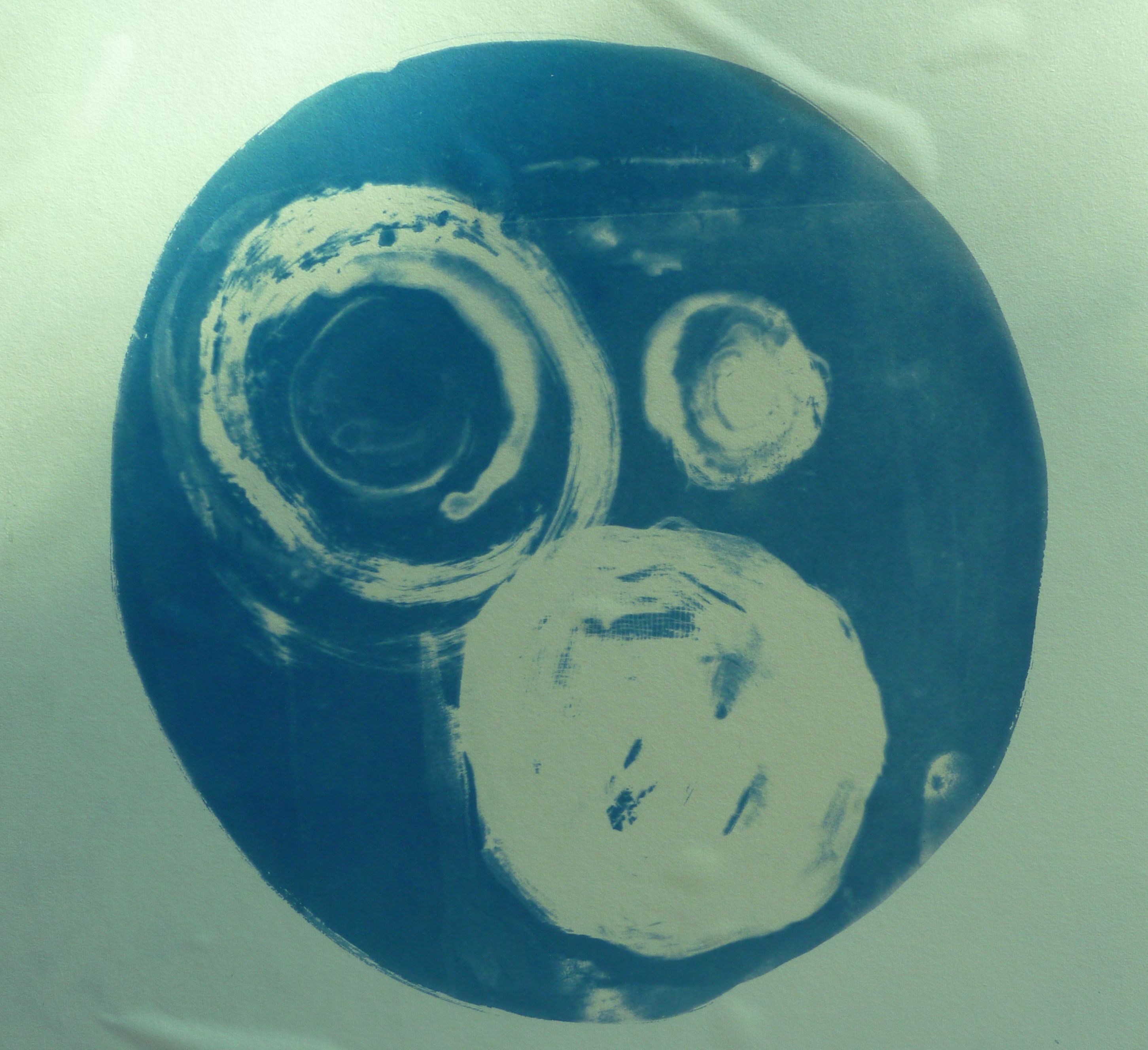
two moons and moving objects

two moons and moving objects


Finally these are the ones I want to develop into a slightly larger piece:
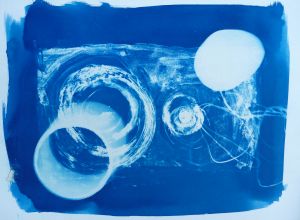
two moons; Combination ink wash and 3-d objects
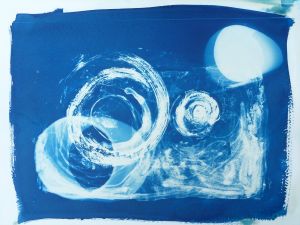
two moons; Combination ink wash and 3-d objects

two moons: combination wash and 3-d objects

two moons: combination wash and 3-d objects

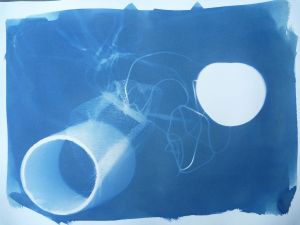
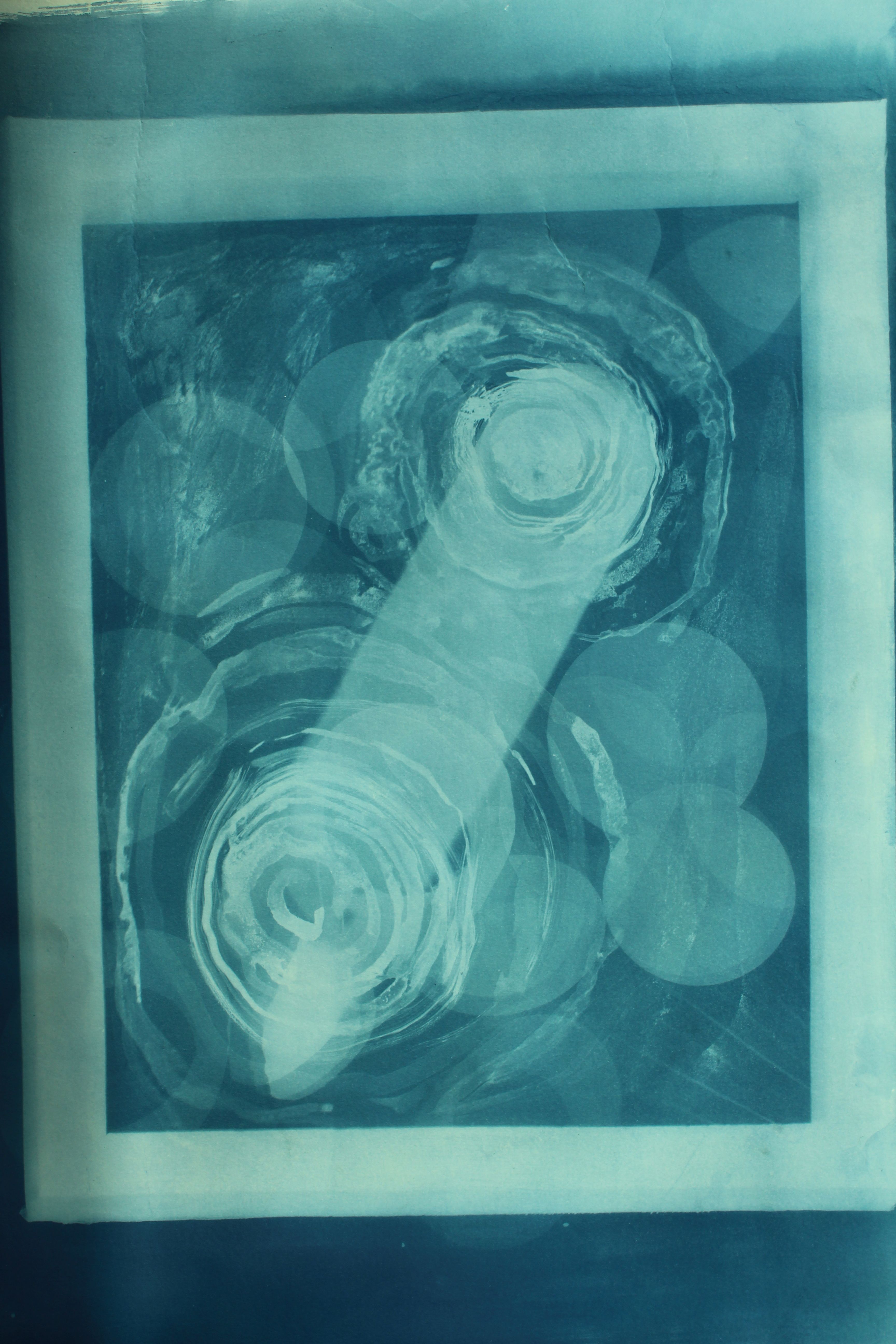
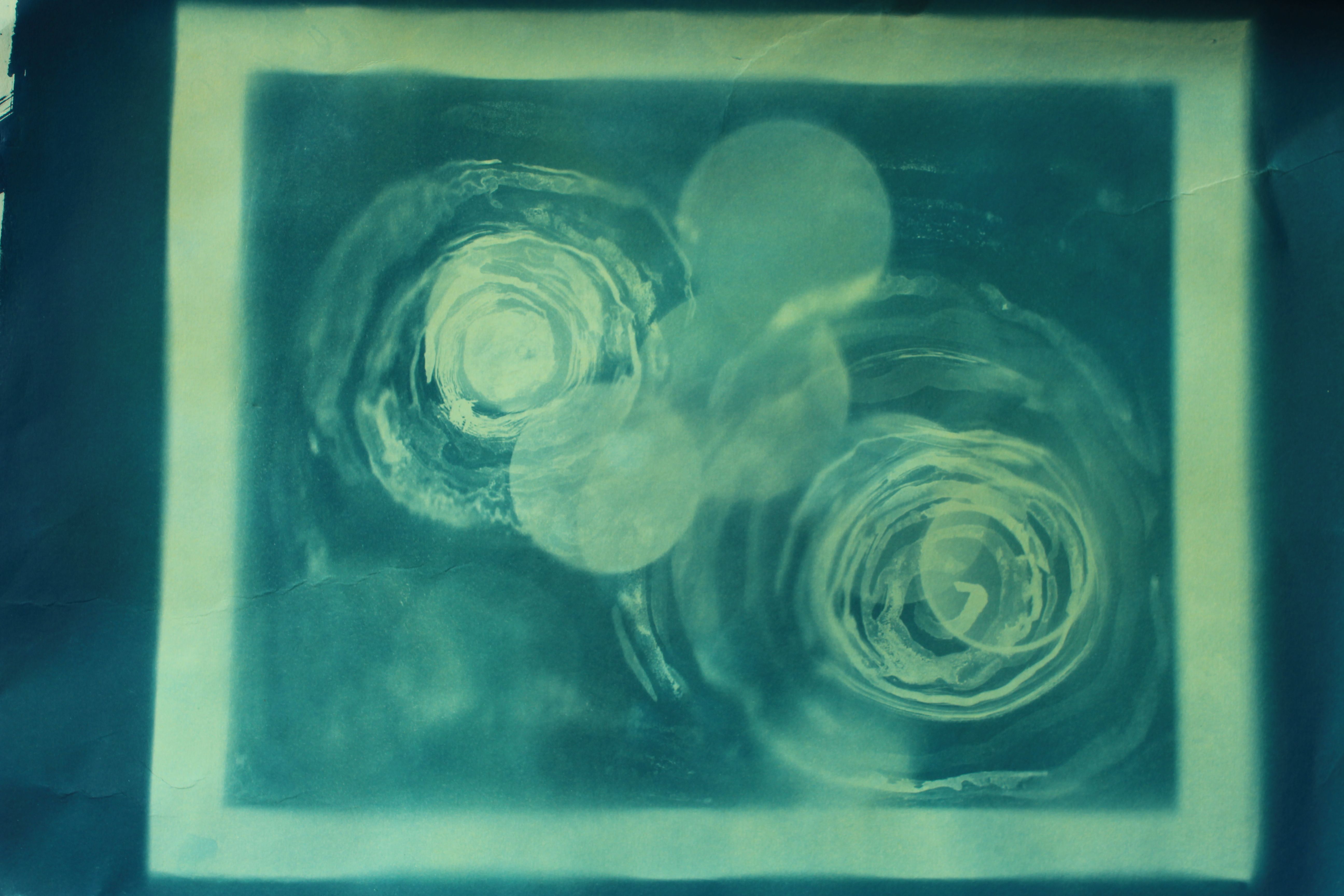
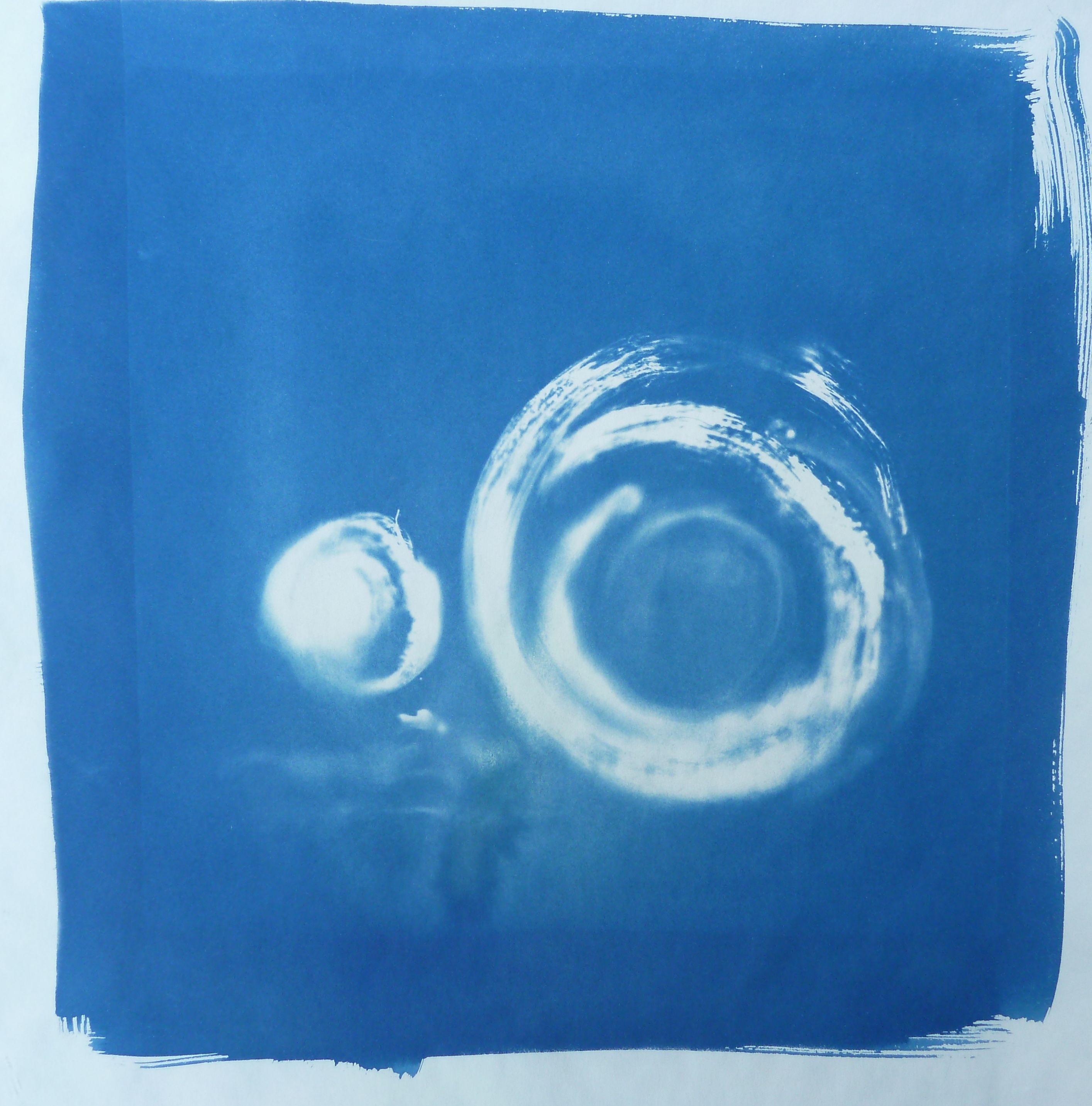
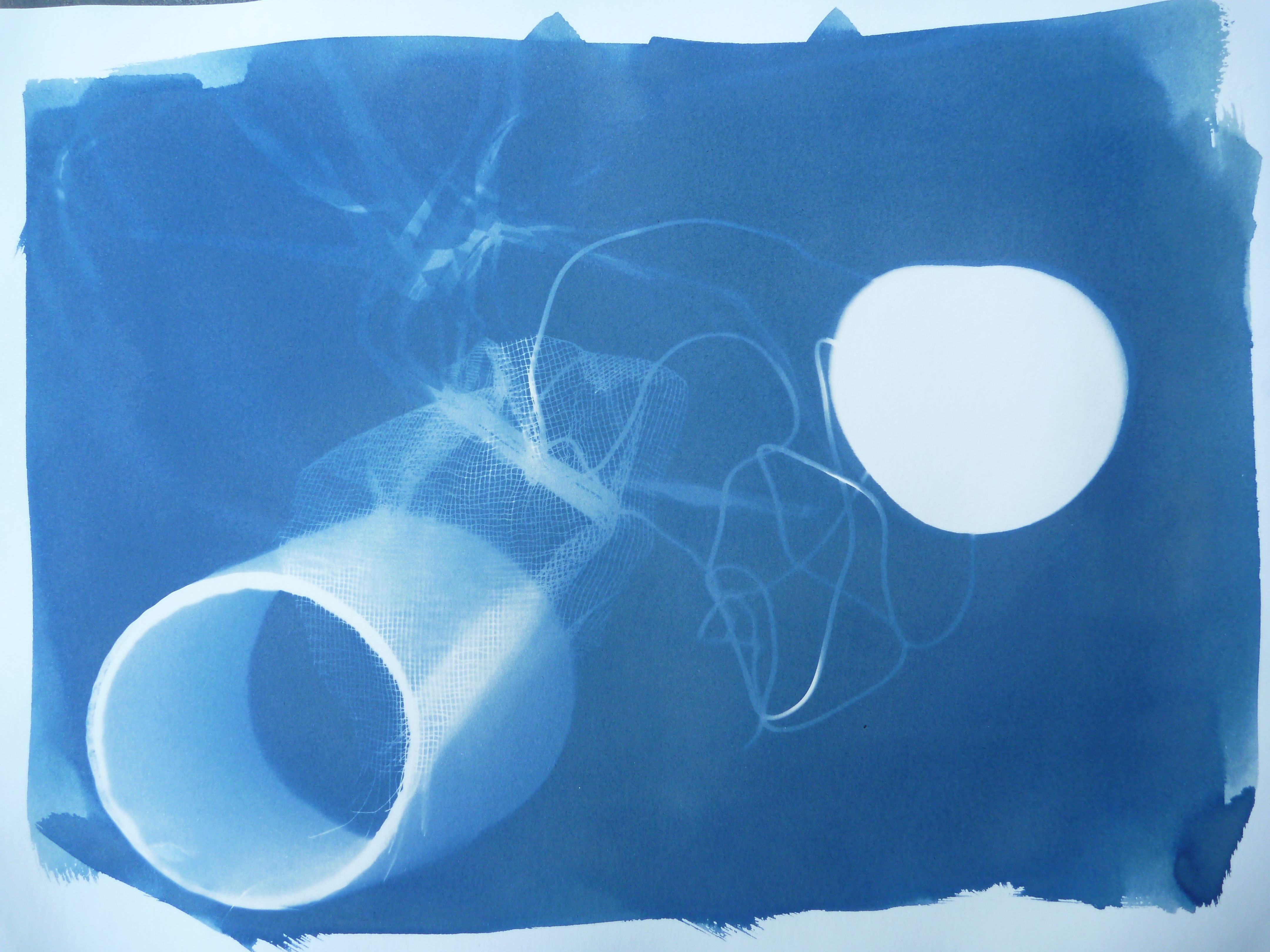
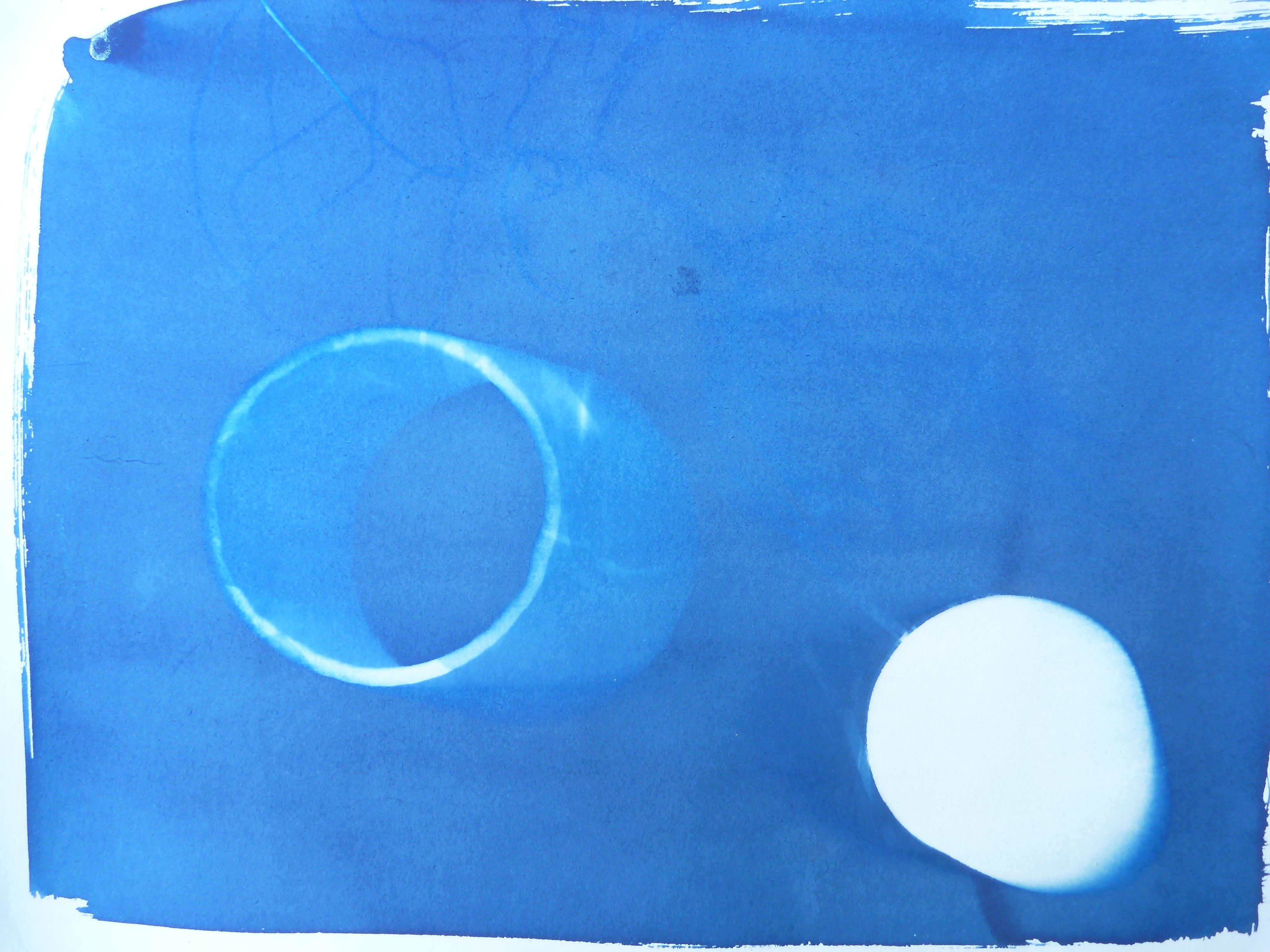
I like the mixture of soft and hard lines, drawn, textured and geometric, with a suggestion of perspectival and telescopic views made by the fact that there was a shadow cast by the 3-D objects, and movement caused by the breeze. The angled cylinder shape will have to be made taking account of the direction of the shadows, so will need strong sun.The image I plan to make will reflect those 18th and 19th century astronomers, working with self made tools, who discovered the age of the universe and had to try to explain to themselves as well as to others, how God still fit into the scheme of things. The confusion that the image cause to the eye is reminiscent of the shifts in perspective from believing that the stars were fixed on a crystal sphere to realising that they were floating in space.  I think it’s appropriate and slightly ironic to be using the sun to make the image.

I also find this minimalist one attractive- the two simple shapes, one a bit like a balloon, the other a solid looking object that is actually a mere shadow: lots of play on presence and absence, and the ambiguous relationship between the two shapes, flat or 3-d, moving or still: one shape looks like a pendulum, and the other seems to recede, so I have called it “Space and Time”.
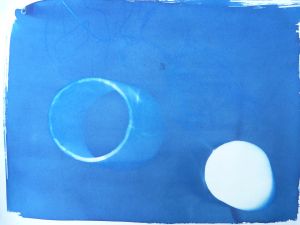
P1040567

Space and time

I’m torn between the two- last feedback I got was to avoid doing too much. Is this personal taste? When I show these images to other people, they immediately appreciate the ones with the richest texture. In many ways, I find more to contemplate in the simpler one.
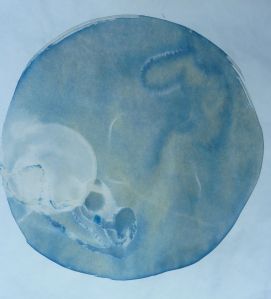
P1040574

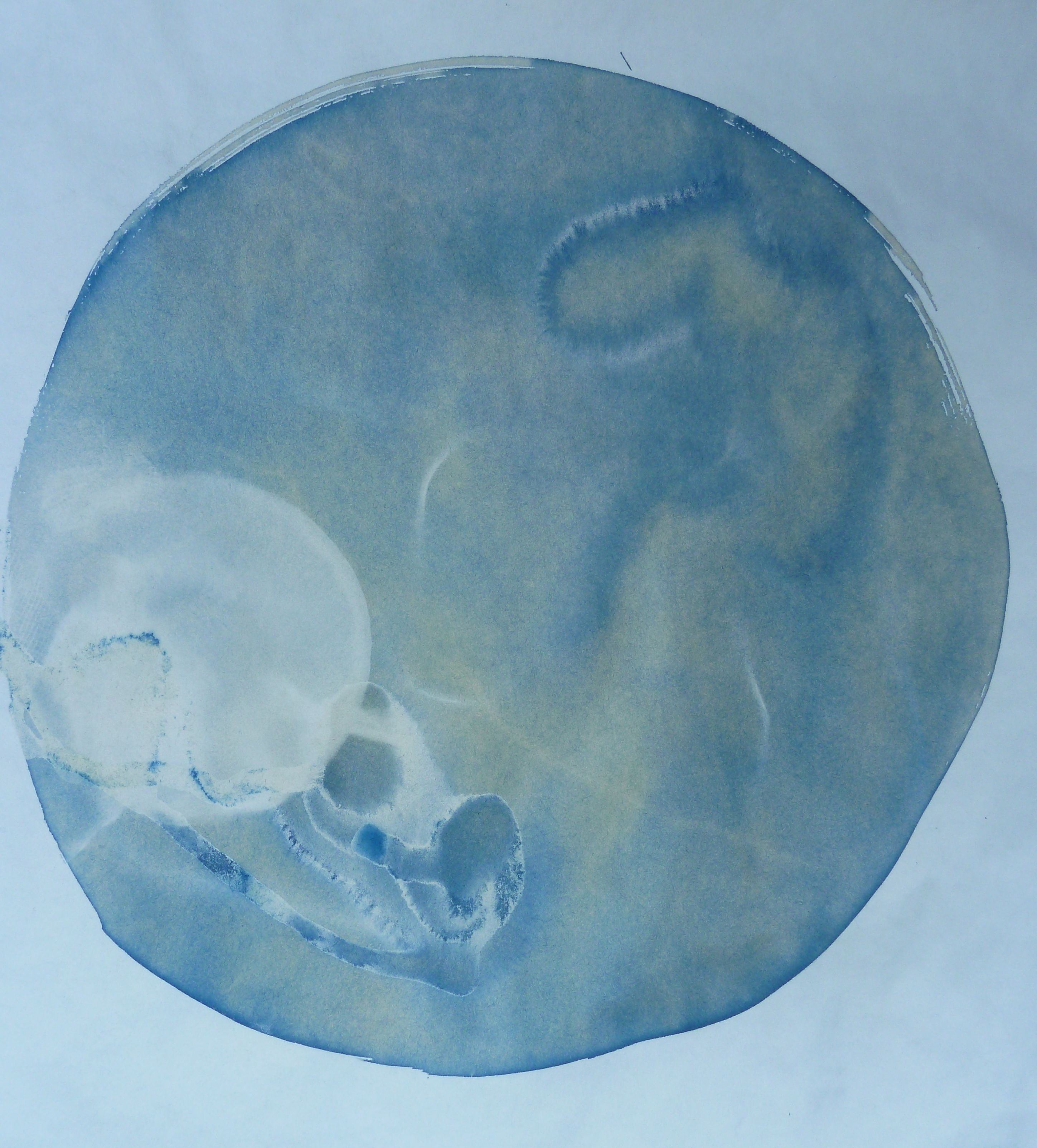
This one’s also interesting to look at- the product of accident- the liquid didn’t dry evenly, the UV wasn’t powerful enough, and in the end I abandoned it overnight, under the full moon as it happened, not that that will have done anything. But in the morning it looked like an embryo.


Secondly, I am going to produce a copper plate etching, now I have materials again. This is going to be using the same techniques as the “enquiring mind” piece, but will start with an image of the moon and degrade it to the point that it looks like a rock: this is using process to reflect the story of how those astronomers turned a mystical object into something more prosaic.

Sunday 11 October

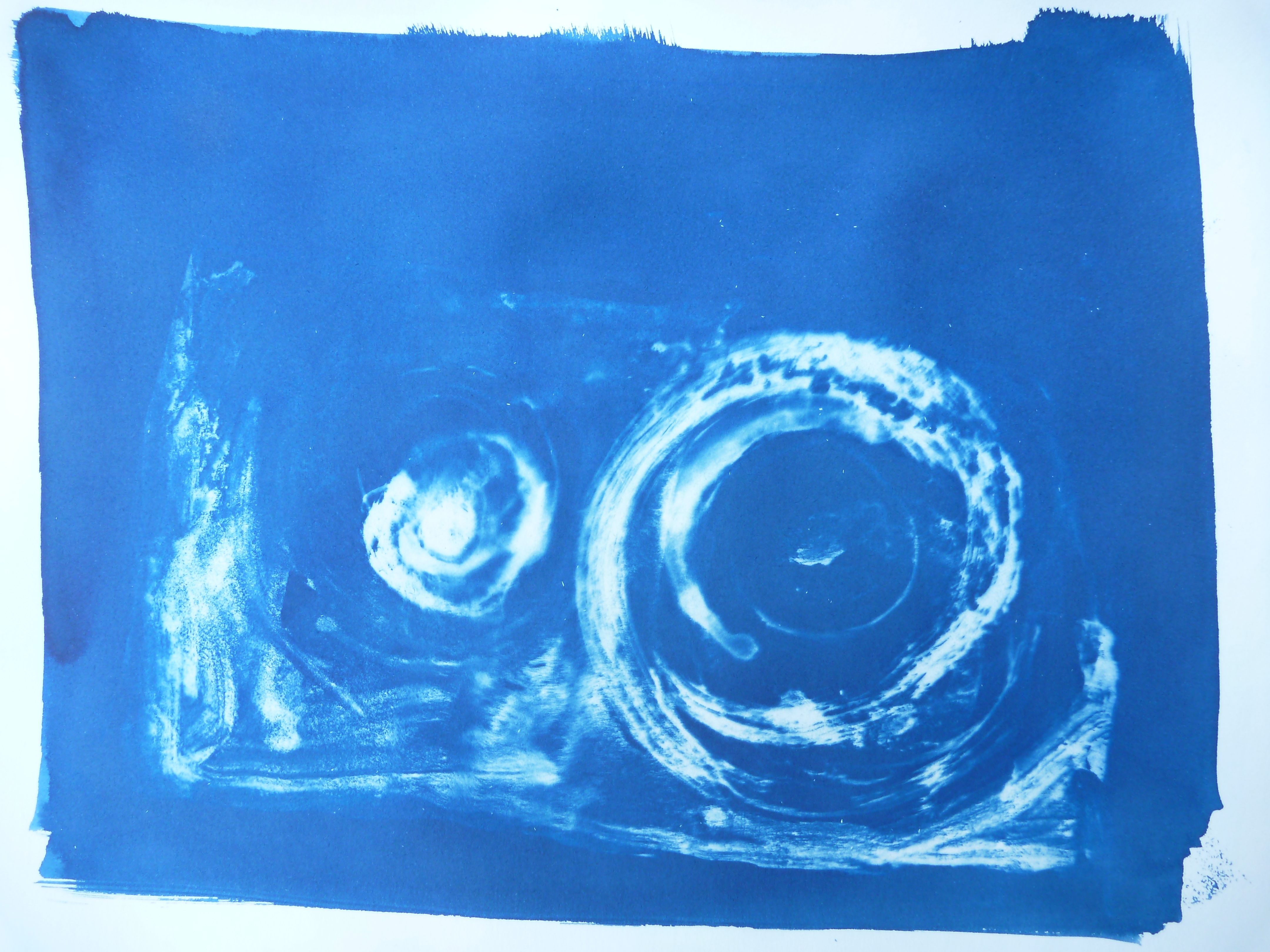
So today I used a UV lamp as the weather just isn’t cooperating. It’s not as fast as the sun, and the colours aren’t as bright. I’d like to do it again if the sun comes out. This is an ink wash and carborundum on cellophane mounted on a frame, with flat shapes and 3 D objects. I moved the flat circles to create different shades, and adjusted the angle of the lamp to keep the shadow of the cylinder soft and ambiguous. I am very pleased with the quality of the lines, with the textures and the shades.

The most striking part of the image is the way a “planet” shape has emerged in the bottom right corner, with blazing light around it. There is a diagonal movement, as if a comet is moving into the skies at the top left corner. This image is channeling for me the Keats’ sonnet “On looking into Chapman’s Homer”, which is about a moment of insight, related to the thrill of discovery of a new planet.


On First Looking into Chapman’s Homer

BY JOHN KEATS

Much have I travell’d in the realms of gold,
   And many goodly states and kingdoms seen;
   Round many western islands have I been
Which bards in fealty to Apollo hold.
Oft of one wide expanse had I been told
   That deep-brow’d Homer ruled as his demesne;
   Yet did I never breathe its pure serene
Till I heard Chapman speak out loud and bold:
Then felt I like some watcher of the skies
   When a new planet swims into his ken;
Or like stout Cortez when with eagle eyes
   He star’d at the Pacific—and all his men
Look’d at each other with a wild surmise—
   Silent, upon a peak in Darien.

The “watcher of the skies” was William Herschel, who discovered Uranus after developing his own telescopes and setting up a grueling system of observation.  Herschel was also the pioneer of this cyanotype technique.


Of course, as looking at the set-up shows, this is a case of the “deception of images”.
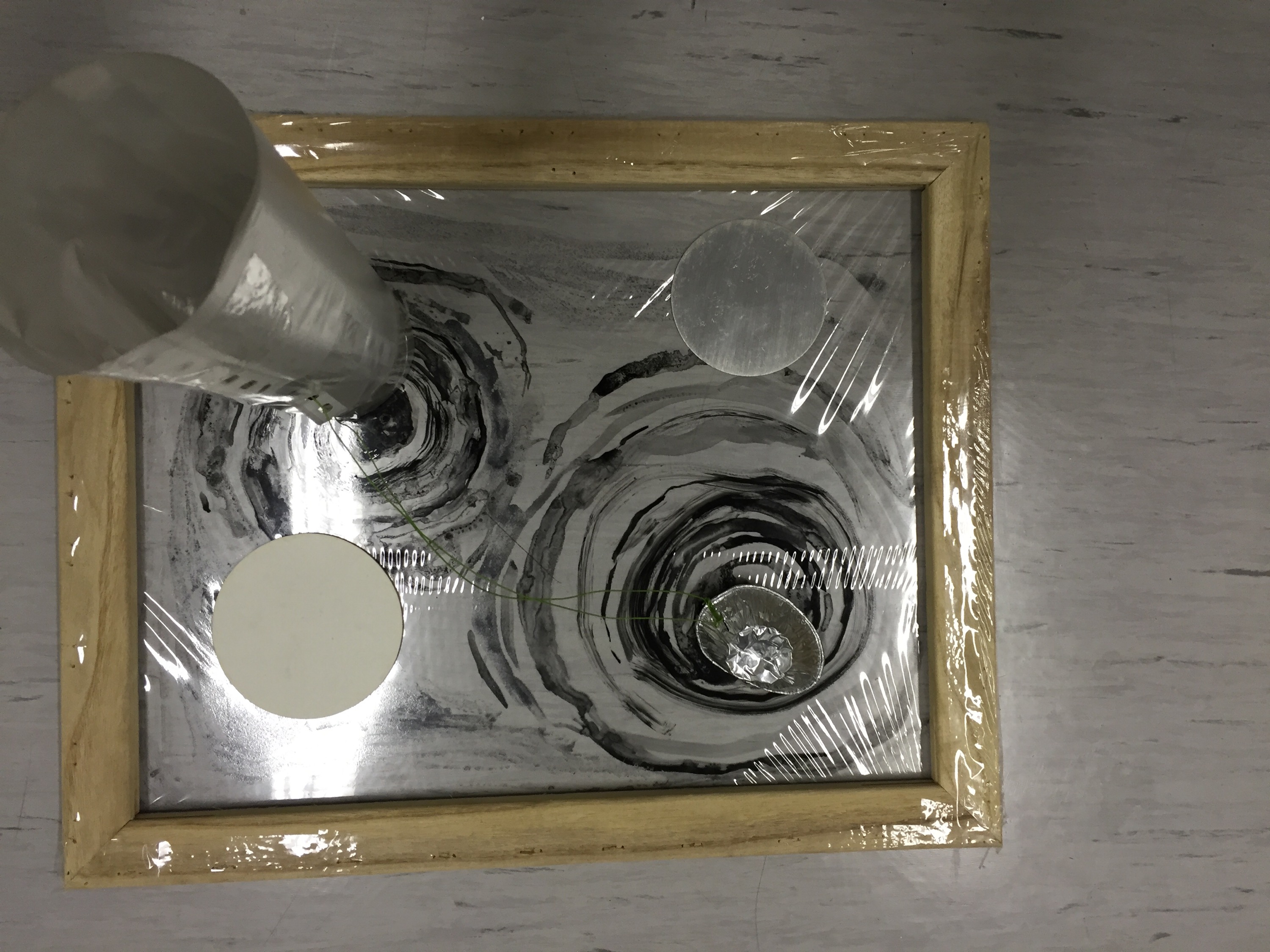
 

The set up: plastic cylinder semitransparent casting a soft shadow and moving circles
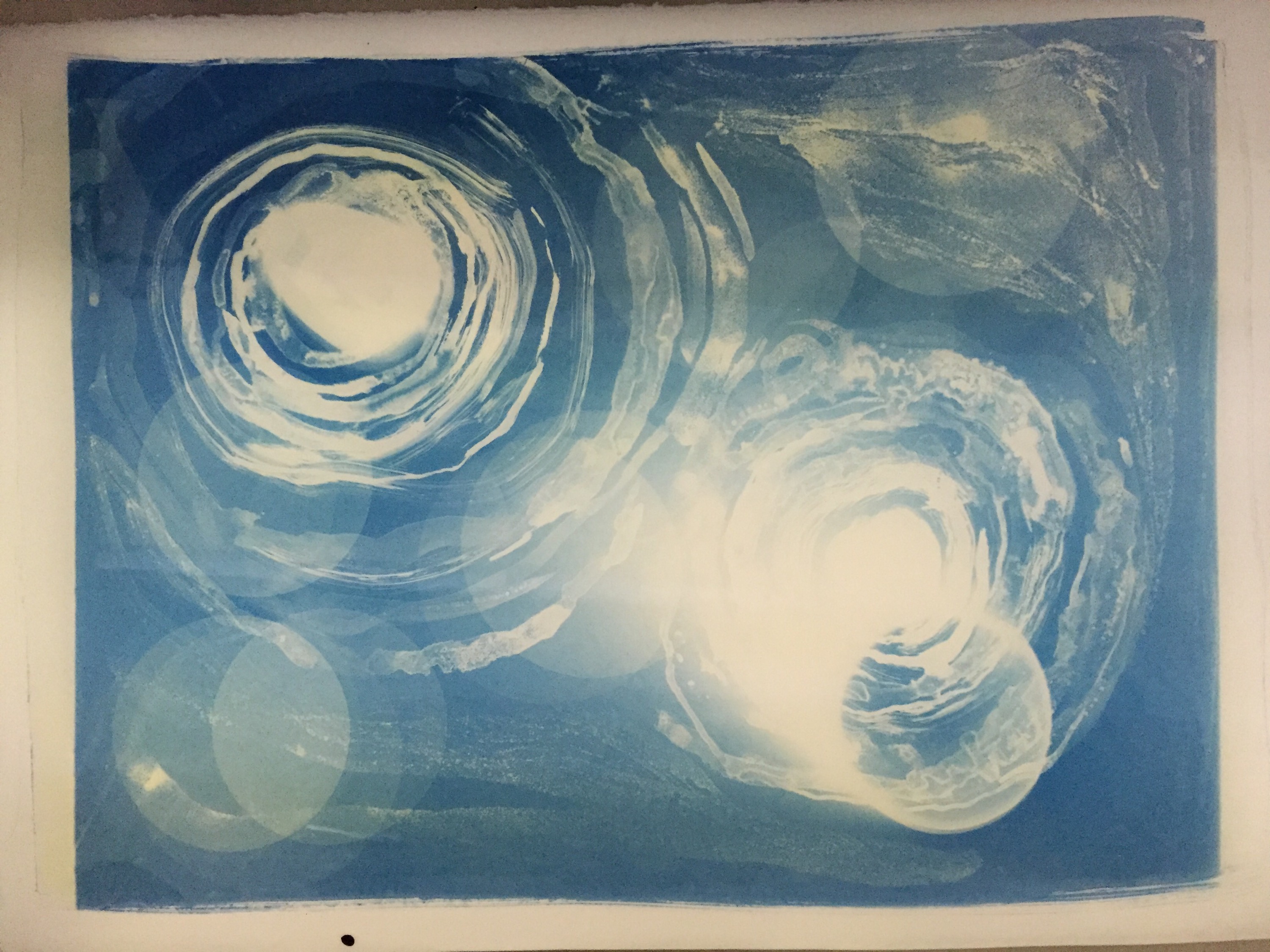
 

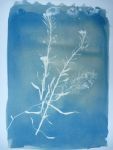
1Q84 Herschel Cyanotype A 2

Then the sun appeared again, and I was finally able to make sun exposures. I also added vinegar to bring out the cerulean blue colour. I think these are amazing in terms of their colour- it was really exciting developing them. This one doesn’t have the same trompe l’oeil effect of the one above and perhaps suggests a telescope shape instead.
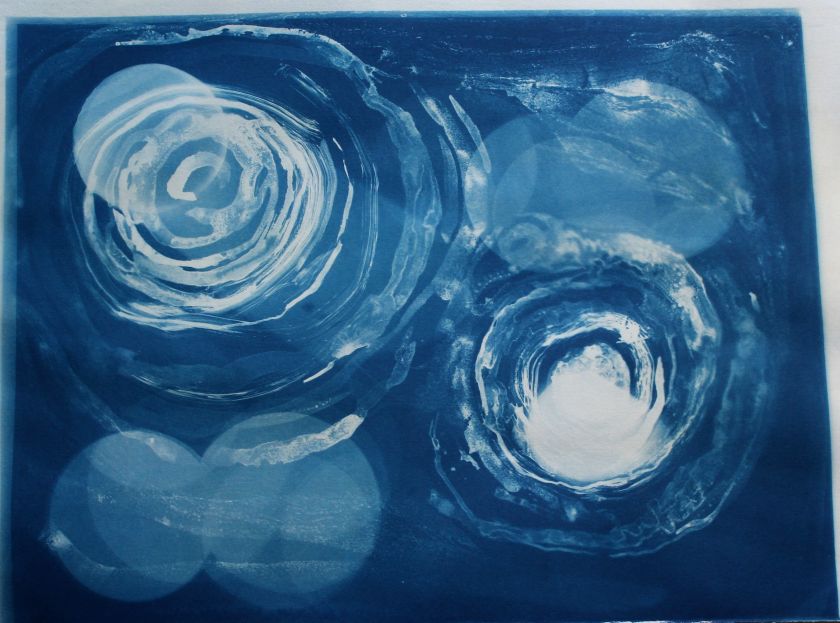
Moons

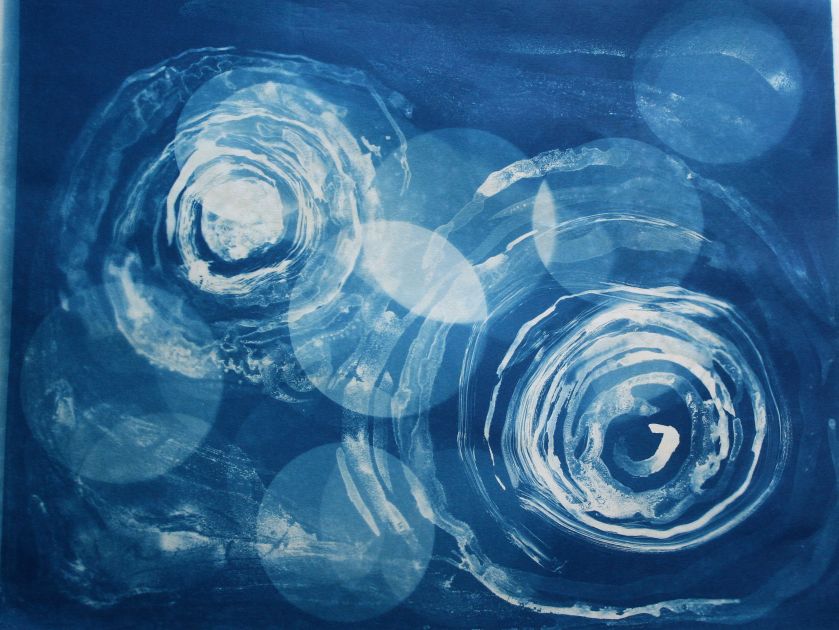
Moons in the Sun 1

Moons in the sun 2

Moons in the sun 2

The speed of the exposure in these has created different effects, in some ways less complex. The colour is phenomenal though. The main interest in these is how the movement of the circles, with their different exposure times and the way they overlapped, has created a rolling movement of transparent circles in the image.


Photopolymer again

With a chance to use a UV lamp and the weather less humid I tried again, and it’s gone better. I tried dry lamination of the plates but that didn’t work, but with a bit of access to art rooms this week I managing to do more- the uv lamp is just guesswork as it has to be hand held but I have managed to make two versions of the “two moons” plate.

Calling it “two moons” is an indication that this isn’t abstract of course- but actually it’s a pattern- a gestural mixture of painterly marks, wash and carborundum texture.

Intaglio wash

These plates were made by mounting photopolymer onto copper plates, exposing them, first to an aquatint screen ( I gave them 40 seconds under a UV bulb, hand held- it was just a guess) and then, under a plate of glass, with a black and white positive exposure, a further 40 seconds. This was then developed in washing soda, and inked and printed.
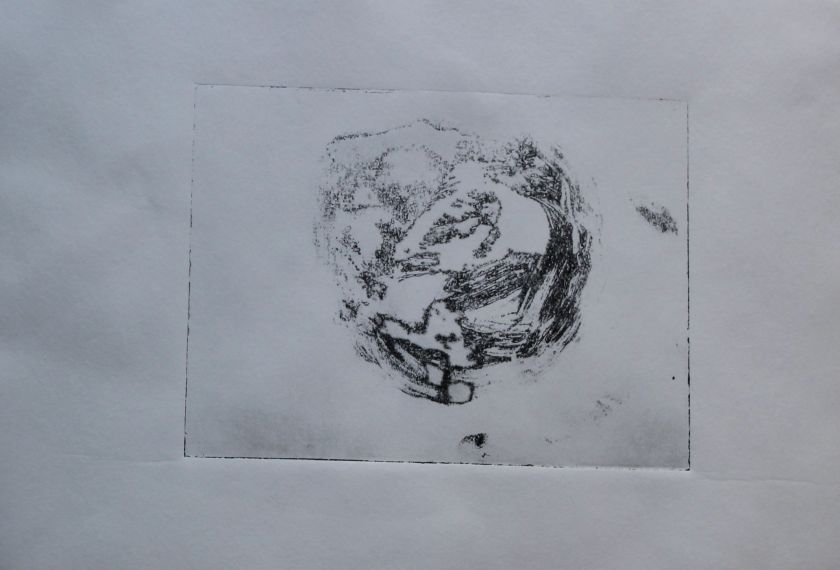
IMG_3865

This was using a basic high-pigment black ink on a sheet of plastic, making dry, painterly brushmarks. The exposure is not correctly times, or else the development is too short: I am guessing here, as the materials are not behaving in the same way as the ones I used in the summer did. I don’t have access to a proper exposure unit, so trials are impossible.

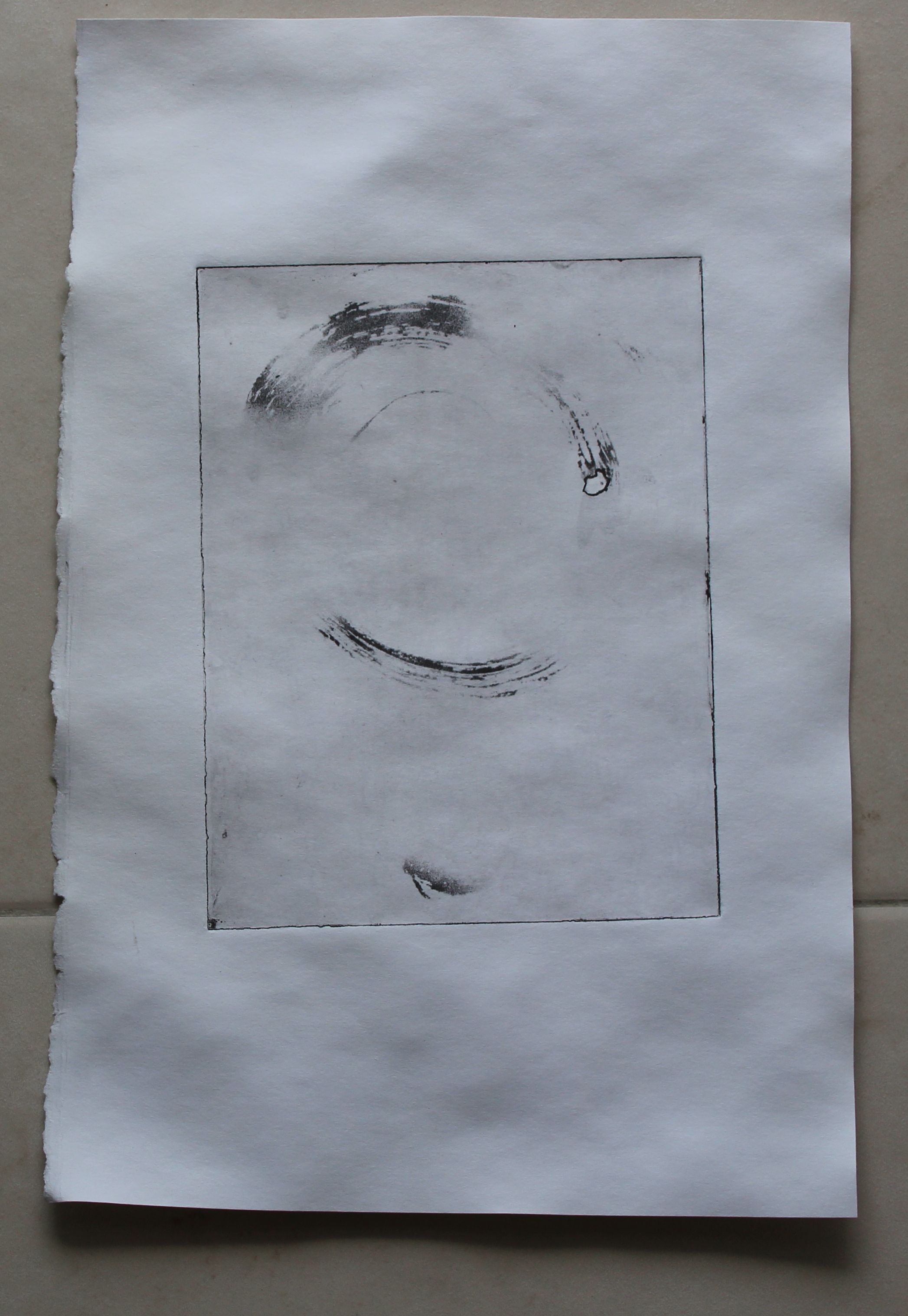
I tried rolling over this one in a colour, just to see how it looked. The brushmarks are there, but there are open-bitten areas where the ink was black. The effect is rather like  rolled up Chinese character, and it’s not unpleasant to look at, but it isn’t what was intended.

The next one worked a lot better. Using the same timings, but two layers of negatives, creating a double spiral, and a greater range of texture. _MG_5834
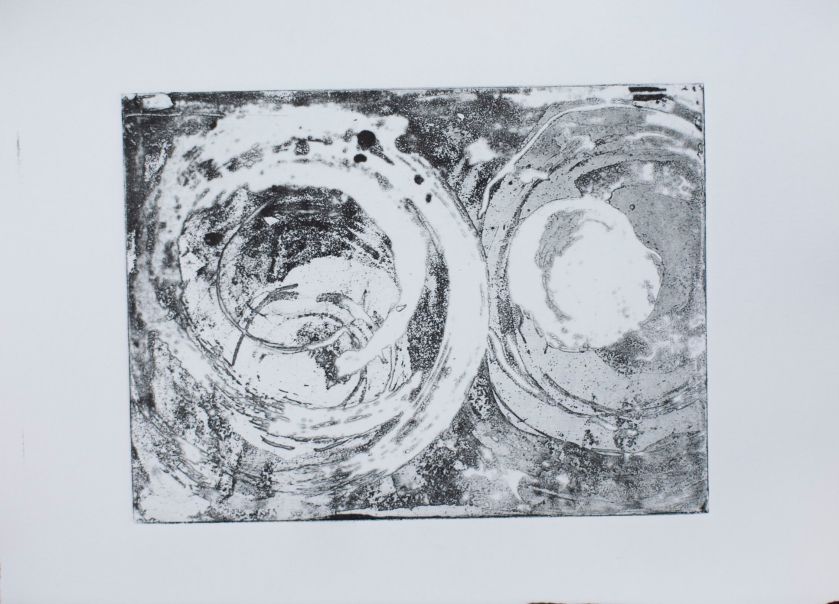
IMG_3774

Again, what was supposed to be thick black areas have come out as open bite – but what is nice is the shades of grey, and the granulated textures.

I tried this one in two colours, although “viscosity printing” is a bit of a mystery to me. I tried using AKUA intaglio inks for the black, then Charbonnel, with added oil for transparency, for the colour. Then I tried Charbonnel black too, as it is nice and thick compared with Akua.

I tried again, and thought at first that this one was better, in that I did succeed in getting some black where it should be, but it’s not evenly exposed- no doubt something to do with the lamp being being hand-held.
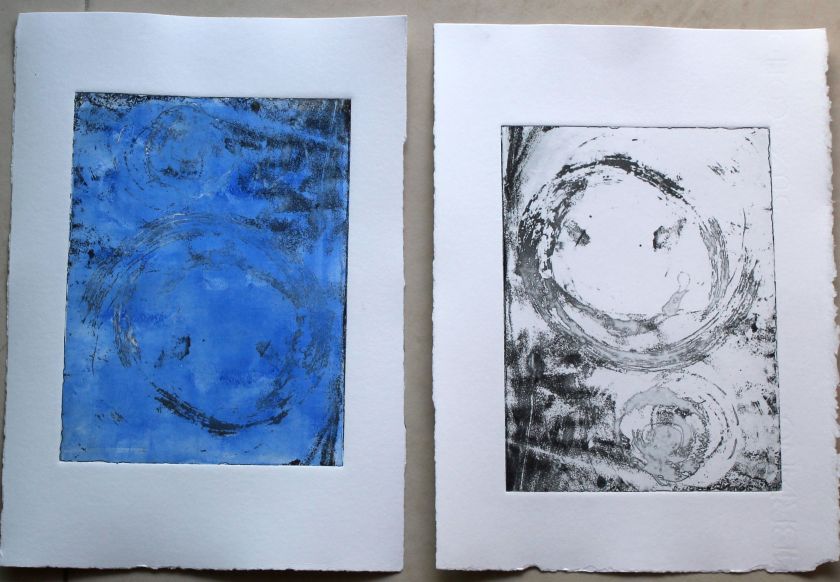
IMG_3879

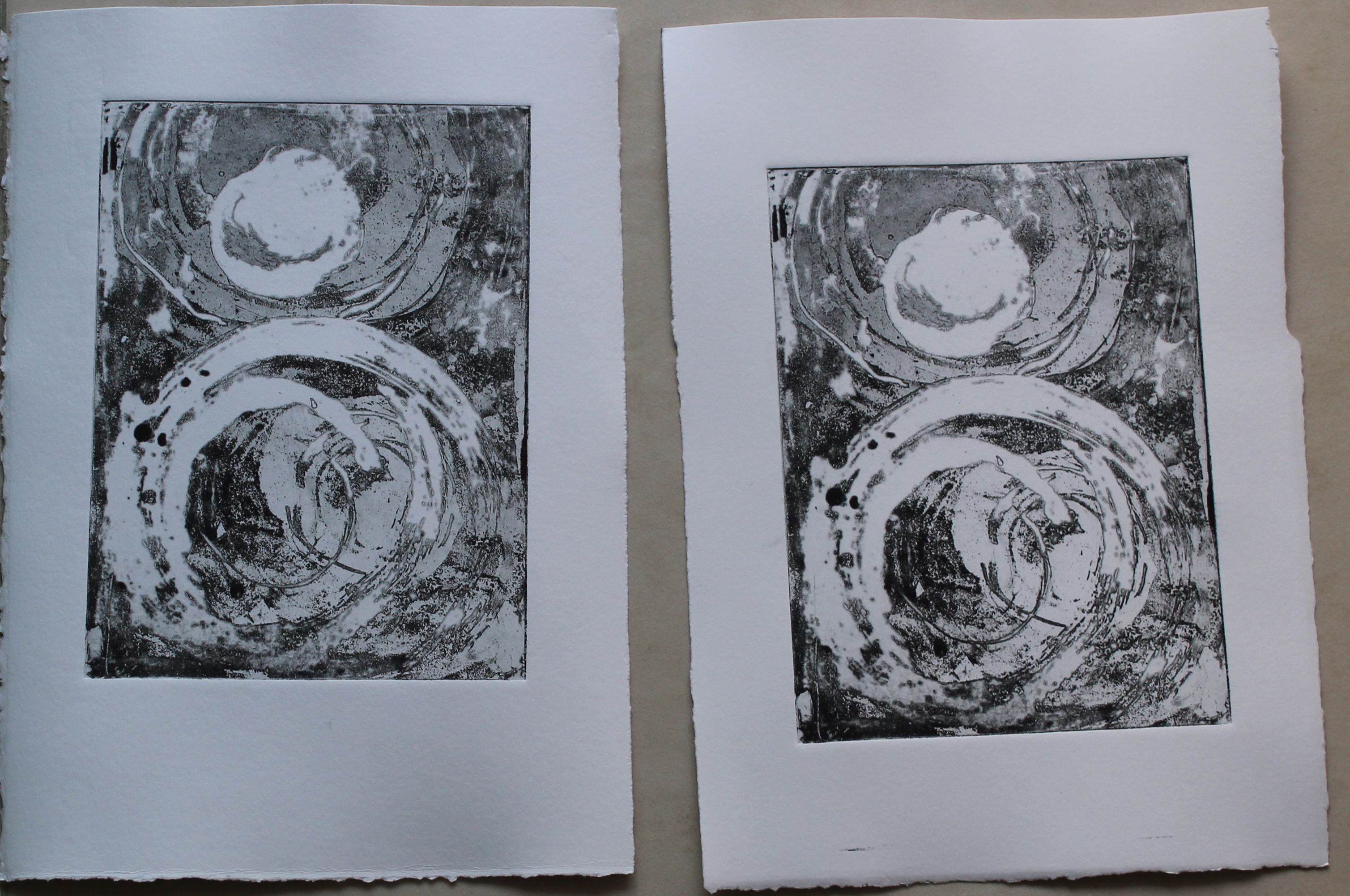
So when I compare them, the one on the right has the most successful variety of marks and tones.
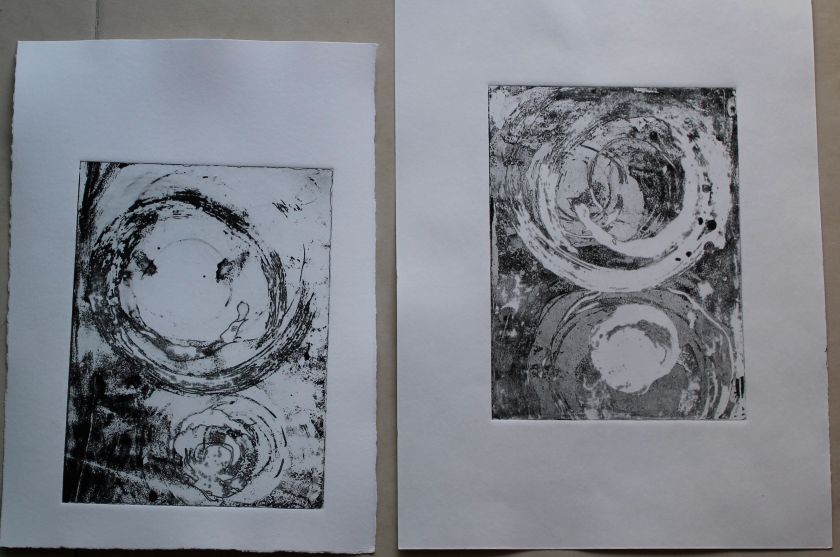
IMG_3875


Intaglio and collograph on perspex

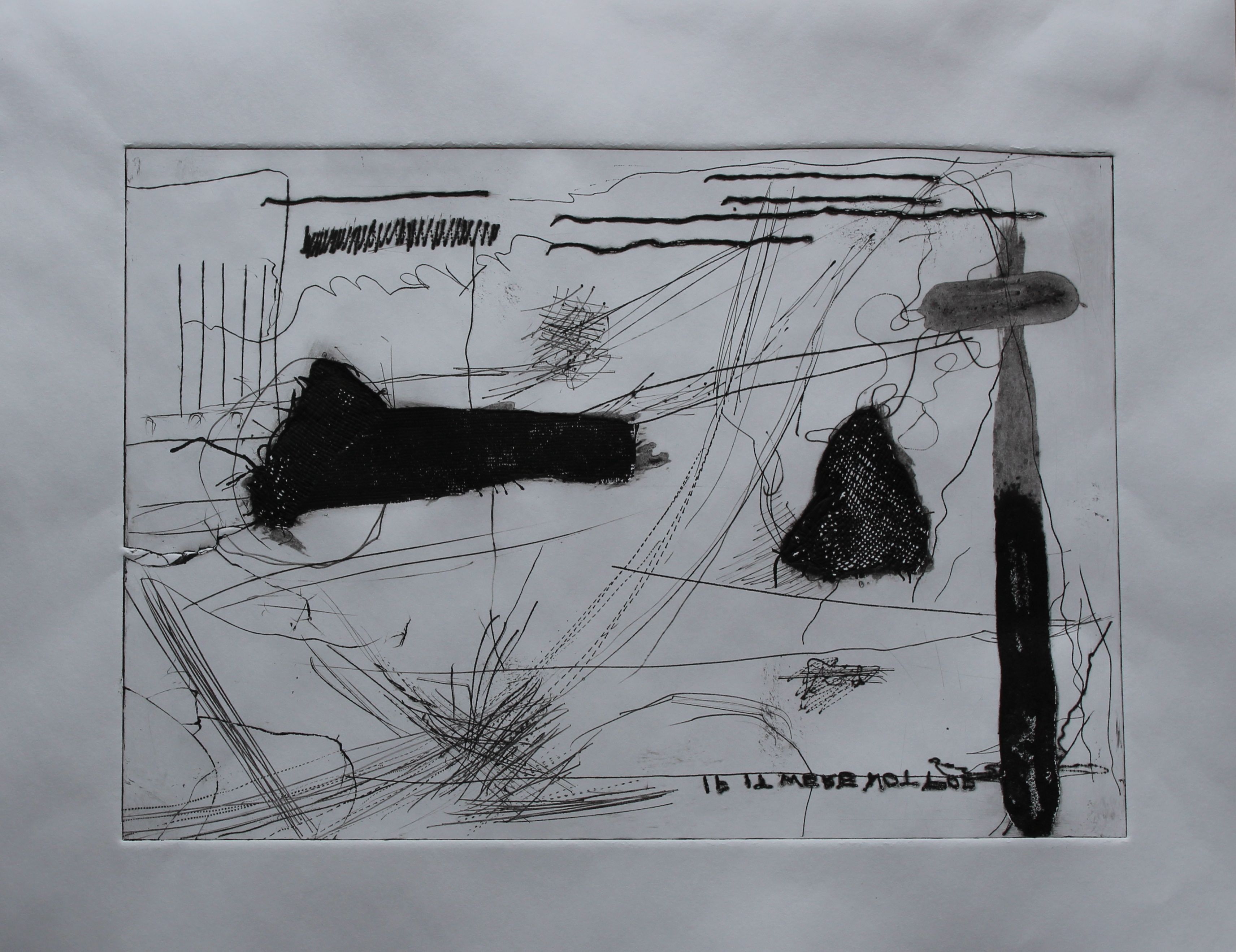
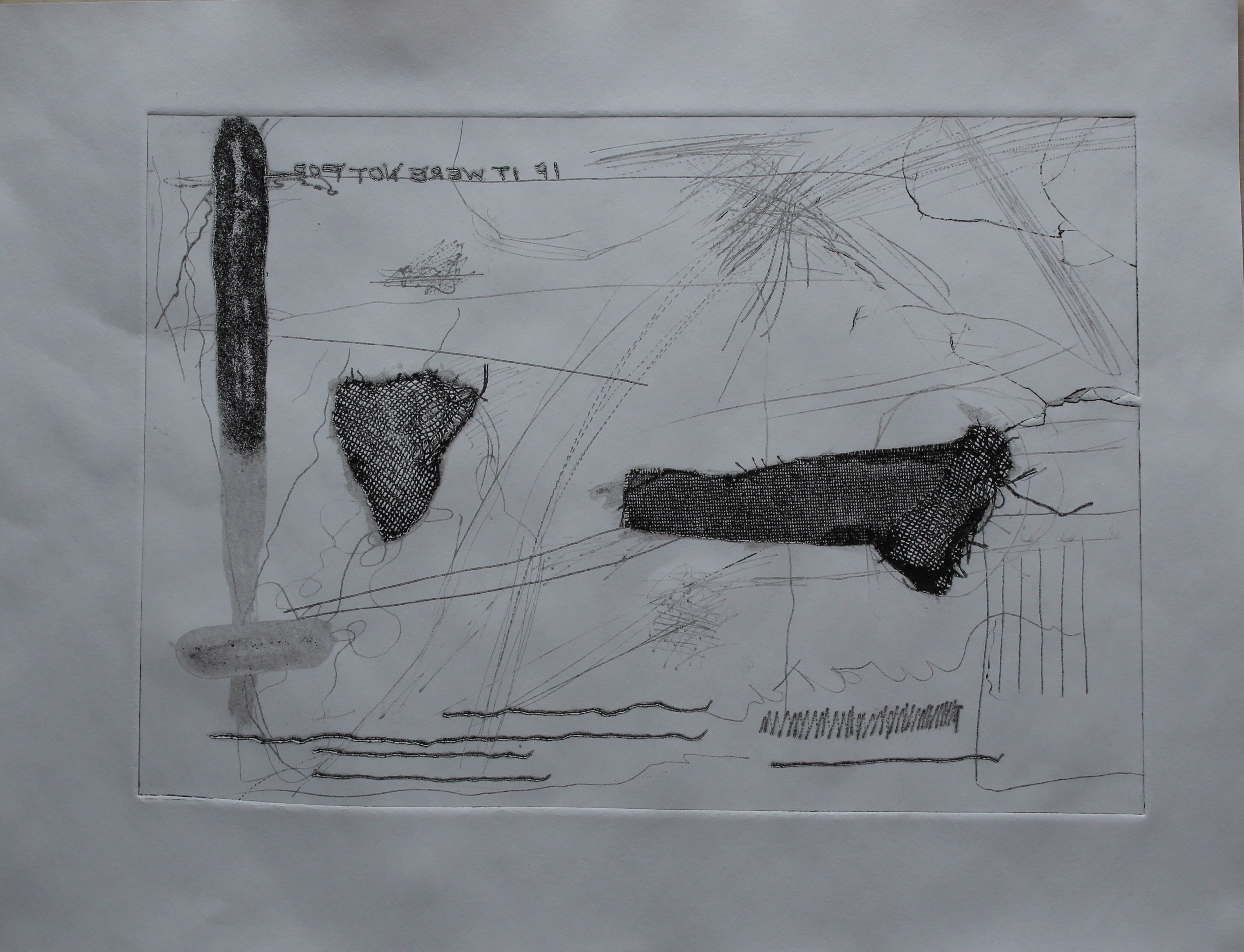
I said I would come back to this one and I have. This is the same plate as I used to explore gestural marks, and was quite destructive; I came back to it with some “healing” layers- acrylic (screenfiller) and gauze to act as plasters over some of the cracks, and to patch the surface, while also creating solidity- shape and texture- with some carborundum. I was after real solid blacks, and “monumental” shapes. Again they were just made intuitively, and any suggestion or symbolism is unconscious.
Gestural marks on perspex, with collograph

Gestural marks on perspex, with collograph

I like the textures of the gauze, and the watercolour effect of the acrylic. The black is really dense. I wonder if I could achieve something like lithographic effects using these materials?
The open bite is quite marked though, and there would be no way to avoid this on perspex I guess? Aquatint screen using spray paint? Or just not using the Dremel.

This is the second print from the same plate.
IMG_3859

Interesting though that was, I then finally found a source of ferric chloride, which meant I could turn back to using copper etching.

Copper plate etching

One issue this time was that the copper plates I have are significantly thicker than the one I degraded last time, so it would take more time.

The first stage was to make a test plate to test the new ferric solution. That meant making an aquatint layer with acrylic ink and masking the plate in strips. Now, you would have thought that, having done this before, I would have got it right, but I managed to count backwards and fail to get an even spread of exposure times. However, the test was enough to let me know that the solution worked quite effectively and fast, and that 30 seconds, 1 minute 2 minutes, four minutes up to 20 minutes was probably the range I as after for aquatint etching.

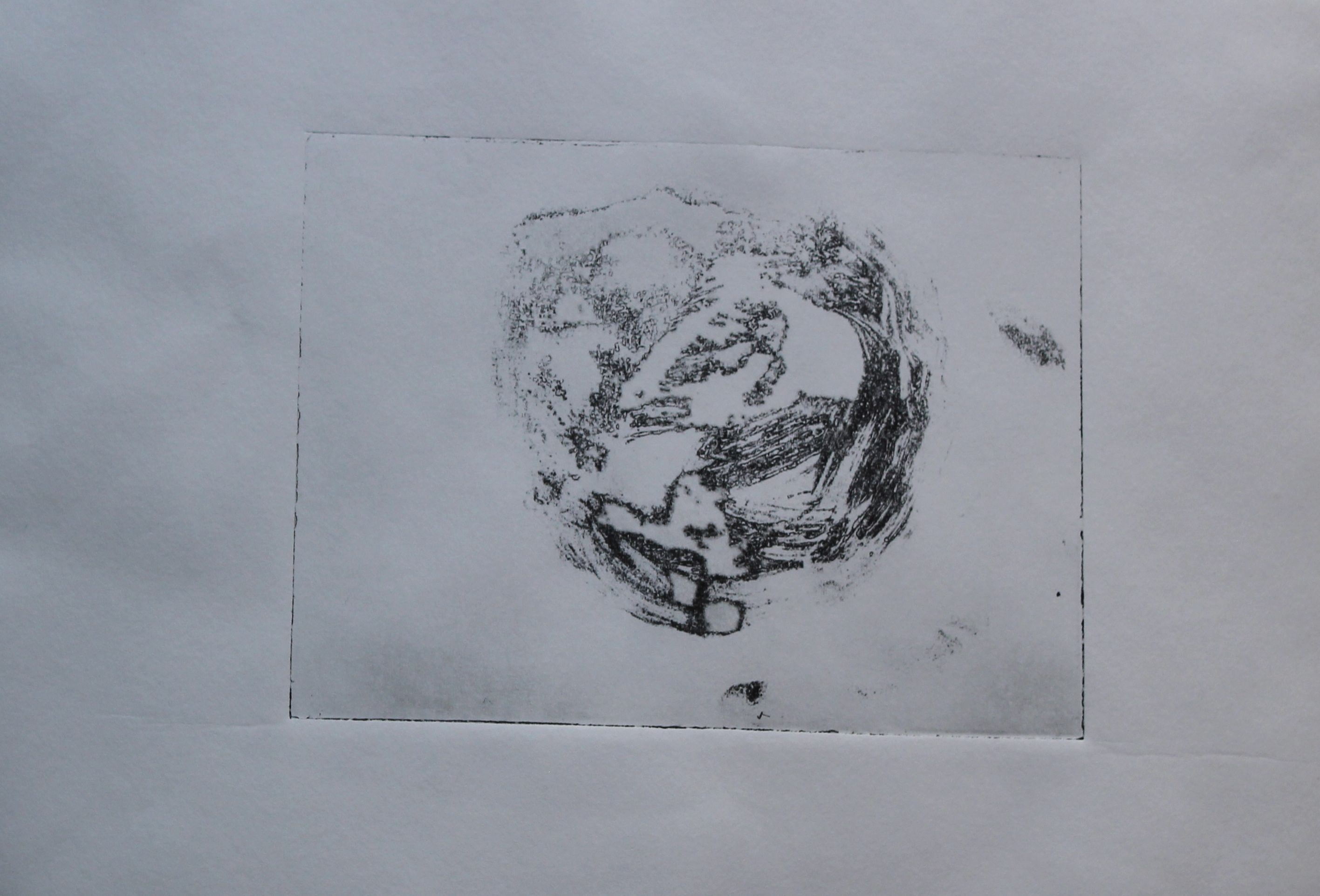
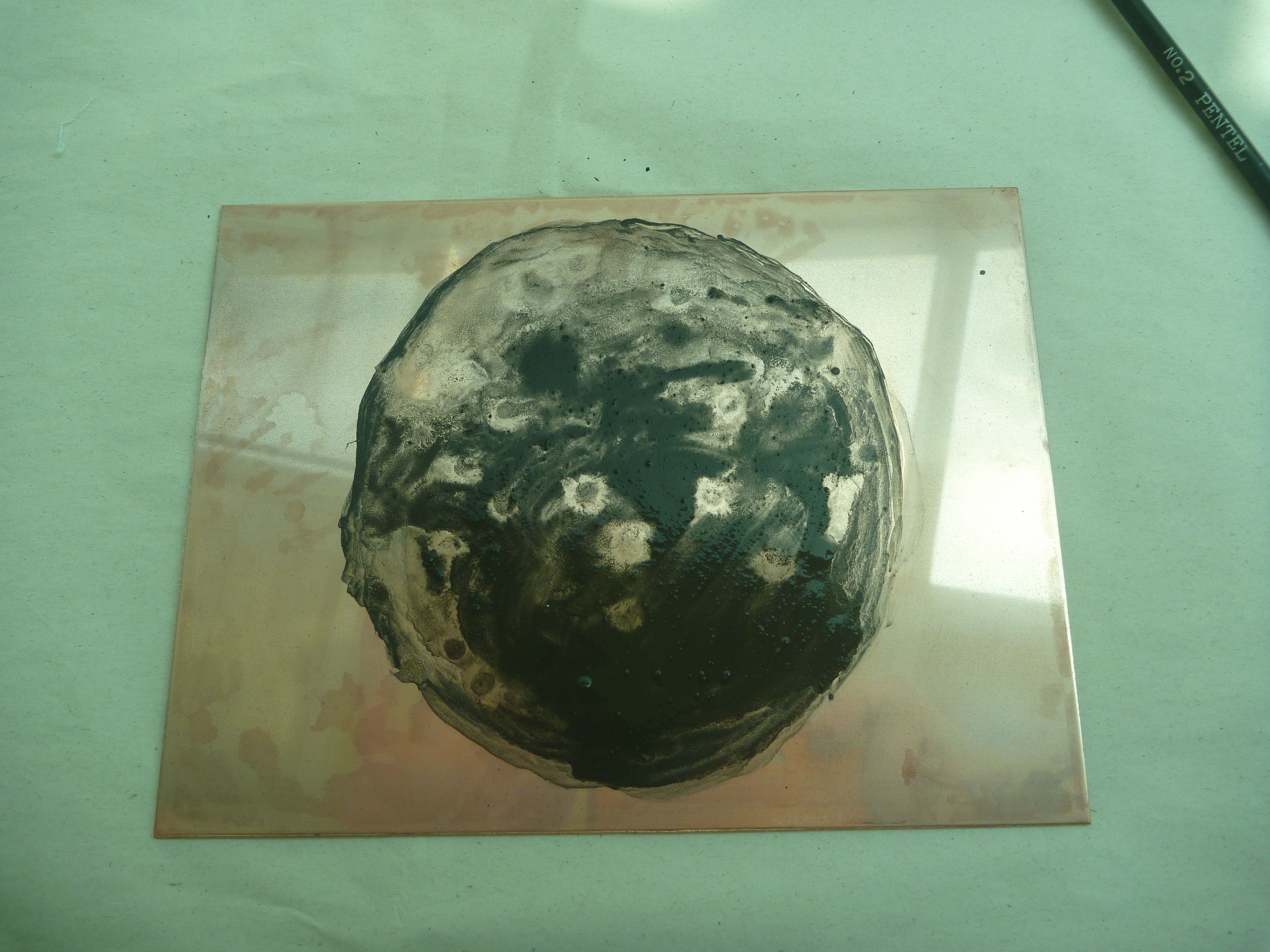
My plan was to degrade a plate down to a circular shape, but to create layers of different depth. The first thing I did was make an aquatint layer and then paint ink and water in the desired shape. You can see the fine mist of the aquatint layer in the picture. The black ink here would stop out the ferric, and the wash part would get eaten.
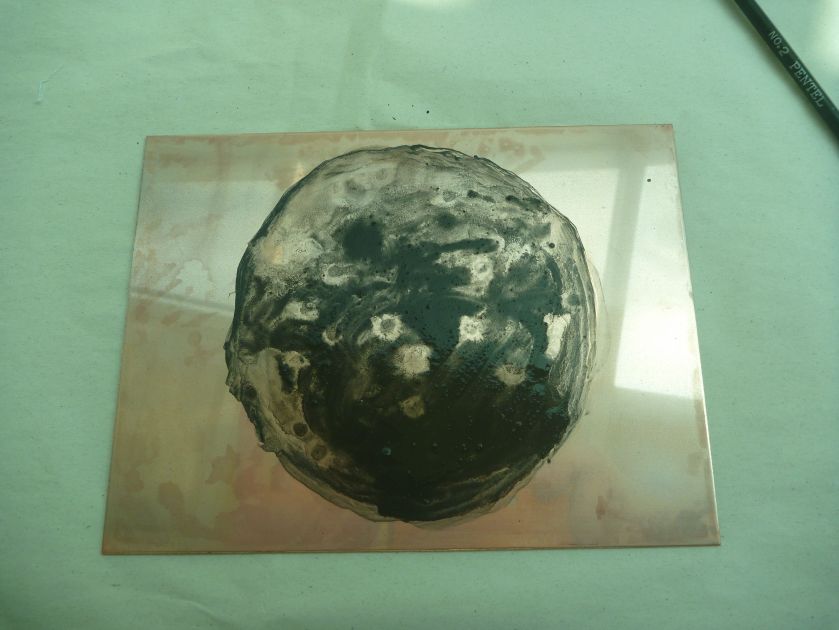
P1040577

I put this in Ferric for 10 minutes, as a first layer, then cleaned it and printed it. The contrasts were not sharp yet. Then I made another layer using no aquatint layer this time, just using pigment from oil-based ink, mixed with water.

This time, when printed, the contrasts were sharp, and the background a lovely velvety black.

The next stage was to start really degrading the copper. Using Johnson’s floor polish as a hard ground/ stop out on both sides, I scratched into the exposed background with an etching needle to make the surface easier to attack with the salts. Then I scratched some lines through the hard ground so that holes would be created. This process took two days and one night. Finally I was left with the roughly textured circle of copper.

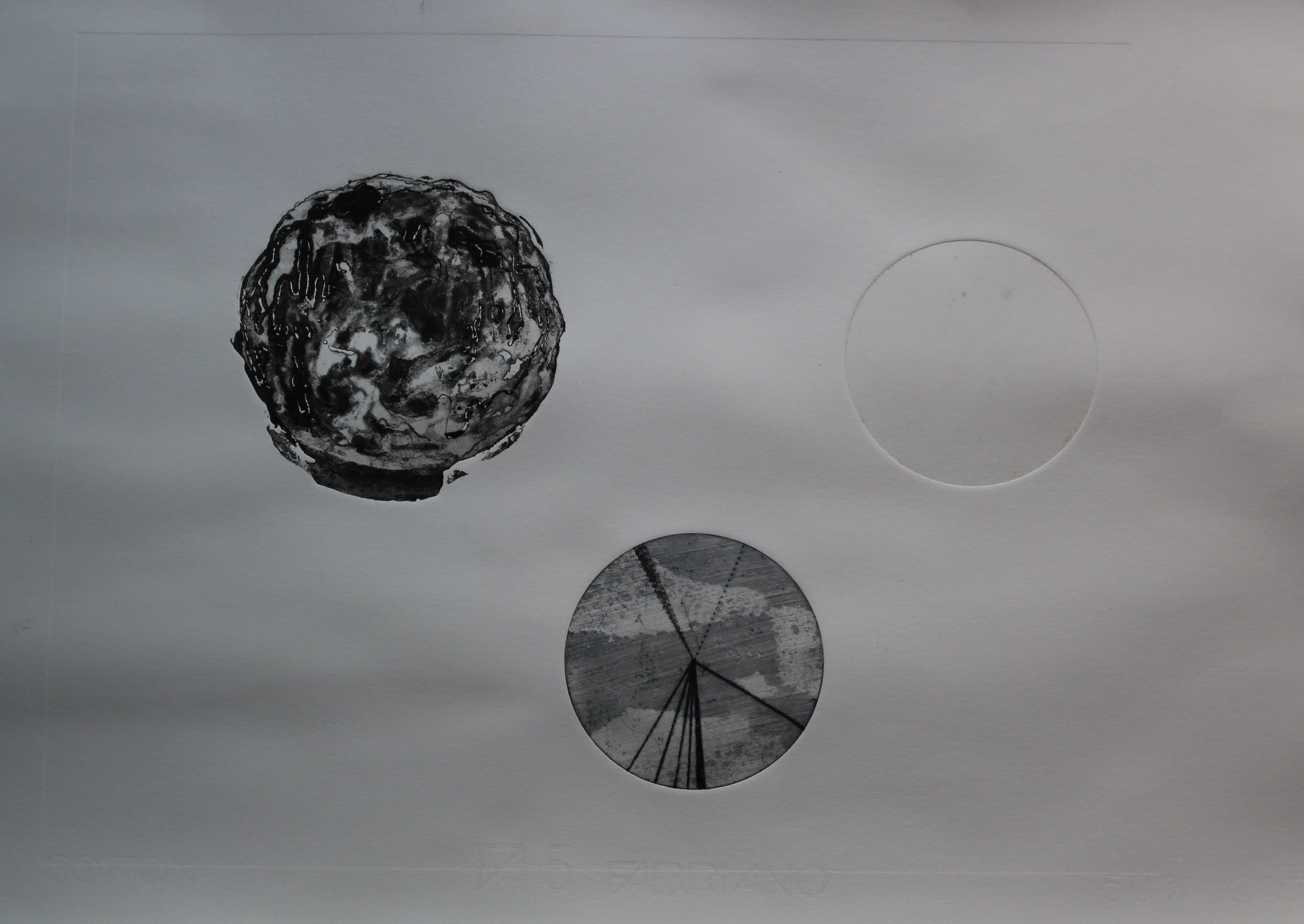
This shape was then inked in black, and set in a composition with a ruled circle- this was a ready made zinc circle which I ruled with an etching tool to make dotted lines – and another cardboard circle to make an embossed shape.

The thinking here was to contrast the materials, the shapes, the surfaces, and thereby the connotations-

the etched copper, its plate warm golden red in colour, rough, accidental, degraded, the irrational, the experienced, the harvest moon, the real: the accidental uncorroded piece of copper giving it a “base” a bit like a crystal ball, so also connoting the supernatural

the scored zinc, silver grey, cold, precise, measured, the logical, rational, the plan, the abstraction, the plan, the analysis: the image is like a pie-chart, mathematical, but the lines also suggest a clock face, and the accidental cloud shapes on the surface, possibly caused by humidity, further connote the passage of time (and it also made me thing of the cloud passing the moon/ eye in the surrealist “Un Chien Andalou” in an inversion of the rational)

the cardboard circle- un-inked, untouched, the blank, the conceptual, the pure, the unreal, the non-existent, the Platonic form.
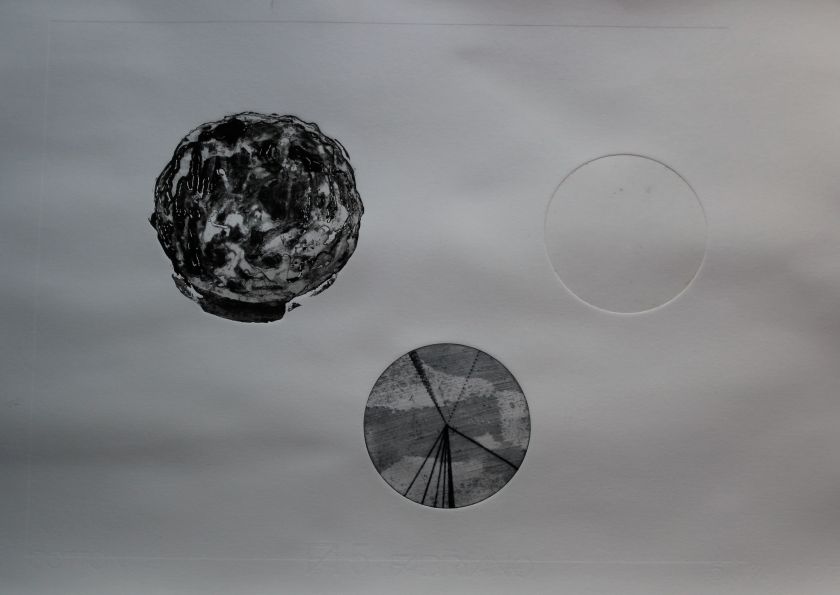
 

IMG_3870

I was not satisfied with the composition. And time ran out for using the press, as a class of students arrived. So I will just reflect on what is wrong and what might be changed.

The juxtaposition reminded me of Joseph Kosuth, “Three chairs and one”, the forms of the same object, drawing attention to the relativism and constructed nature of all instantiations of a single concept.

There was something I didn’t like about this group of three- the way a group of three immediately suggests narrative progression- or is that just me?- there’s an immediate sense of before, now and then, or a suggestion of causation which didn’t please me at all with this. Would having just two items make a difference to that? Would an arrangement in a straight line be less annoying? Does the whole thing need more space?

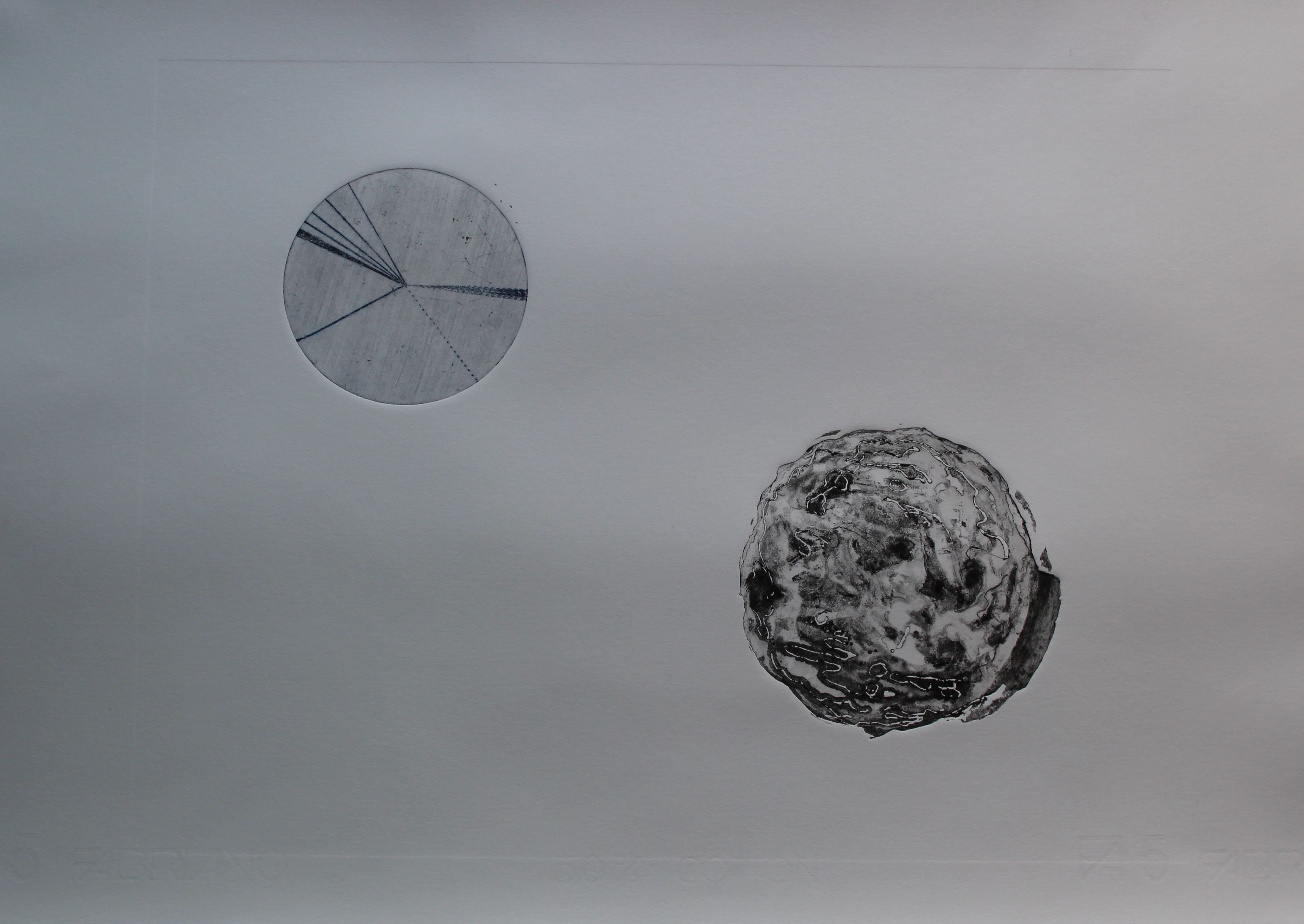
I removed the embossed shape and quickly re-printed. The cloud formation on the zinc was gone, and possibly won’t be recreated.
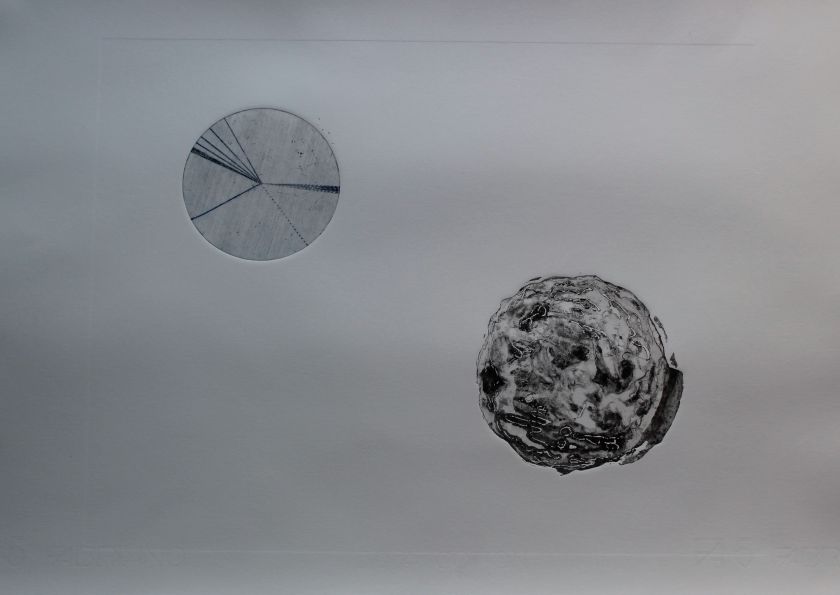
IMG_3871

There’s still an inevitable balance between the two- or tension. The orientation makes a difference. Is it balanced in too obvious a way? There is a clear organic vs geometric opposition- order vs chaos, yin and yang.

The meaning of it is forming in my head and I think I know what has to be done.


Assignment 3: Chiaroscuro: hand

Assignment 3

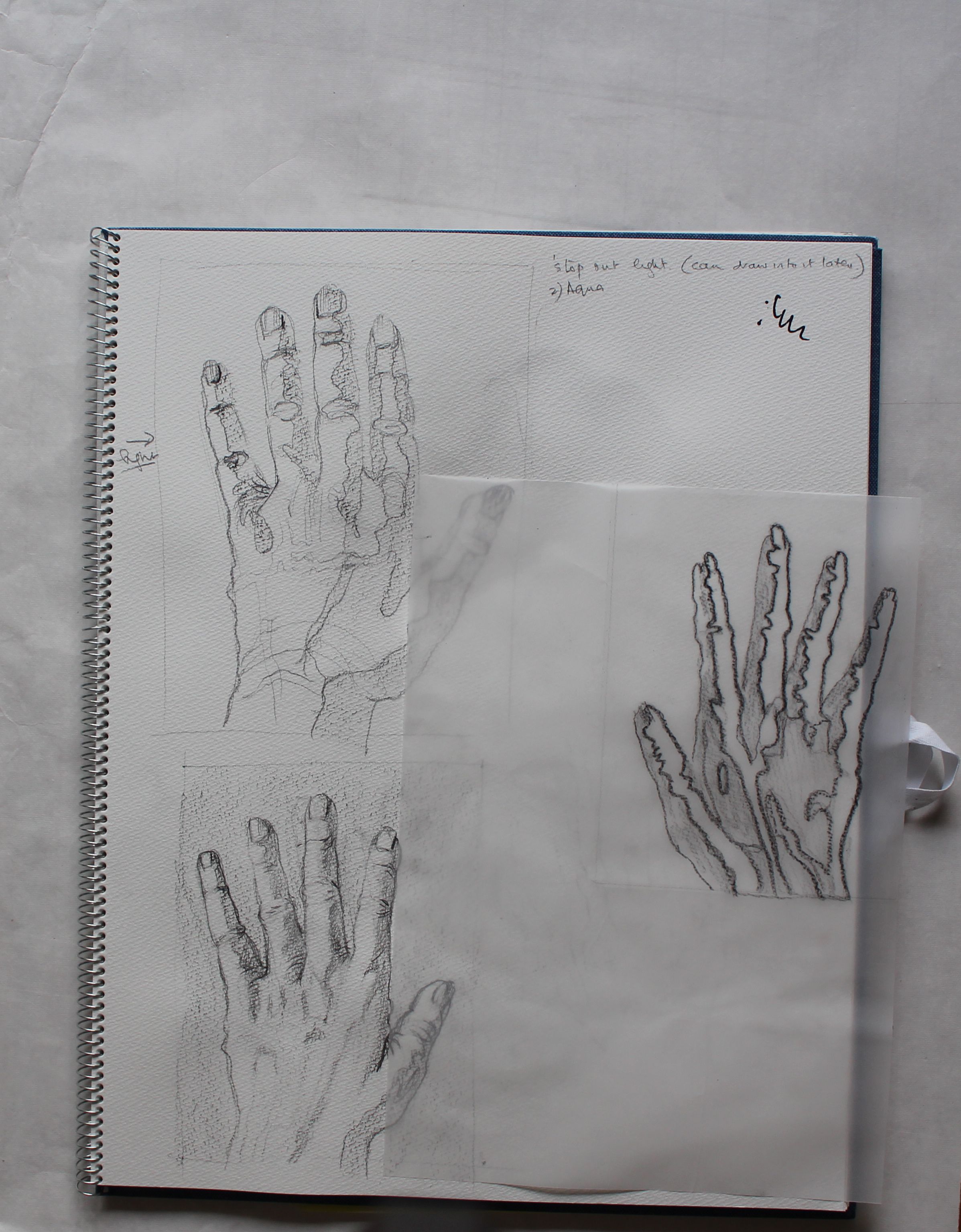
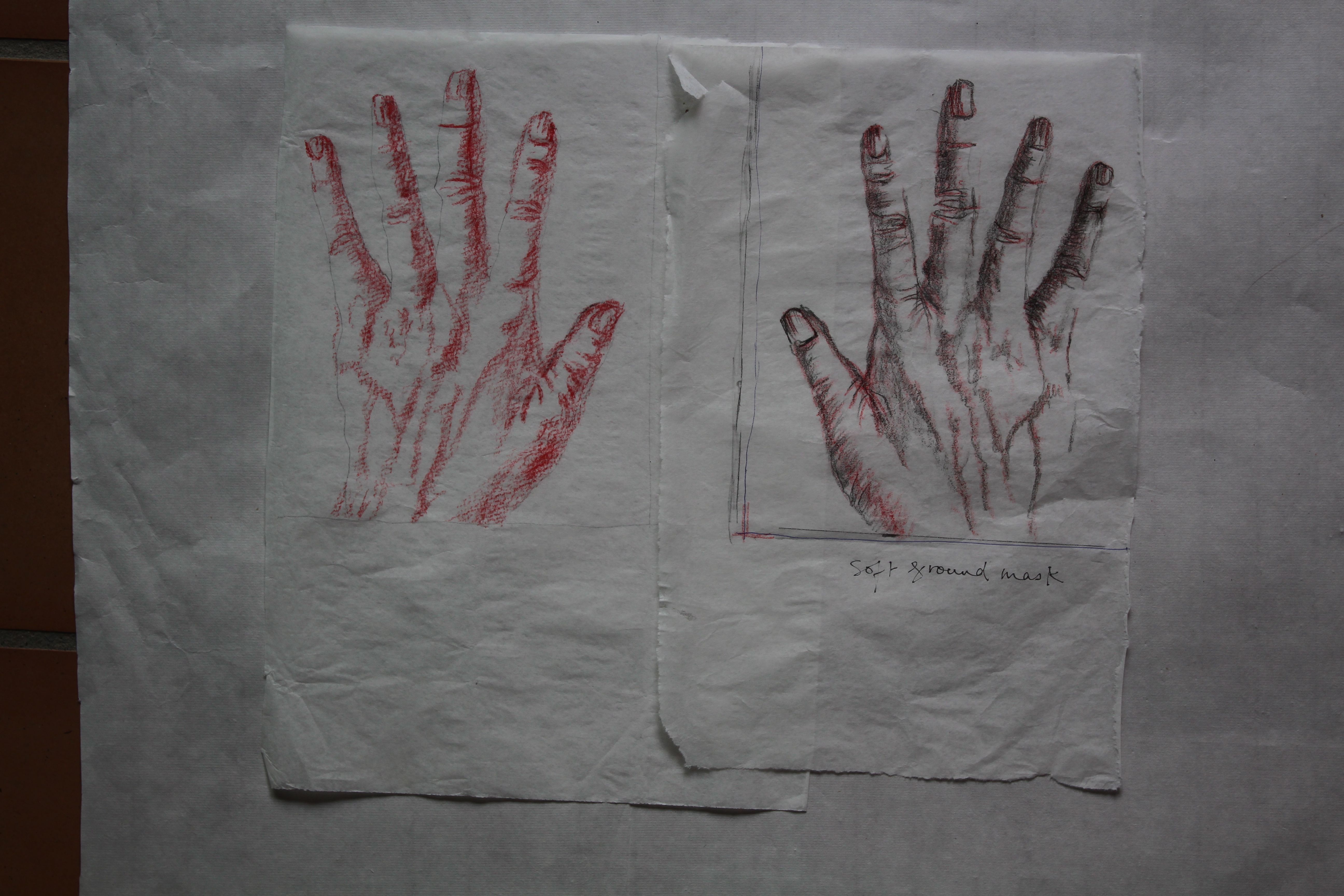
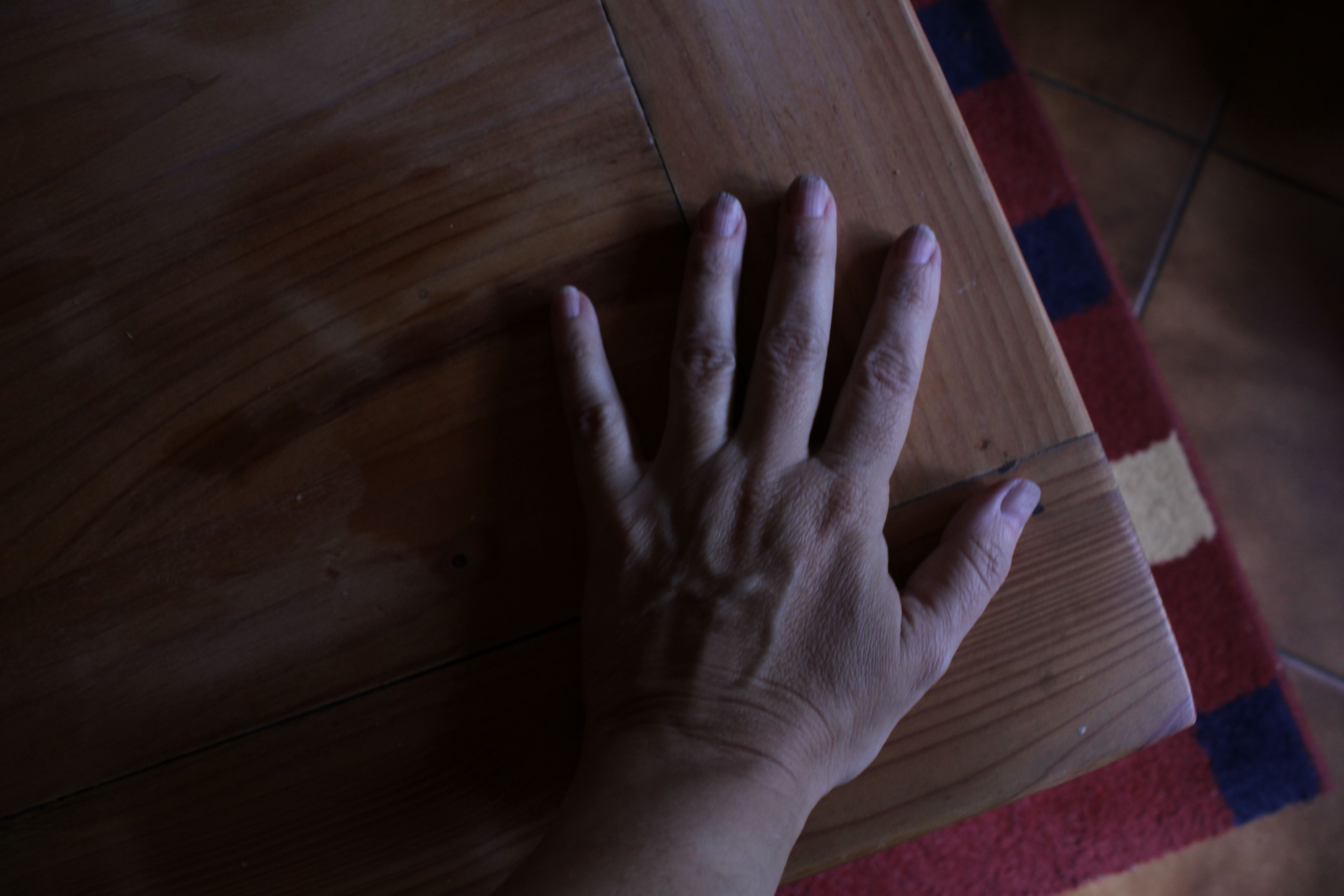
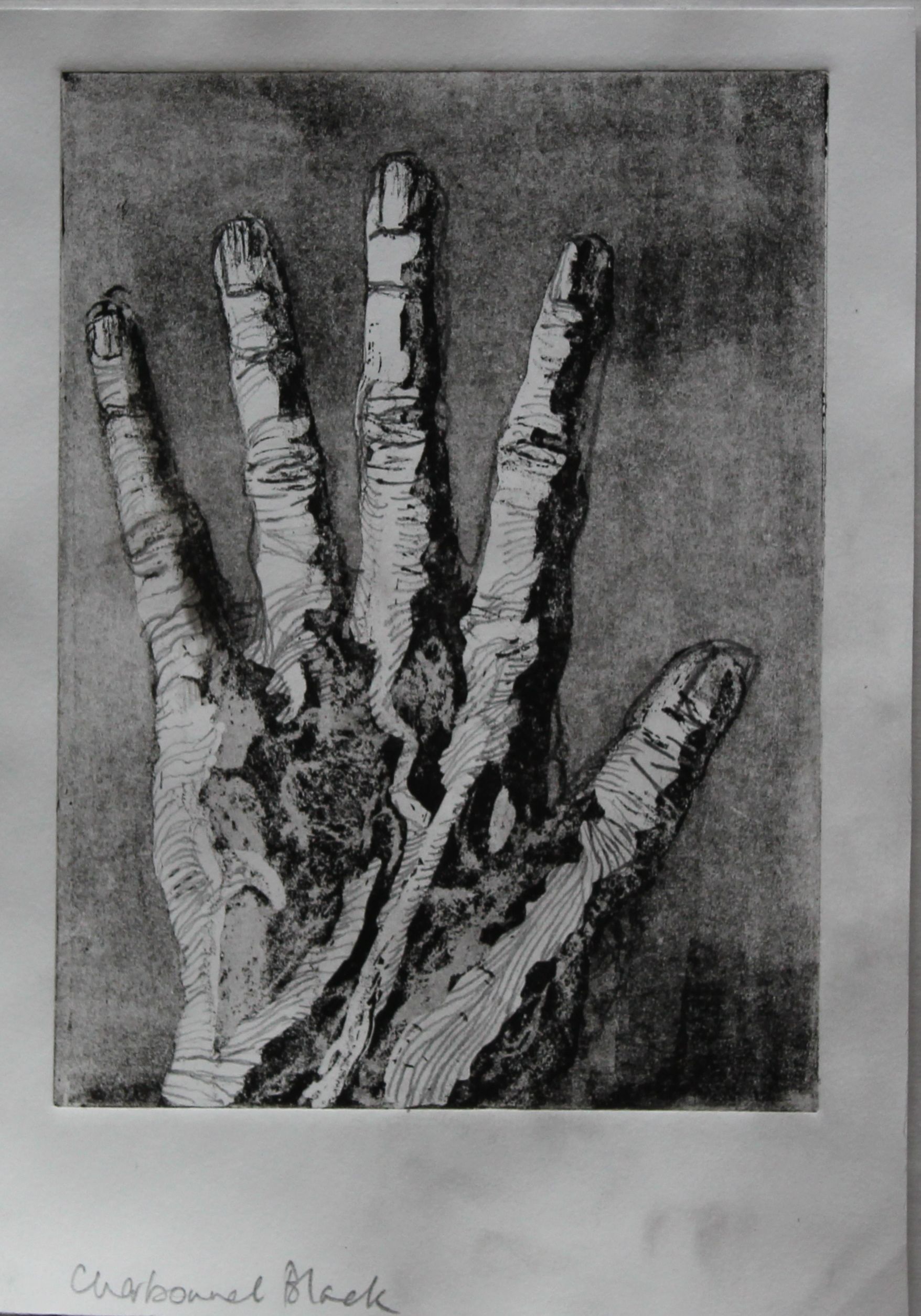
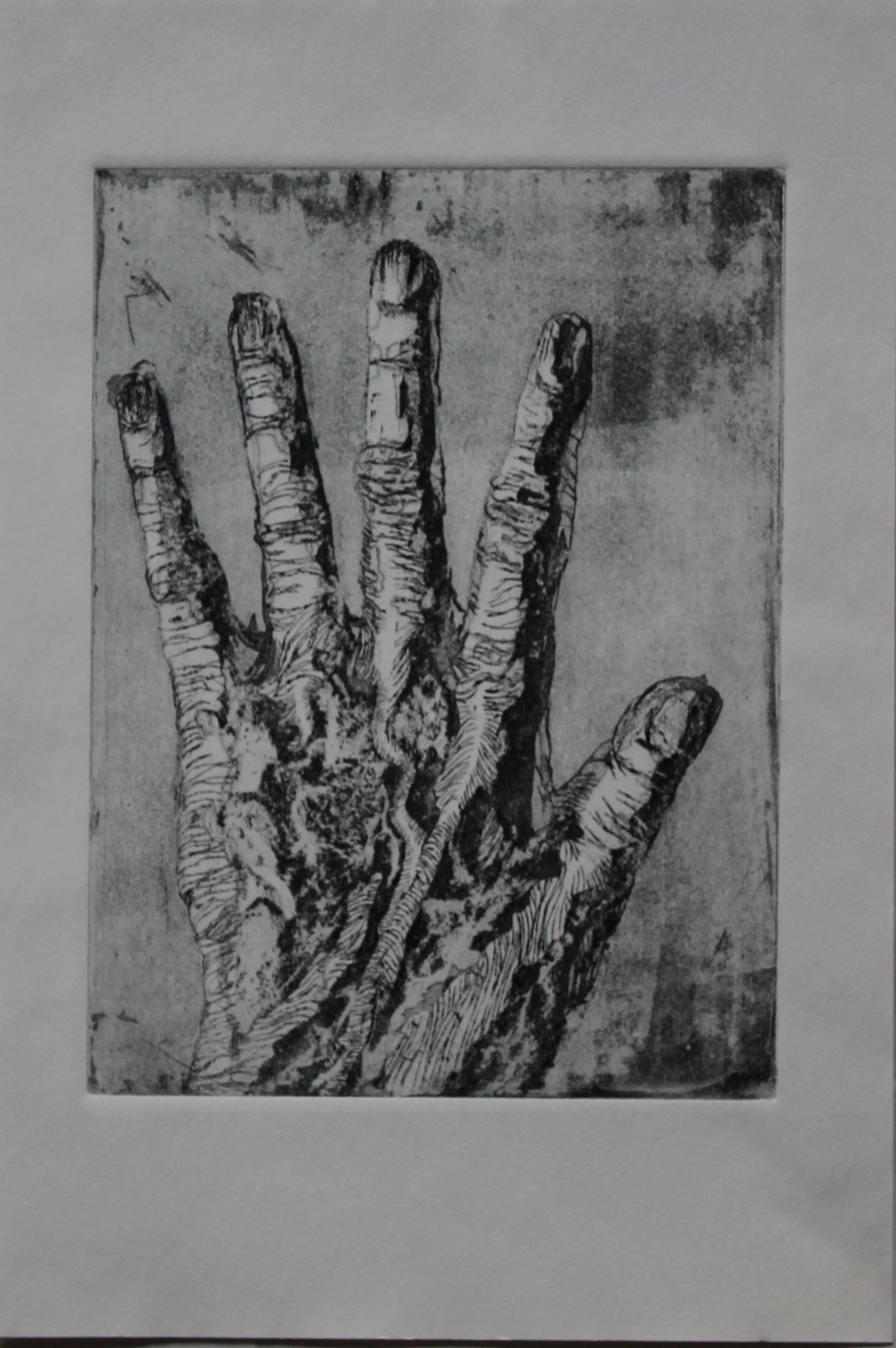
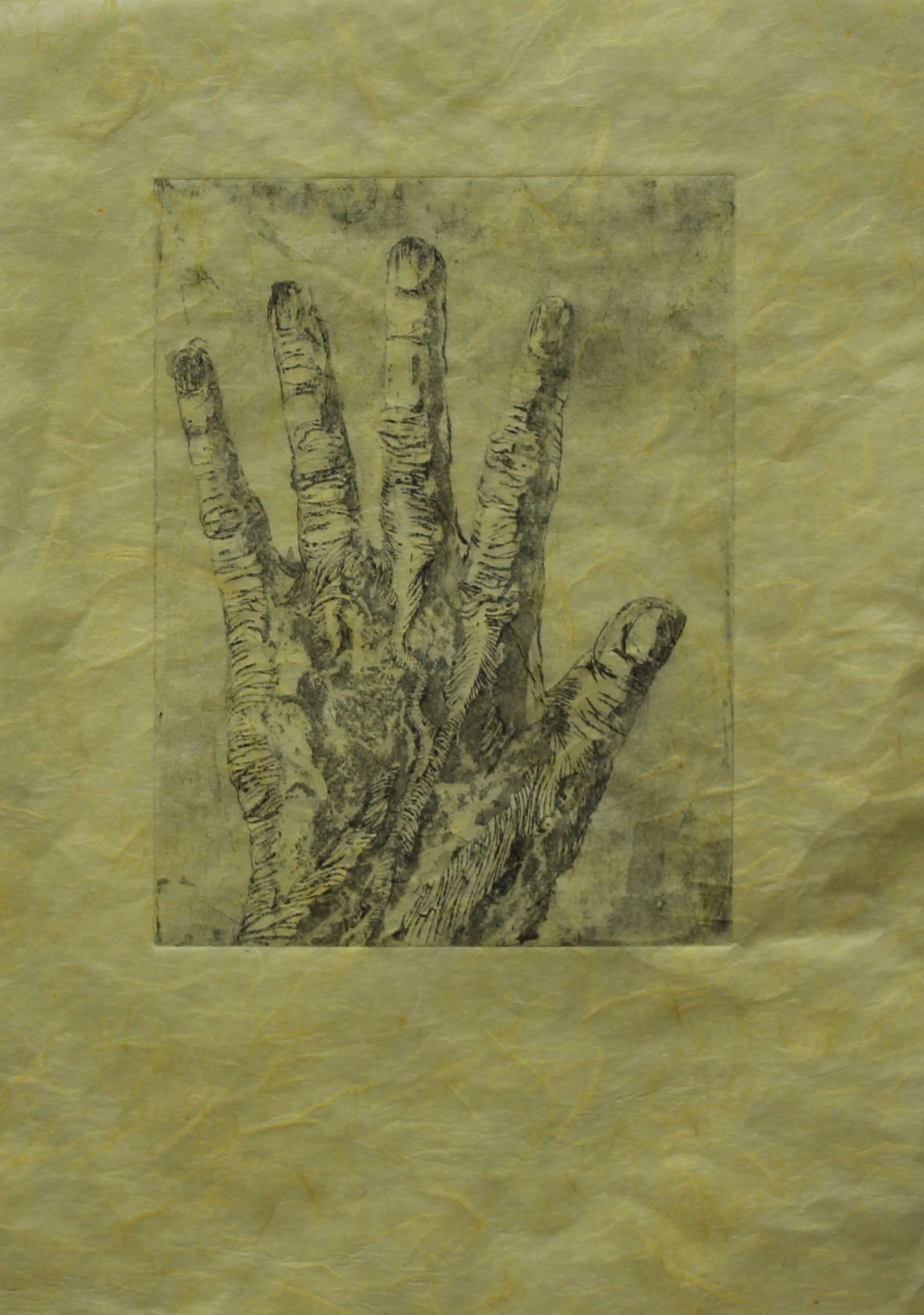
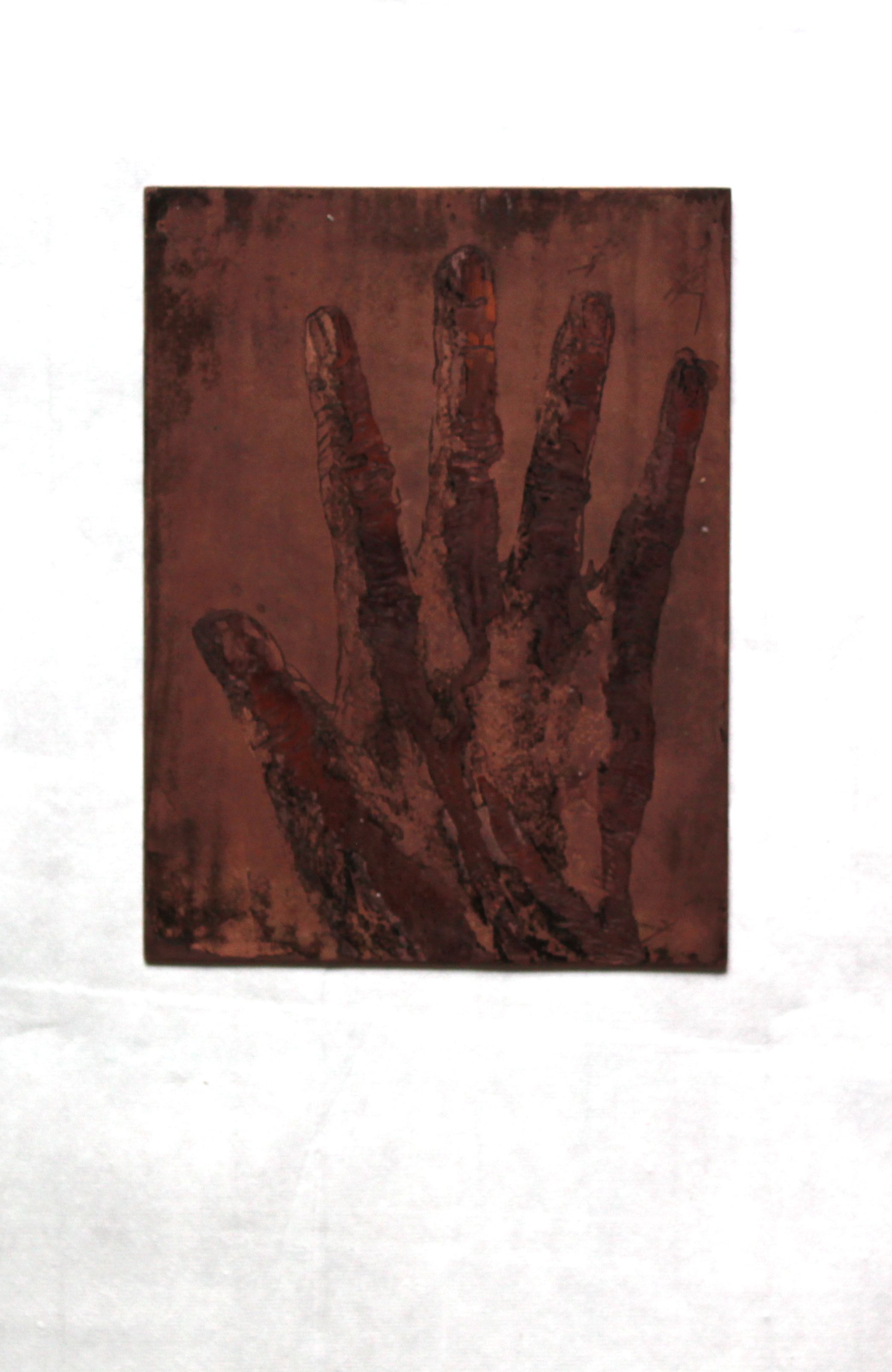
For this next project, I wanted to try to create an image of a hand- also inspired by the 19th century photo.

I drew my own one, and planned a series of steps:

  1. Stop out acrylic marker for whites
  2. Aquatint layer
  3. 3 sets of greys: 30 seconds, 1 minute (for the background) and 3 minutes exposure
  4. Soft lines/ shadows on soft ground
  5. Fine lines on hard ground (Lascaux)


IMG_3707

IMG_3722

I photographed with lateral light:

IMG_3643

The final version came out very hard though, because the acrylic liner gives very hard edges. I thought the subsequent layers would work to break them down, but they stayed quite hard. This is the version with the plan for the hard lines.

IMG_3708

It ended up rather scary, considering it was my own hand. It looks flayed, and I somehow lost the greys.


IMG_3714

I tried to compensate for the hardness by printing on soft paper again. I need to do a monoprint or something to tone down all the lines, and the hard edges of white. How could I have reversed that during the etch?
IMG_3712

IMG_3715


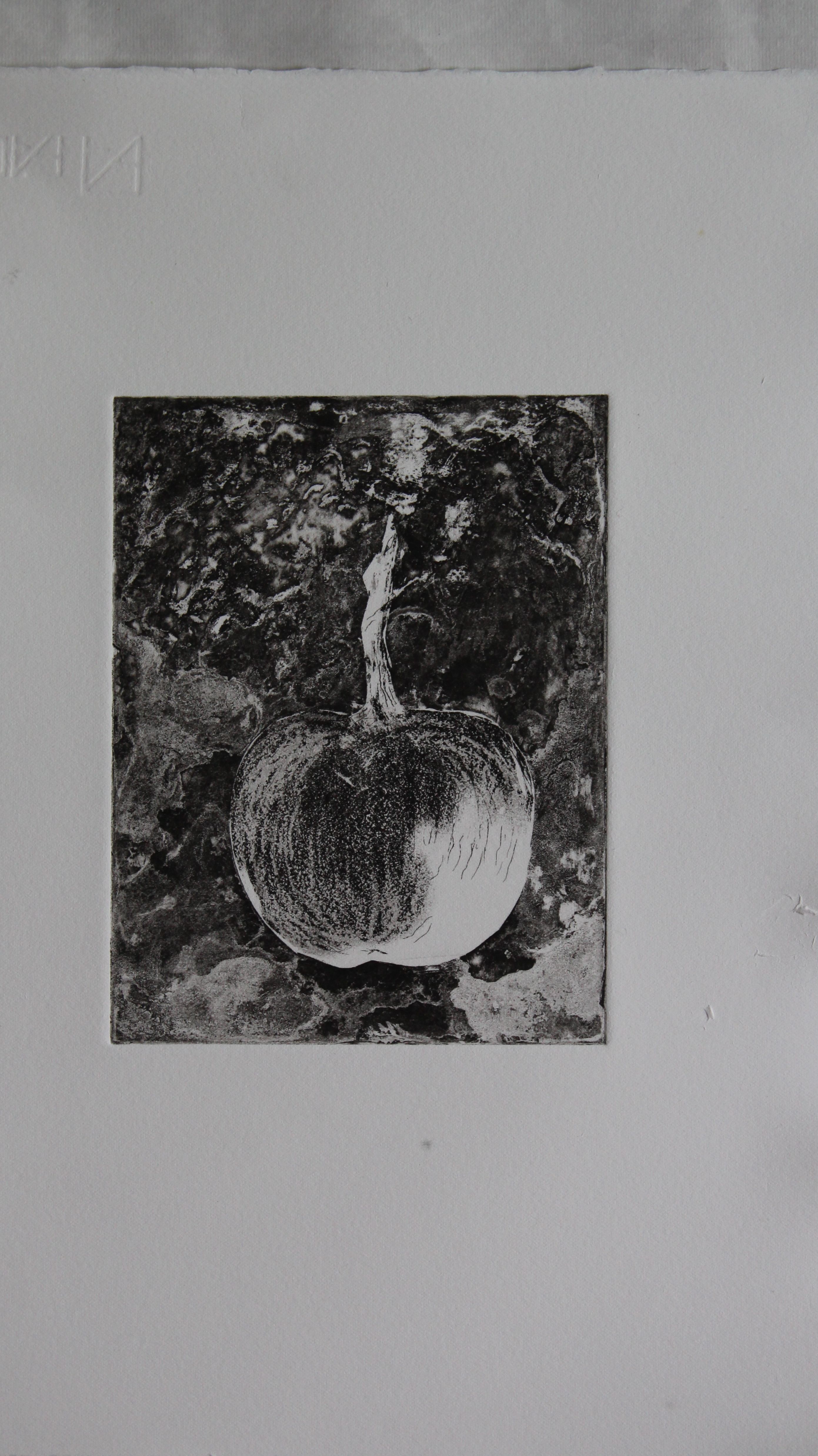
Assignment 3: Chiaroscuro: Newton’s apple series 2: copper plate etching

Assignment 3

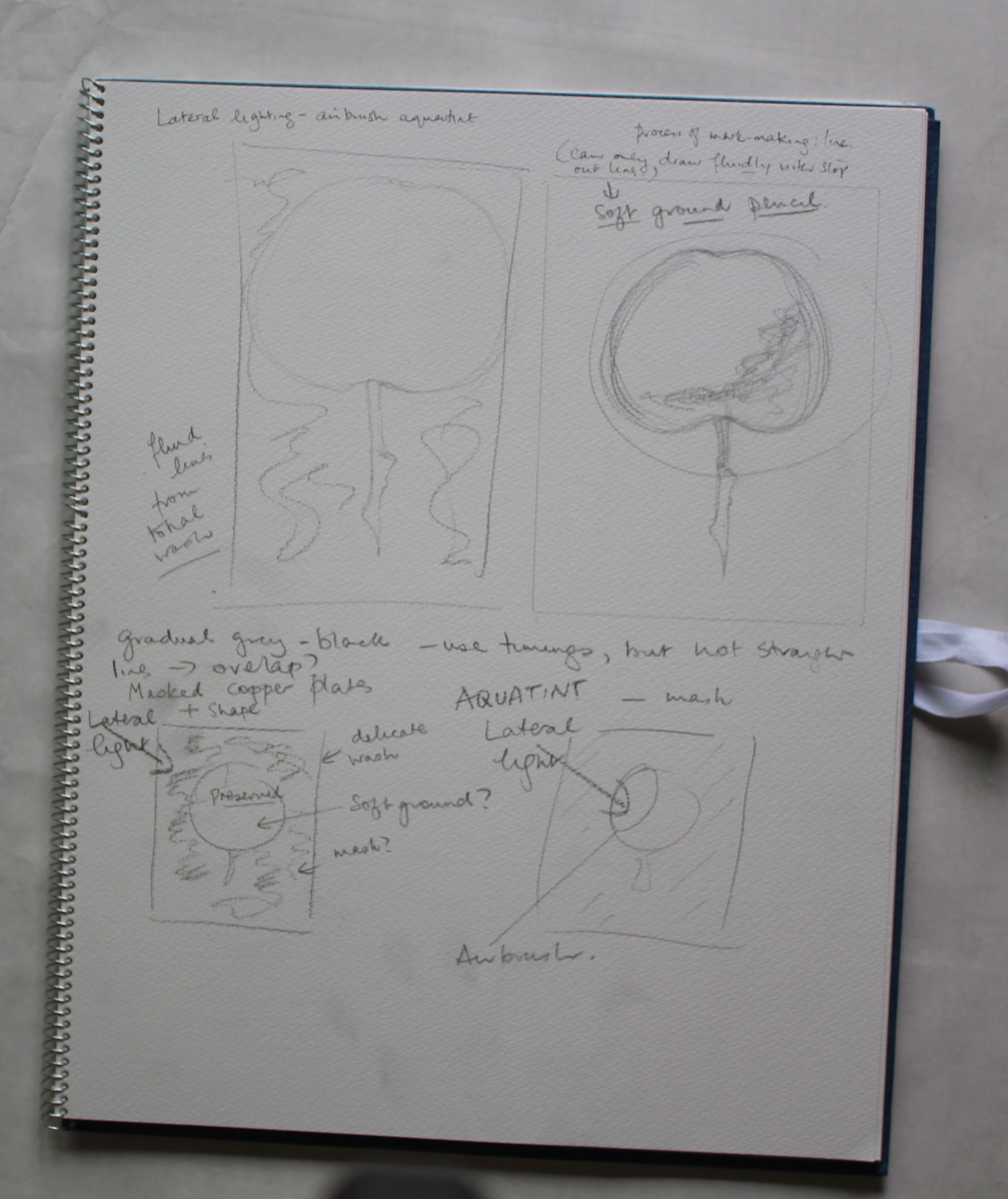
The monoprints and drypoint were ok, but it was time to use my new materials, and plan an image using multiple techniques of engraving. I sketched my ideas, and wrote a list to follow, as it’s hardly intuitive yet.
IMG_3724

IMG_3723

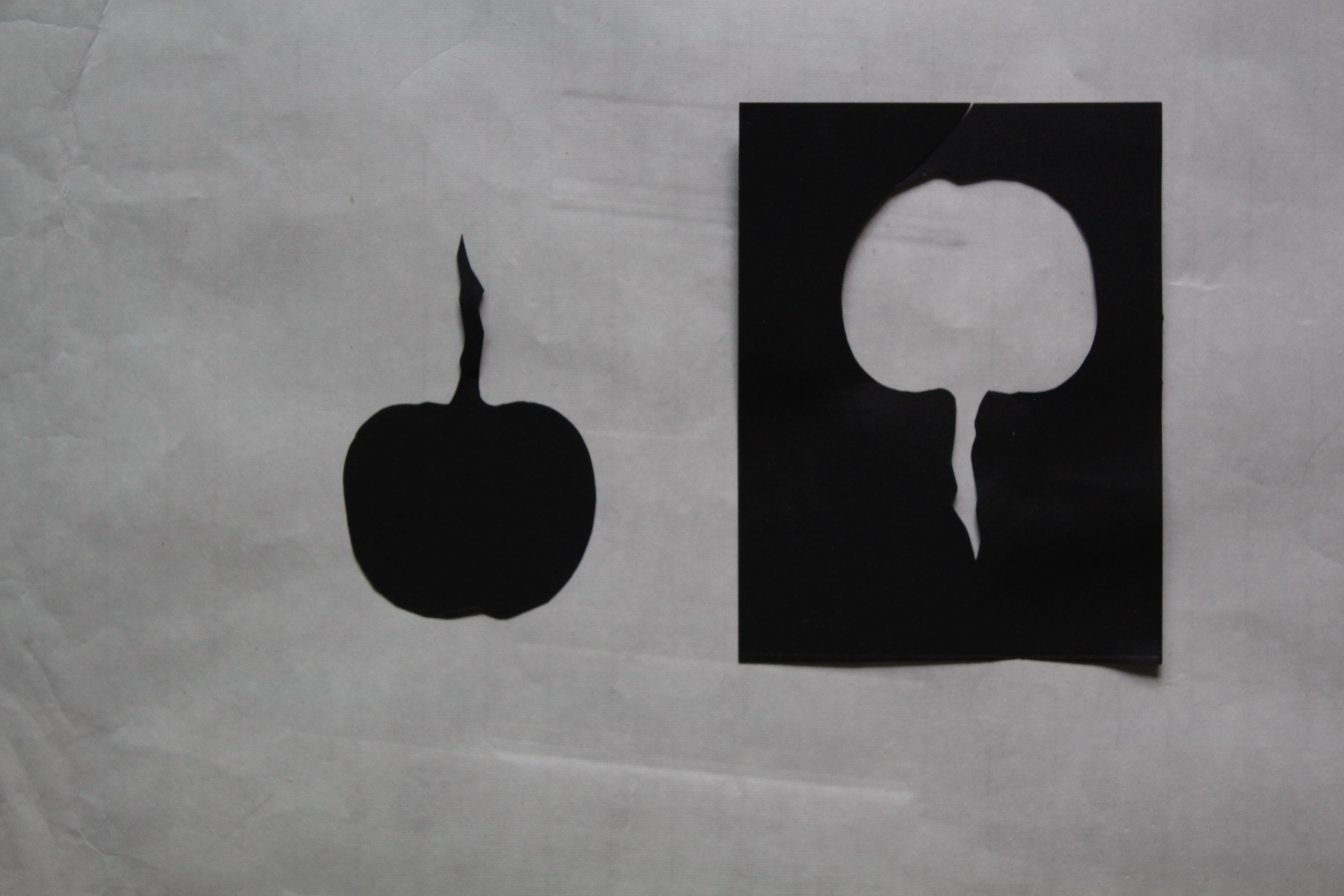
This would involve masking- again, using photopolymer. I decided to make two parallel images, using the positive and the negative mask.

Here are the cut masks ready for sun exposure of laminated copper plates.

IMG_3725

The lamination, exposure and developing all went well. The delicacy of the laminate was demonstrated when I realised that the tiny cut I had made into the black paper in order to start the shape was exposed- a tiny sliver of fixed polymer. It was ok, some caustic soda on a cotton bud removed it.

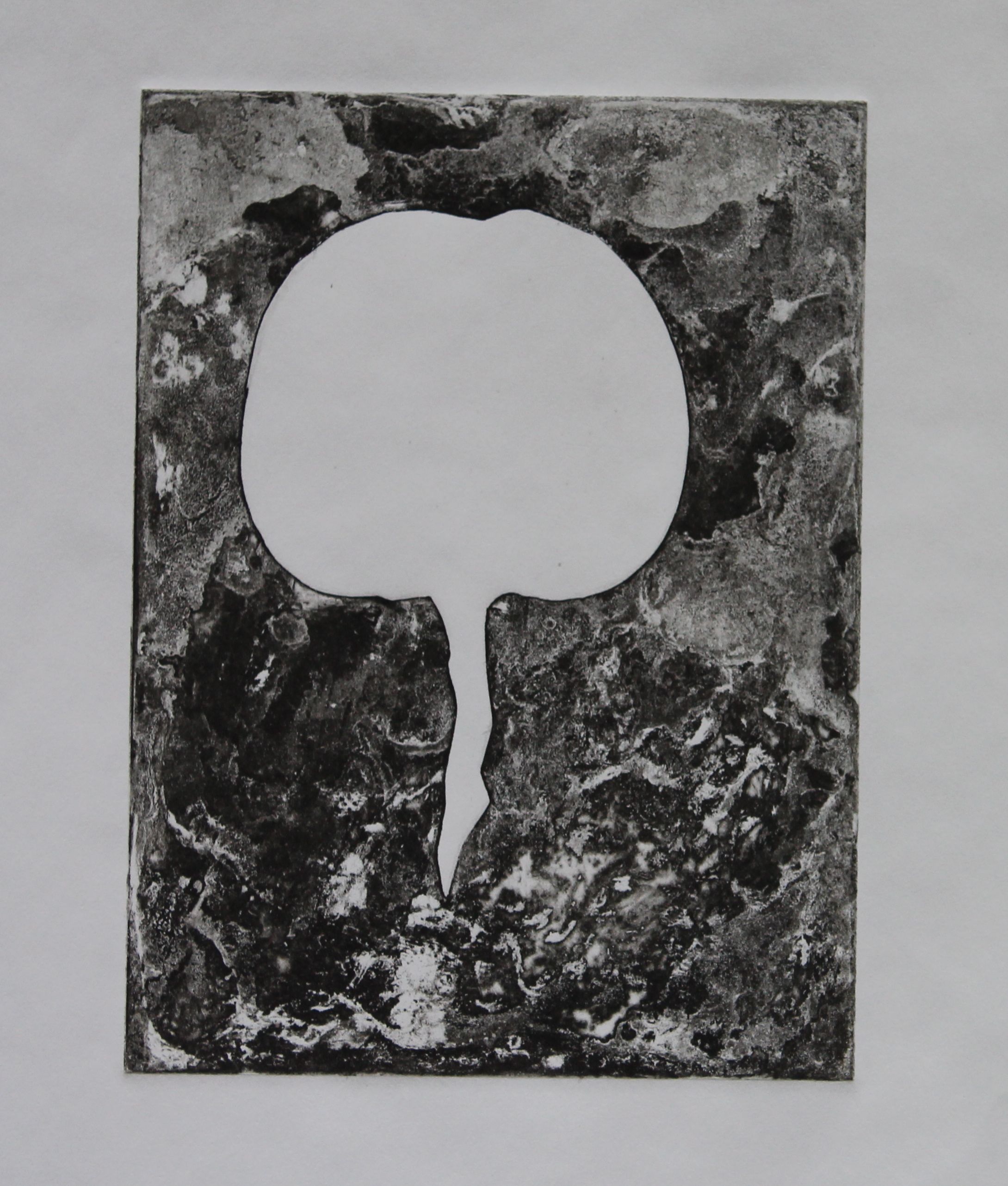
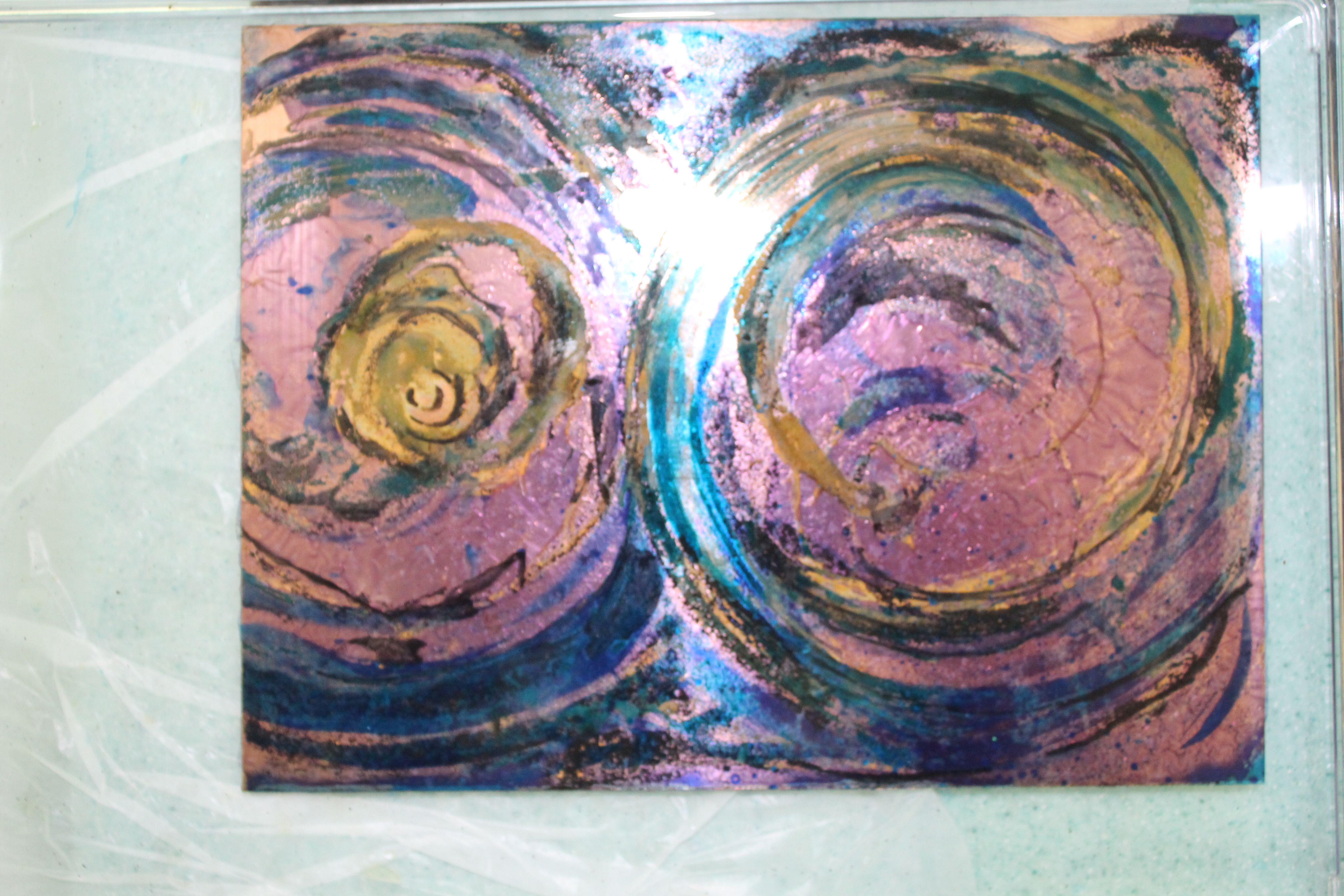
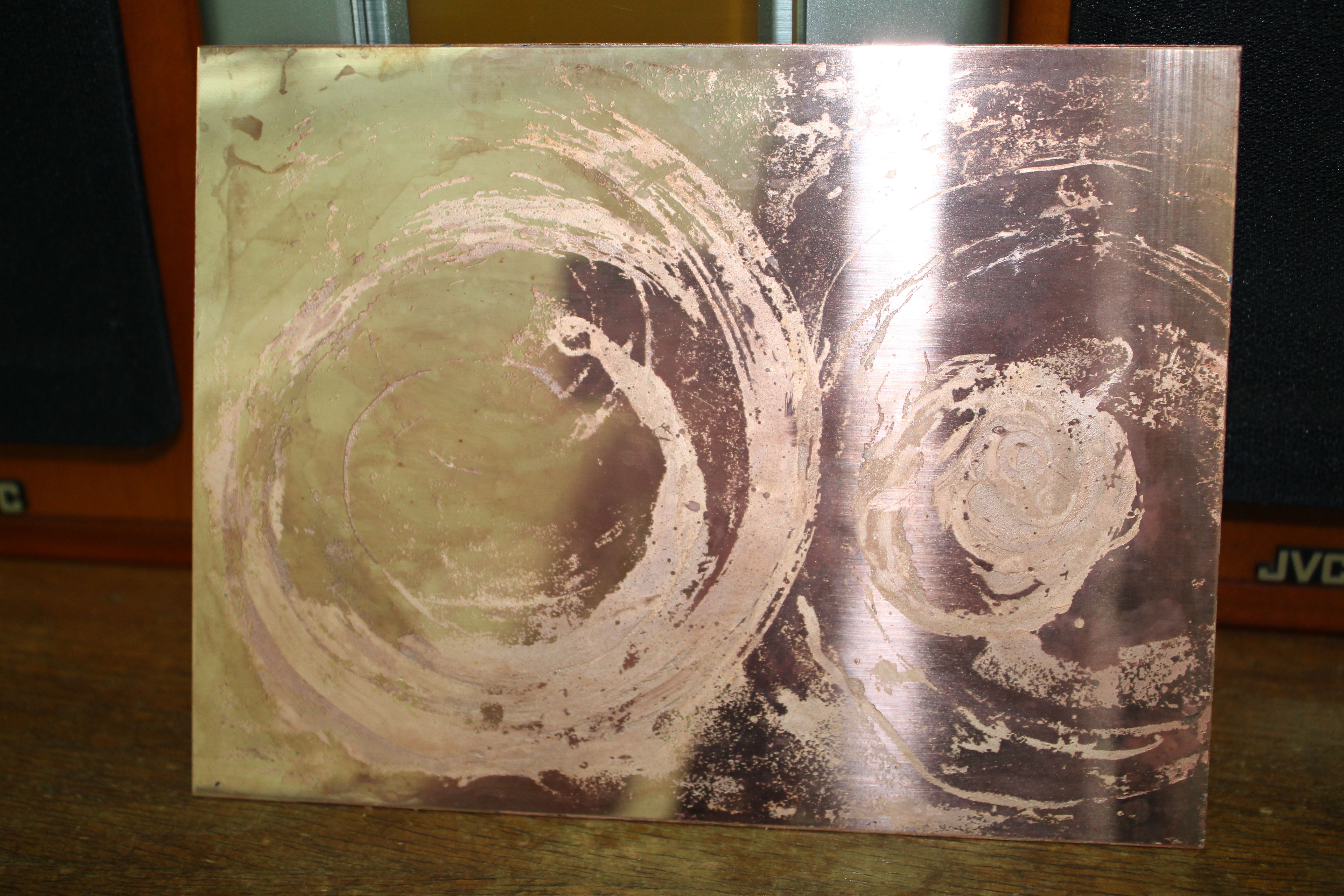
I now had two plates, a negative and a positive apple shape. I started with the negative. I was very keen to try a “tonal wash” which I had a recipe for from Capileira- it involved using a mixture of Graphic Chemical black ink with  high level of pigment, and demineralised water. The two could be moved around on the surface of the plate, and the pigment would be released and will dissolve, forming a surface with a variety of tones and grains, which would substitute for an aquatint layer. It was a technique that could be controlled, ink wiped off with brushes, and redone until it was good. This was the result. I like the swirling patterns: they make me think of the dawn of the universe.
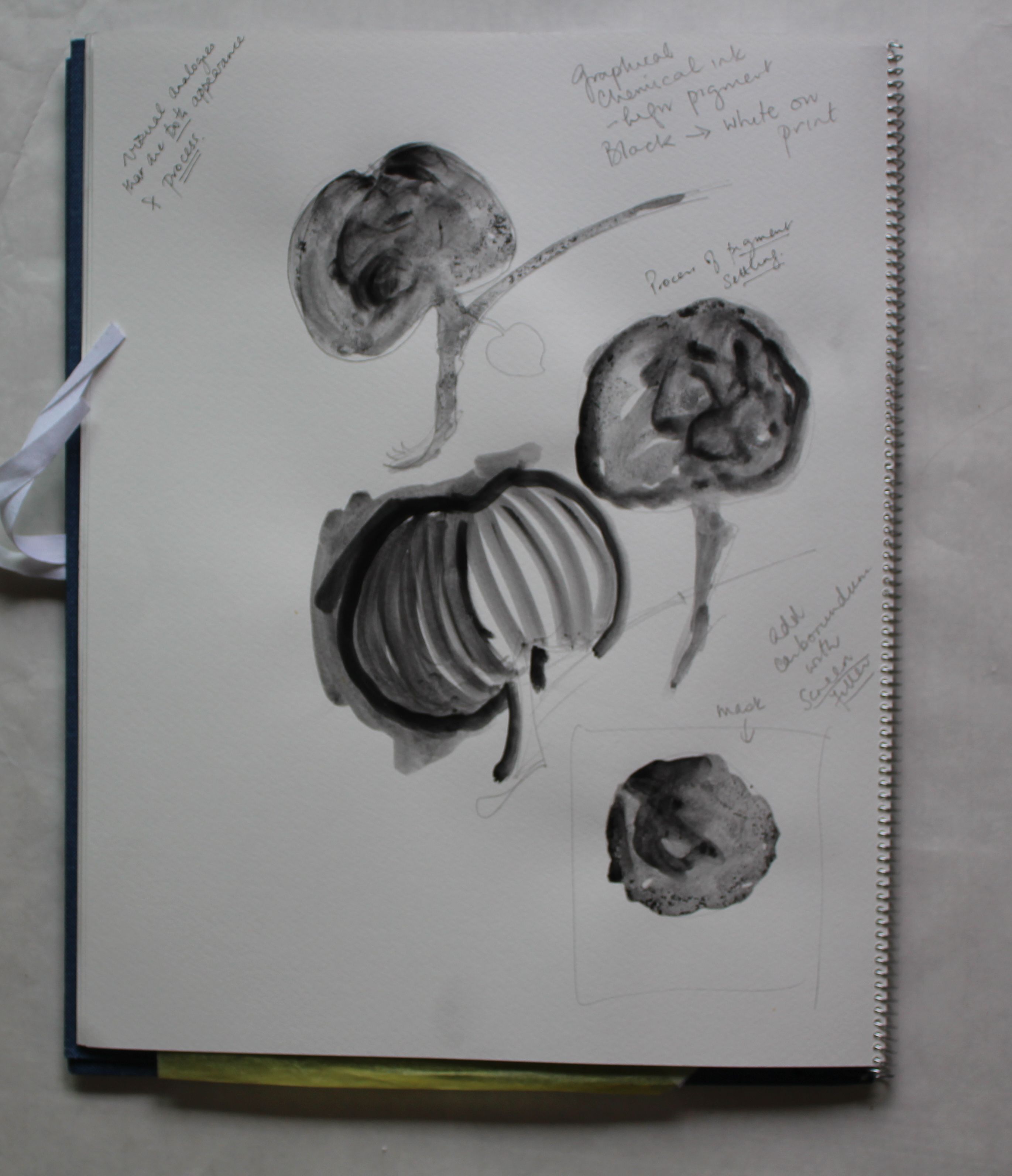
IMG_3728

I liked it and decided to use the same technique on the other plate. Having done one, this was now relatively easy, and simple. I etched them for 18 minutes. The unexpected thing here was that the hardened photopolymer was hard to remove, and small dots remained on the plate that I could not remove with caustic soda.  In fact, they work quite well, as otherwise this is quite a simple image. Now they suggest stars, adding to the sense of this shape being a world.


IMG_3739

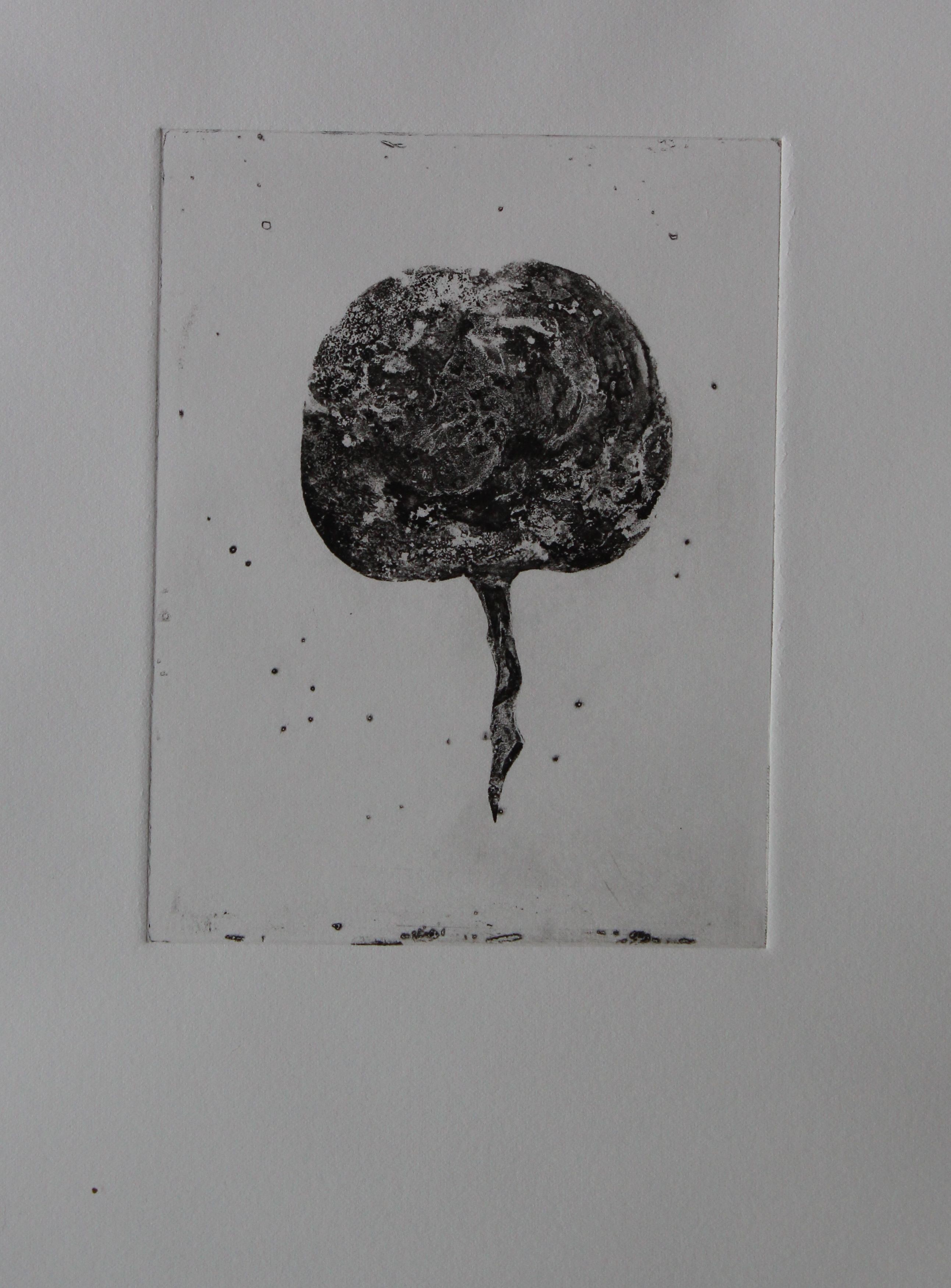
Now back to the other plate. I removed the photopolymer successfully with caustic, and made an aquatint layer with an airbrush and acrylic – concentrating a dense spray on the highlighted part of the shape. The background now had to be stopped out, which I did by painting a layer of acrylic ink- also making a fine line on the apple, to create a thin highlight. The shading was done using a wax crayon- two layers of dark and light grey, and sharp lines engraved with a needle. The stop-out ink was hard to remove from the background though, and I wonder if this could have been done differently.


IMG_3738

Evaluation:

The background of this one may be too busy, and too dark- going back to the original photo, the grey background rally set off the contoured apple.