http://www.tate.org.uk/whats-on/tate-britain/exhibition/conceptual-art-britain-1964-1979
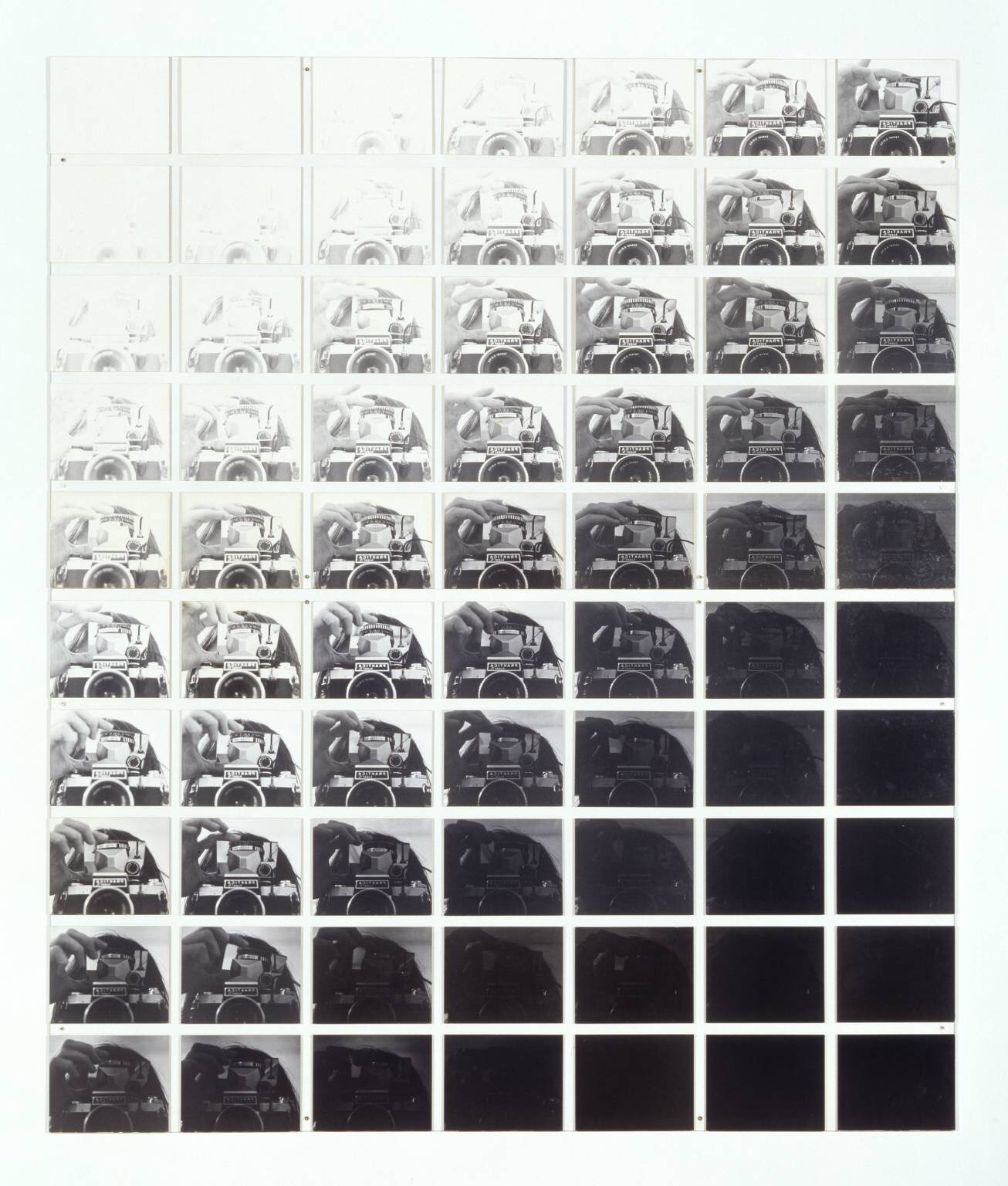
John Hillard
Camera Recording its Own Condition (7 Apertures, 10 Speeds, 2 Mirrors) 1971
Honestly, a lot of this was hard-going, as room after room of typewritten print, after a visit to the rest of Tate Britain, was rather exhausting, (and probably not the way to do it, although it had been my conscious decision at first that this was precisely the way to do it..) Challenging established ideas, questioning what art is, all great, but the works in themselves are often tedious.
The artists were preoccupied with truth and verisimilitude while acknowledging the impossibility of such an act of appropriation of “reality”. I liked the works where this was expressed succinctly, such as in the image above, where the camera itself becomes the object, and exists differently according to its physical settings, while it also functions to communicate different versions of itself. As an expression of both the multiplicity of meanings and of the instability of meaning making, this piece speaks highly effectively.
Visually, of course, it resonated with me and my work on images of my mother on cloth, in a matrix of multiple versions, although the similarity ends there. Hillard, like many of the other artists on display here, is intent on recording the context of production in detail, making the link to the contextualised nature of text. Mine is a softer approach, materially and emotionally, more akin to the blurring of impressions over time, and more personal, expressing an emotional need to hold onto memories in whatever distorted state.
 Christine Bruce