Mona Hatoum – Exhibition at Tate Modern | Tate

Research

http://www.tate.org.uk/whats-on/tate-modern/exhibition/mona-hatoum

I spent time in London and got a chance to visit some galleries, and this was my favourite exhibition.

I loved the visceral, tactile nature of Hatoum’s work, the way everyday domestic objects were repurposed to create visual effects of patterns and geometries, and to evoke powerful emotions, often fear and threat. The best though were the most abstract. The black cube first encountered on entering the gallery was just demanding to be touched, as it seemed to be made of hair, or something soft and organic,  but was actually iron filings. It was mysterious, other worldly, and looked like a scale model of the Kaaba.

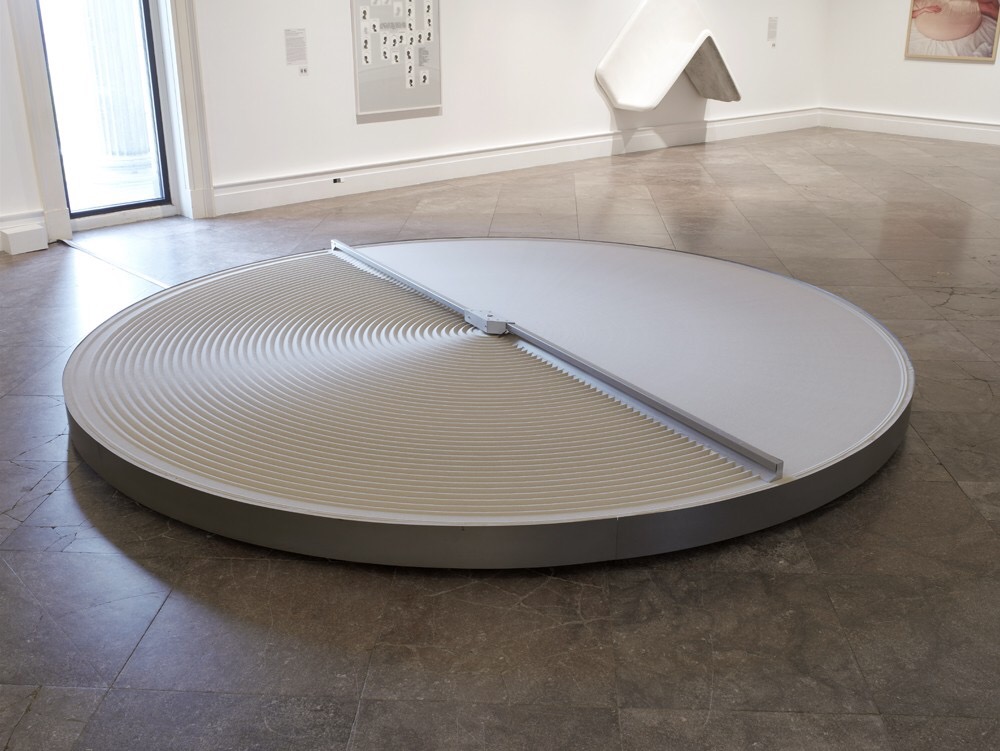
My favourite piece of all though was + and -, a large circle of sand with a mechanical rotating arm, one side of which raked the sand, the other smoothed it. It was a paradox in motion, marking and erasing, doing and undoing,  a continuous cycle, and hypnotic in its effect.

  
Edited:

Kate MccGwire mentioned Hatoum as an influence, as she relates to the “intricate and repetitive” nature of the process of making. I found that this resonated with me, and describes a lot of the work that I admire, such as Xu Bing, Agnes Martin.

Conceptual Art in Britain 1964–1979 – Exhibition at Tate Britain | Tate

Uncategorized

http://www.tate.org.uk/whats-on/tate-britain/exhibition/conceptual-art-britain-1964-1979


John Hillard 

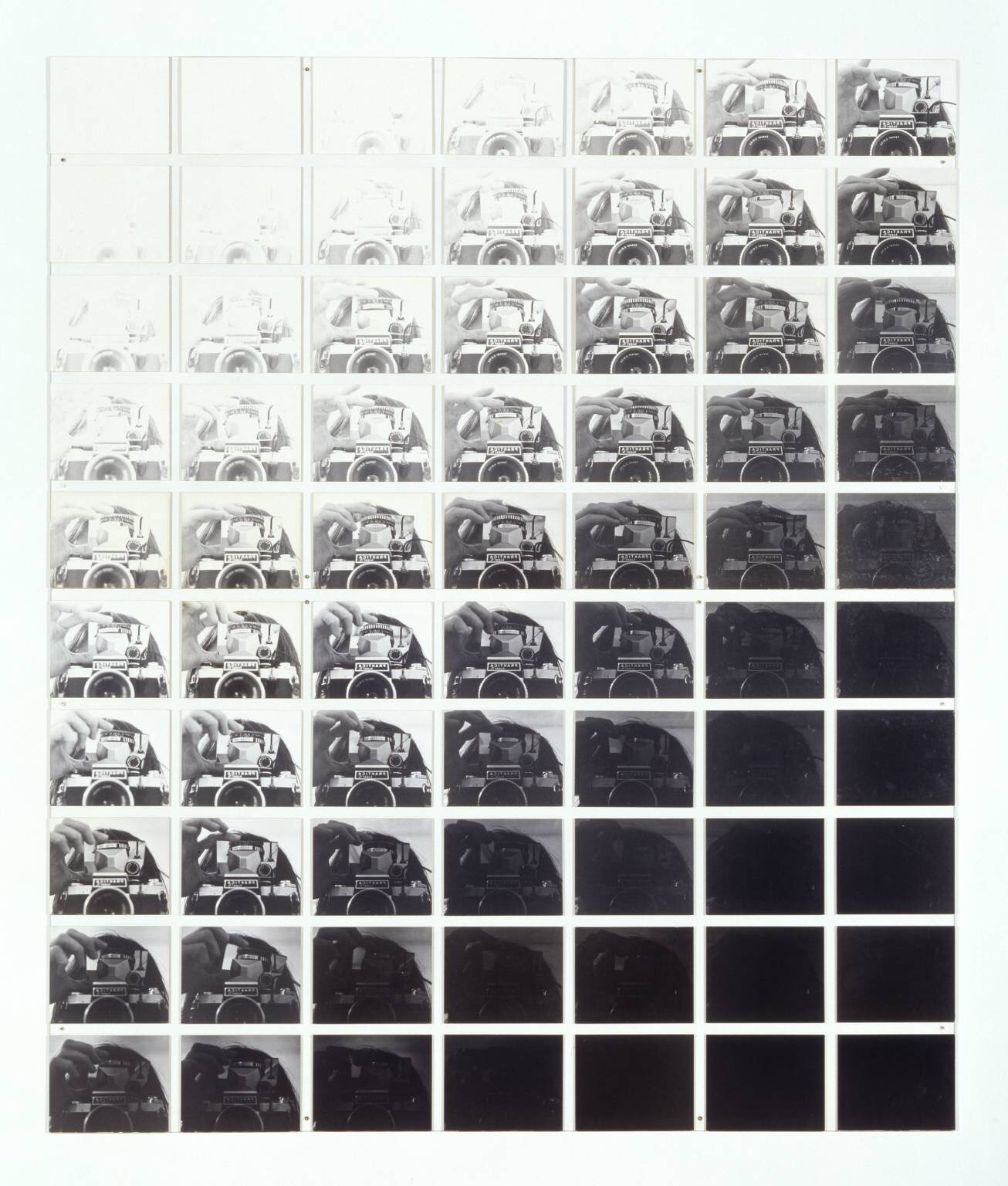
Camera Recording its Own Condition (7 Apertures, 10 Speeds, 2 Mirrors) 1971

Honestly, a lot of this was hard-going, as room after room of typewritten print, after a visit to the rest of Tate Britain, was rather exhausting, (and probably not the way to do it, although it had been my conscious decision at first that this was precisely the way to do it..)  Challenging established ideas, questioning what art is, all great, but the works in themselves are often tedious. 

The artists were preoccupied with truth and verisimilitude while acknowledging the impossibility of such an act of appropriation of “reality”. I liked the works where this was expressed succinctly, such as in the image above, where the camera itself becomes the object, and exists differently according to its physical settings, while it also functions to communicate different versions of itself. As an expression of both the multiplicity of meanings and of the instability of meaning making, this piece speaks highly effectively. 

Visually, of course, it resonated with me and my work on images of my mother on cloth, in a matrix of multiple versions, although the similarity ends there. Hillard, like many of the other artists on display here, is intent on recording the context of production in detail, making the link to the contextualised nature of text. Mine is a softer approach, materially and emotionally, more akin to the blurring of impressions over time, and more personal, expressing an emotional need to hold onto memories in whatever distorted state. 

Bankside Gallery: Sally McLaren: In Search of Stillness

Research

http://www.banksidegallery.com/exhibitions/144

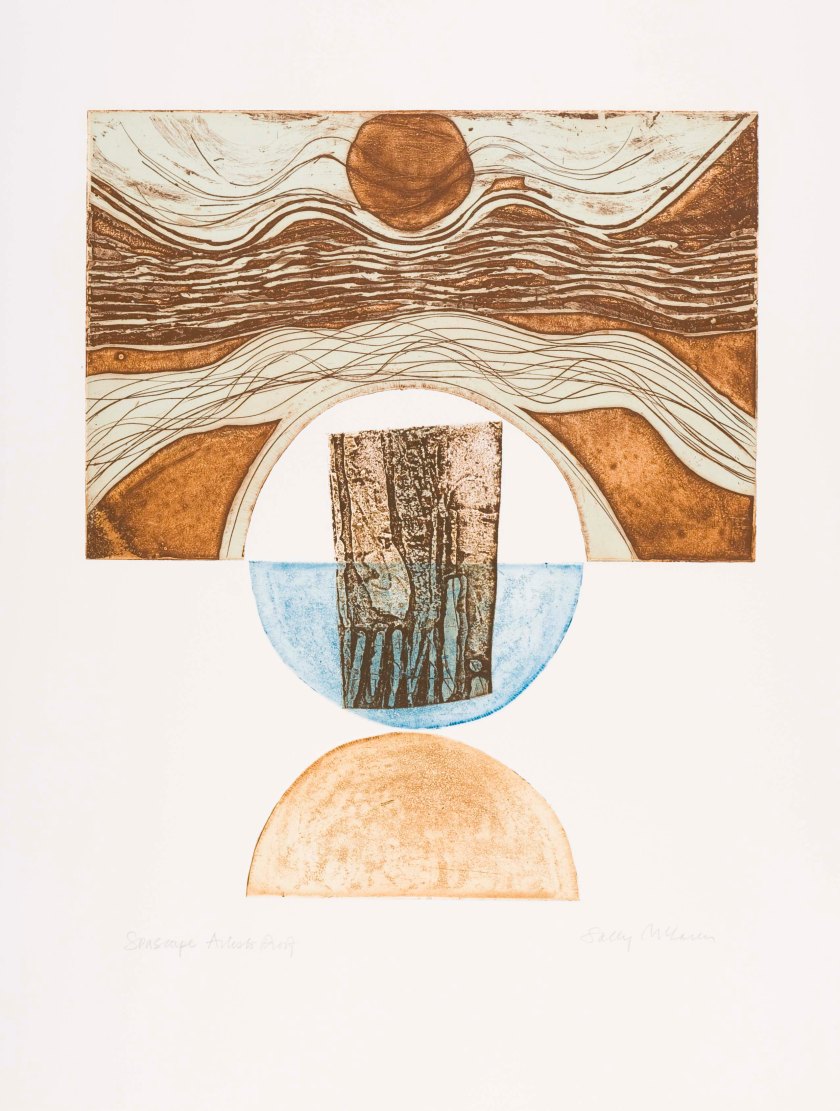
This was a lovely exhibition, including prints which have really inspired me to go and try collographs. I particularly liked the prints that featured collographs that had been cut into separate shapes, something I tried with my “Greying” series. McLaren’s images are semi-abstract landscapes, and the collograph technique gives them unique textures. McLaren studied printmaking under Stanley Hayter.

img_0324

There was no information on the techniques, but this looks like a combination of collograph, drypoint  or perhaps lithograph… I think I can try it with gel and drypoint on Perspex.

Her painted landscapes remind me a little of Richard Diebenkorn’s, but they’re softer, more lyrical, with their glowing colours and painterly marks. She also uses mono printing and drypoint techniques in a minimalist way, on a large scale.

Besides that, the colours and the subject matter were calming and meditative. I enjoyed this one very much  (and appreciated the gallery shop too, which had a brilliant selection of books on printmaking).


Assignment 4: Portrait Post script

Assignment 4, Uncategorized
2016-07-15 01.34.49

Nature Morte


Boltanski (Modern Art Oxford, 2014)postulated that you could create a person’s identity from their belongings, an idea that underlay his exhibition of photos of belongings in “Inventory of objects belonging to a young man of Oxford” in which he displayed museum-like collections of photos, which could be a way of exploring the sense of presence and absence.

I’m now living with lots of my mother’s possessions here in my house. Similarly there is a sense of presence and absence.  I thought about using some of the objects to create a still life in a historical, nostalgic style.

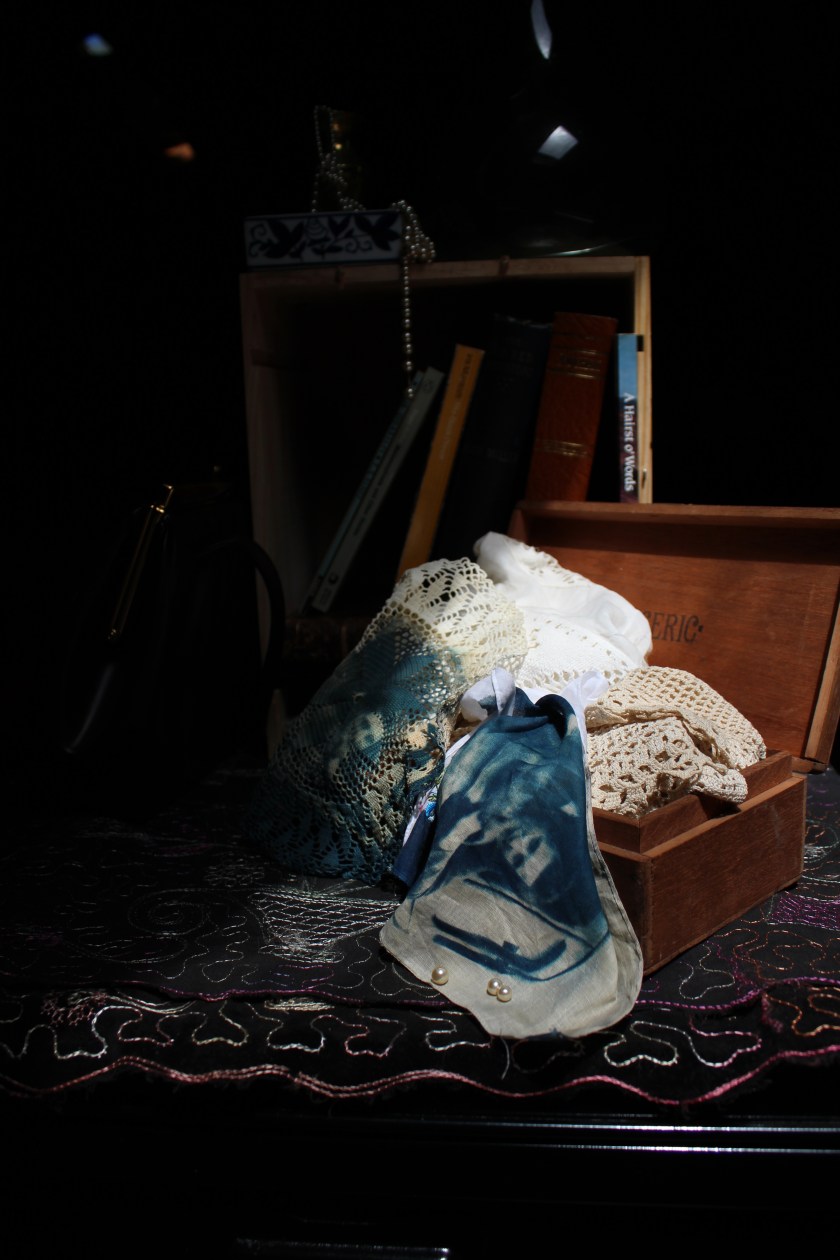
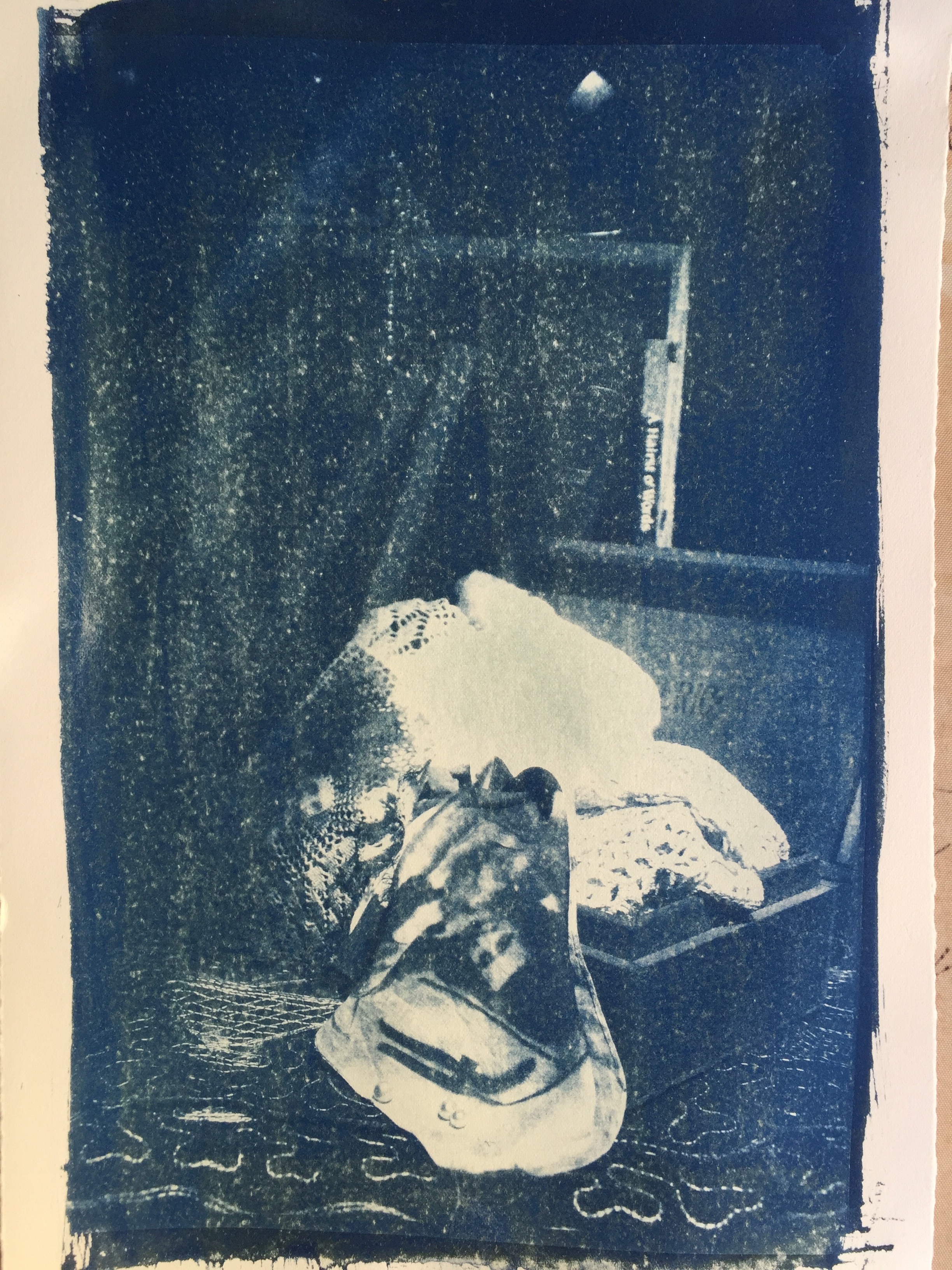
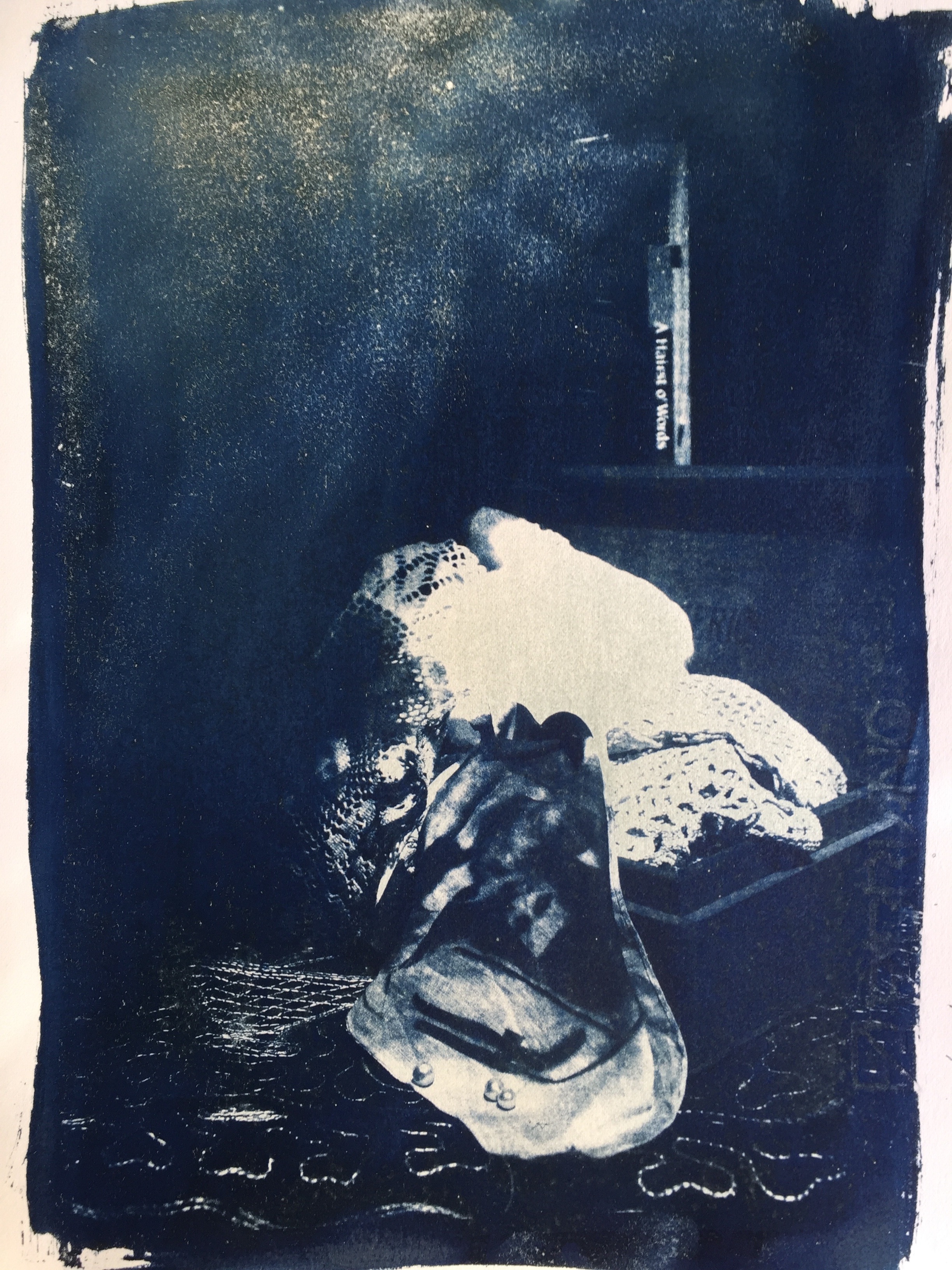
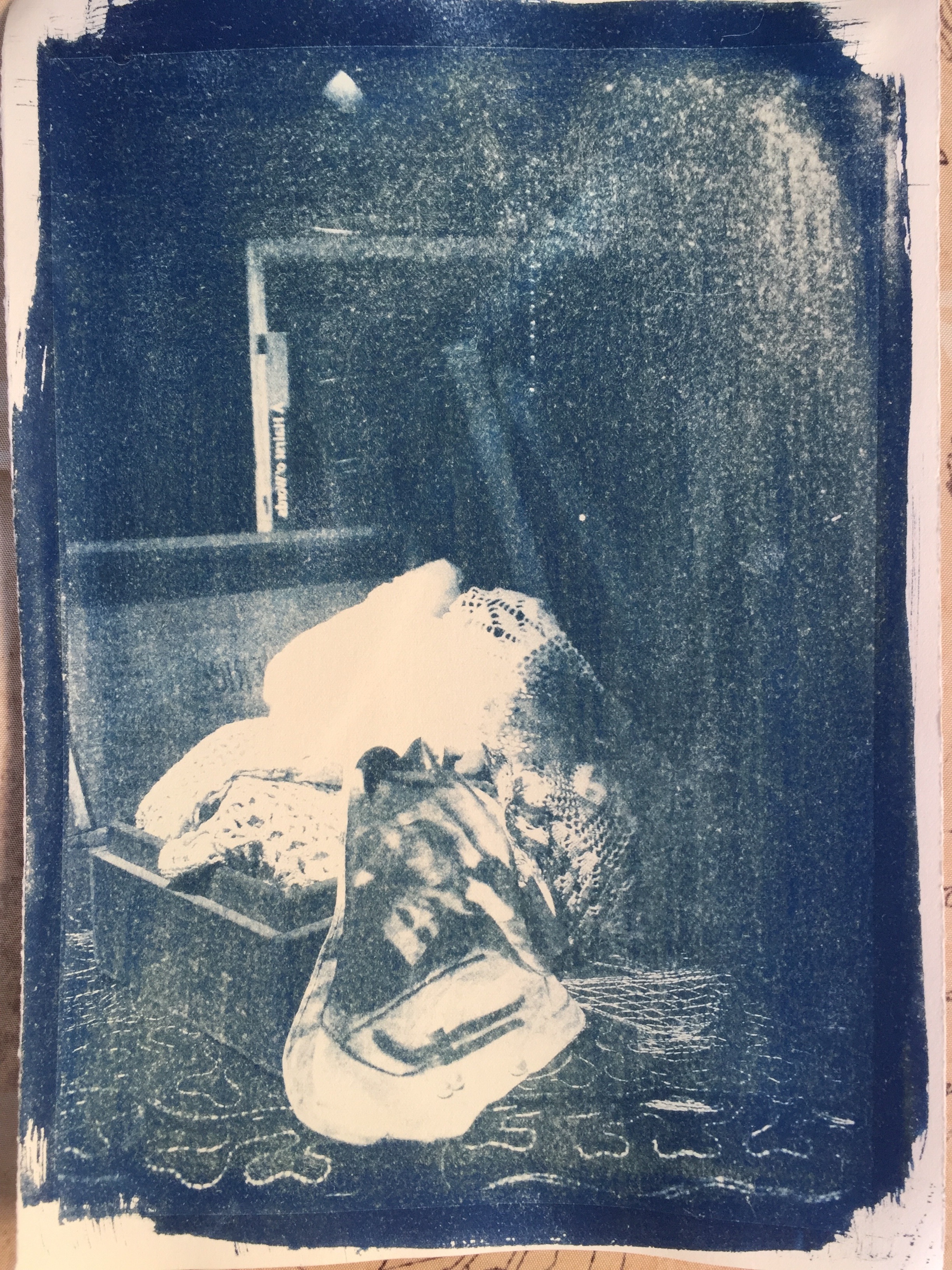
I decided to try putting cyanotype images on other materials- I tried a few items, but they all proved more or less impermeable, but it worked with a handkerchief and a hand crocheted doily. These are old, antique, materials, of significance in themselves, now being stamped with an identity. I arranged these in a still life, trying to arrange the light so as to achieve depth from the chiaroscuro effects. The still life was composed of books from my mother’s collection, and one from mine, TS Eliot, Four Quartets. A handbag, a broken string of pearls from my brother’s wedding, an antique glass vase, a small brass container, a wooden box which she had used to keep my father’s papers in, and a collection of my grandmother’s lace. The effect is of a Victorian photograph, and resonates a feeling of a dusty unvisited room, relics, memorialising as an art form. Without this stamp, this is an ordinary object that is only recognisable to me. By placing an image on it, it becomes clear that this is some kind of object of reverence, stamped with an identity, and evocative of a presence. I’m thinking of Tennyson’s poem, In Memoriam, in which the weight of memory is overpowering, and the stillness of the present is palpable, making it hard to move forward. That makes it become fetishistic, perhaps.

It is a still life, but “nature morte” is a more chilling title. The images of my mother are now entirely objectified. She is imaged on handworked textiles, with objects that recall days gone by, as if to freeze her in a time and set of values.

What I want to portray with this image is an acknowledgement of their “museum” artefact status, and even, going beyond that into perhaps an unhealthy obsession, a fetish.What the practice hints at is the idea of the artists as a collector or curator of images, rather than a creator, acknowledging the impossibility of creating anything new in our multi-referential world. The art I make is a reflection of my culture and experience, holding up a mirror to what I value, and revealing, in my composition, my interpretations and priorities.  The fact that this is a self-consciously staged picture, a tableau, the pearls carefully placed, the box artfully open and the textiles seeming to fall out, the images posed, all entirely unnatural, further acknowledges the fact.


To extend this, and further create a “museum-like” feel, these are cyanotypes based on the above. I need to consider the paper used- this is Fabriano, and it’s too grainy, maybe with sizing that reacts chemically. The negatives are not sharp enough either. Perhaps this needs an exposure unit with a vacuum.


imageimageimage

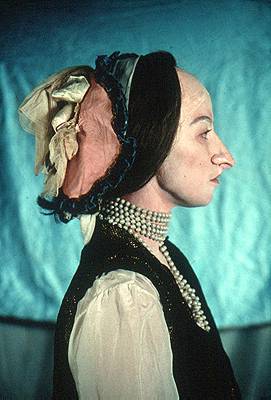
I am thinking of Cindy Sherman and her staged tableau self-portraits, in which the artifice is clear, and seems to parody a particular genre, below, the Elizabethan oil-painted portrait,  stressing the profile, the genetic identification of that nose and high brow, the status of the sitter, the textures of her clothes and jewellery, the pose, not making eye contact, but having the look of being looked at.

CindySherman-Untitled-211-1990

Cindy Sherman Untitled 1990


Reference:

Click to access CHRISTIAN-BOLTANSKI-exhibition-notes.pdf


Assignment 4: Reflective Commentary

Assignment 4, Reflective Commentary

In this assignment, I have been facing up to difficult subject matter, and attempting to deal with it in several ways: to explore photographic images in philosophical terms, to use art and creativity as a way of dealing with difficult emotions and to search for meaning, and to seek resolution to the problems of making that I had in the last assignment.

The outcomes are that I have considered the photograph, specifically of a person,  as a meditation on states of being, and this has led me into reading that has helped with the second issue. In addition, my research into Xu Bing has led me to consider the application of Zen Buddhism as a method and a purpose in art, and this has helped with the third issue too.

The choice of my own mother as the subject clearly ran the risk of being too personal, but I think by the end that the meditation into the photograph as an object, even a “museum object” moved this well into the realms of the general, and I feel that I have “objectified” the image in various ways, and transformed it into pieces that make sense. The objects-  comforting ones, wishes and hopes, memorialisation, also meet my own emotional needs.

Thinking in a zen-like way, to the extent that I am capable of it, is obviously therapeutic when facing loss, but I think the biggest effect of this influence was in my own way of working. I have struggled with photopolymer plates in this assignment, and sometimes wondered why I was bothering: at times I made lots of errors, through rushing, or trying to do too many things at the same time. Because I am now away from school, it is possible to concentrate, to practice and to care about quality. I’m not saying I have achieved that- the Japanese master printmaker I watched at work had been doing the job for 17 years and was still considered a junior –  but I do feel that working more slowly, in a calmer way, not trying too hard, helps  the works emerge. Also, the idea of function played a part here- I tried to think, when making these pieces, what their function would be, rather than seeing them as “pictures”, which suggests decoration. It felt important that they should function in some way- not that they will necessarily be used- but that their purpose is defined. (This is not a statement that everyone would agree with.)

The final images, “Moment in the Sun”, are combinations of image and text. I had tried this earlier with “The image remains”. Any use of text can be problematic, and it’s necessary to question the nature of the text and what it adds. In this case it is a commentary, but I think in the final images it avoids the “telling not showing” that was definitely a weakness of the “image remains” set, with its rather obvious commentary on fading sights and the onset of darkness. The final piece uses text that is much more tangential, much richer in its allusions (it assumes, as Eliot always does, a knowledge of context) and more leading as interpretation of the image. The fact that it is “caught” through exposure to the sun is also fitting the context of the text, and the image, so I felt the process and the form were appropriate.

I now wish to move on to explore the idea of “the rose garden”, inspired by TS Eliot’s Four Quartets. I would like to create a series of images, and explore further the concept of “becoming”, and need to consider appropriate materials, forms and techniques  to express a relationship between concept, form and material. I see this as a fitting summary of the work for the course, as it will start with observation- a rose bush in my garden that I have just planted- and develop into abstraction, and analogical thinking about the rose, with the rich layers of symboli that it comes with.

Assignment 4: Moment in the Sun

Assignment 4

This is going to be my final piece for this assignment, as I feel it is getting to a point where it is segueing into another theme, one I want to explore in the final assignment.

This is still based on the photograph of my mother walking down the street- this is definitely my “Winter Garden” photo (Barthes, Camera Lucida, 1981).  And I think I have come closer to understanding what it is about the image that appeals to me, apart from the space it has left to ponder the nature of photos and portraits, the viewer, the photographer, and the subject.

As I’ve discussed, the photo is a moment both in time and out of it, of a subject both dead and alive, a little time capsule, a museum object, yet in Barthes’ strangely phenomenological terms it is “authentic”, a guarantee of the existence of the subject, and as such it makes the past certain. It is both a product of and a testimony to time. I have been considering these ideas in relation to Zen Buddhist concepts, which often express their opposition to Western dualism in paradoxical phrases which attempt to conjure up flux and singularity, and to deny the importance of space and time. They seem to be very different ways of thinking, but I was rereading TS Eliot’s “Four Quartets” and was struck by the similarity of language, in fact the way that Eliot seems to travel via Eastern religion and philosophy to arrive back at the Judeo-Christian tradition, “and know it for the first time”.

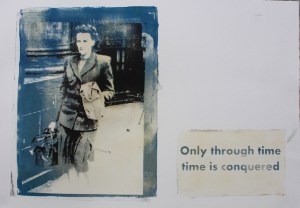
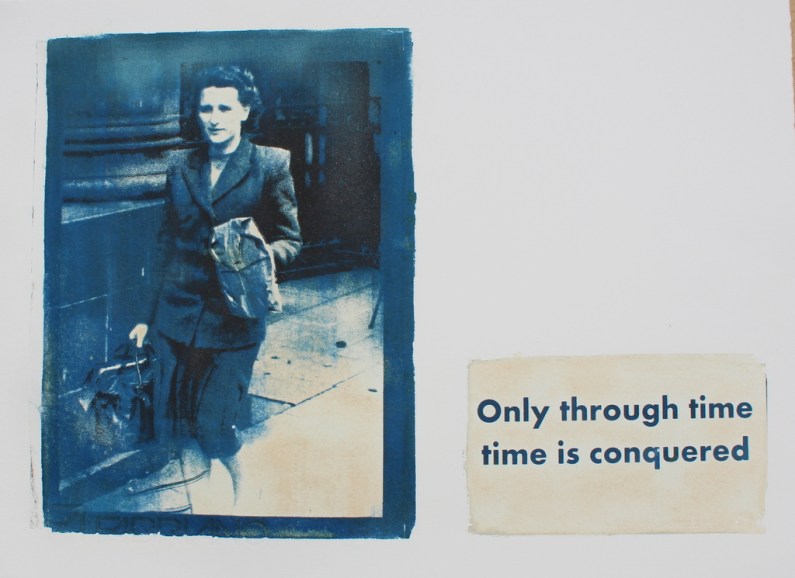
Eliot describes “the moment in the rose garden”, when enlightenment occurs, when past present and future coalesce, when we attain a “little consciousness”: it happens in time, and becomes a memory, although it seems to be a moment out of time. “Only through time time is conquered.” Wordsworth also wrote about “moments in time”, the Romantic experience of the Sublime which transcended time and place, the memory of which sustains and inspires. Eliot’s line is open to multiple interpretations, including the idea that by moving beyond time, time becomes unimportant, a more eastern perspective, or a more pragmatic reading, only by living, i.e. passing through time, and taking what it throws at us, are we undefeated by life.

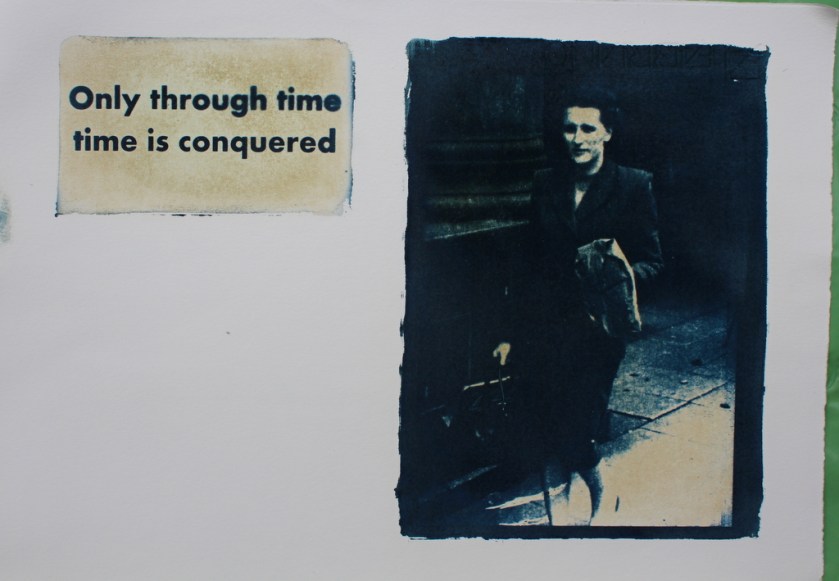
I chose this quotation to go with the photograph, as it expresses the paradoxical nature of the image. It plays well with the content too- what gives the photo a narrative feel are the converging lines of the paving stones, which create a forward impetus, echoing the motion of the subject. The face is set ahead, clearly going somewhere. There is irony in the verb “conquering”, as my mother holds her brown paper parcel like a shield as if defending herself against the onset of the future.

But the image is of a moment, a brief one when a stranger noticed another stranger in the street- I feel as if the photographer is like the creator of the girl with the red dress in The Matrix, timing the click of the shutter, constructing this moment in the sun of my mother, and making a timeless object.

As befits a moment in the sun, a cyanotype seems a good choice, and so I made a double negative of the image and the text, but left it in the sun for a long time so the the blue would be intense. There may be some reaction to sizing in the paper (Fabriano Rosaspina) which is giving the browned effect.
IMG_6612

Only through time; cyanotype on paper, A4

The text is there for its meaning, but it also attains object-status through being “photographed” in the sun, a captured idea, an insight. Poetry is text as object, but the best goes far beyond that. The shape of the text, its font, are meant to evoke a memorial, a plaque, or inscribed stone, which fits the subject. The repetition of the word “time” has a nice parallelism and a sense of the paradoxical.

It could be said that there is an element of the internet meme in it, the picture plus the pithy text, but I’m not sure of that adds or takes away. I am more inspired by the work of Ian Hamilton Finlay though, the memorialising effect of his writing in stone, and his elliptical texts. His allusions are not obvious, for example making reference to the French Revolution, or to his local council. On the other hand, his images of boats, and use of the registration numbers of fishing vessels resonates with me, as I was brought up in that community, so there is a nice feel of both the familiar and strange, which I am also trying to create here. In this example, “Sea Poppy”, the registration numbers, unemotive, bureaucratic factual things, become juxtaposed with the idea of a flower, a poppy, associated with loss, and memory. The circular layout is reminiscent of the boat’s wheel too, so that it becomes a kind of concrete poetry.   The fonts here are mixed, serif and sans serif, bold and simple, which creates the undulating effect of a flower and its petals.

Sea Poppy I [collaboration with Alistair Cant] 1966 by Ian Hamilton Finlay 1925-2006

Sea Poppy I [collaboration with Alistair Cant] 1966 Ian Hamilton Finlay 1925-2006 Purchased 1981 http://www.tate.org.uk/art/work/P07451

The font I chose was solid- partly to do with the practical limitations- it had to be clear. Hamilton Finlay often uses “Trajan”, a classically beautiful font which is favoured by stonemasons, and which is appropriate for his stone carvings, but his screenprinted images use a variety of styles.

Anyway I was delighted with this image, I must say.. Maybe because it has a note of triumph which feeds my emotional needs, but I also think the combination of subject and medium are in harmony, and the feeling of memorialisation is appropriate.

I did of course play around with variants, using different washes, bleach etc.

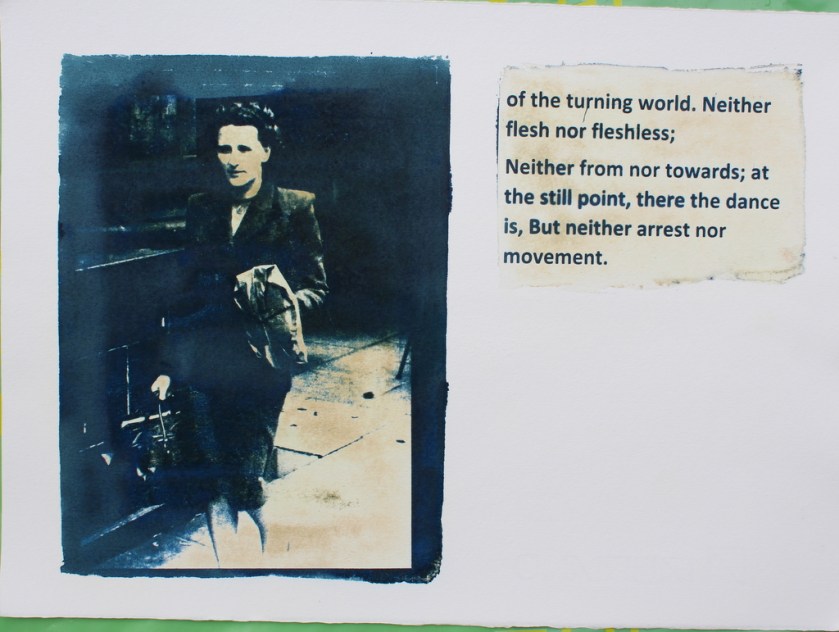
I also tried out another quote from The Four Quartets (a bit spoilt for choice), and used one which contains paradoxes and dualism to suggest a state beyond language, and a place beyond normal experience, “the still point of the turning world”; I started this quote in mid phrase to imply the break in the flow of experience, the moment out of time.
IMG_6611

The still point, cyanotype on paper, A4

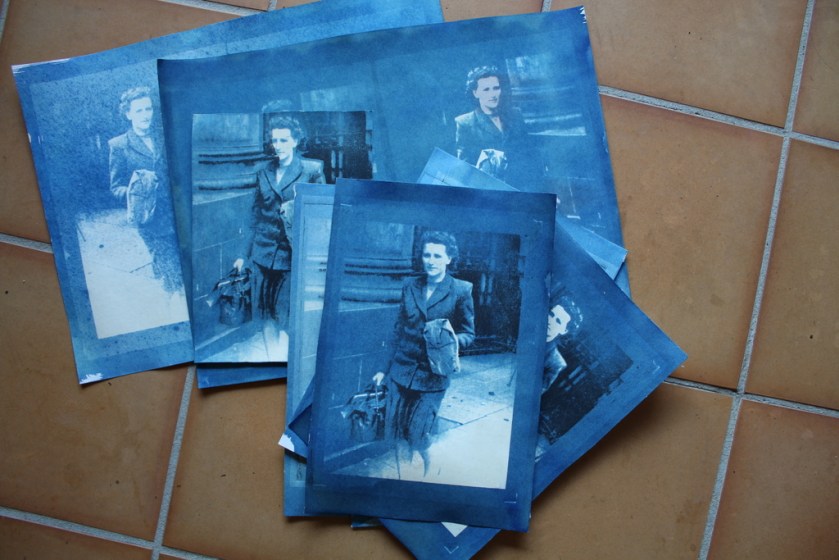
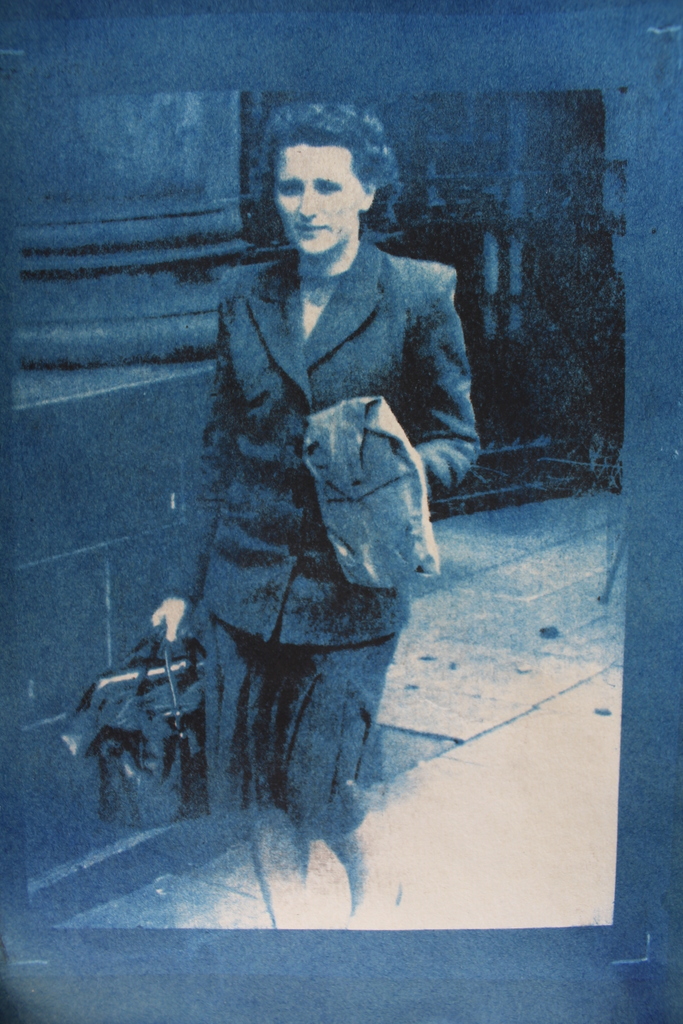
Also, I decided to try adding a second “moment in the sun” by overprinting a photopolymer positive, to enhance the cyanotype (based on a negative). This was difficult to register, despite my adding registration marks to the cyanotypes, but I thought it was a good development, adding depth and solidity to the image. The one below was the only absolutely perfectly registered one I managed- to do this correctly I would need to make sure my original image on the plate had a naturally occurring border, or an image that goes to the edge of the plate. My solution, making registration marks, is ok, but needs the cyanotype area to be big enough to make the registration marks visible, which they then are…
IMG_6597-001IMG_6598

IMG_6613

Using bleach to create different colours
IMG_6610

Less exposure to sun for lighter colour
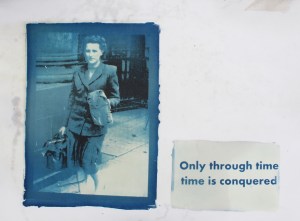
IMG_6606

Red wine development- but the paper stained
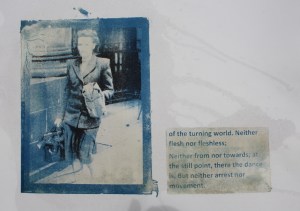
IMG_6605

Only through time; cyanotype on paper, A4

Finally, this one worked best. Because it combines positive and negative images in two printing techniques, it brings out a 3-D effect. The image, from having been flattened, and objectified, now gets a new life. I like the sense of circularity it creates for me, too. I have made my more more “present” in this image. Technically it is an improvement on the simpler version, and the note of triumph in the text is an appropriate emotional conclusion.
IMG_6603

Only through time 2, cyanotype and photopolymer print on paper, A4
 

Assignment 4: Patterns, trends and events

Assignment 4

IMG_6576IMG_6578IMG_6579

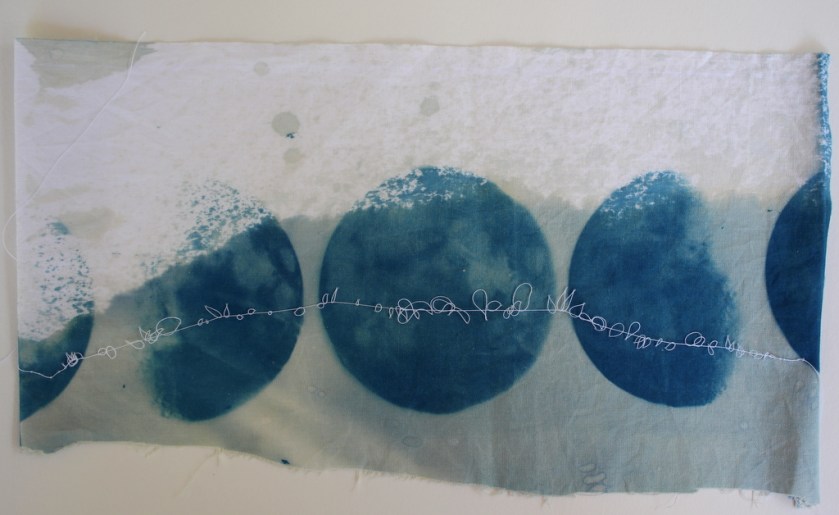
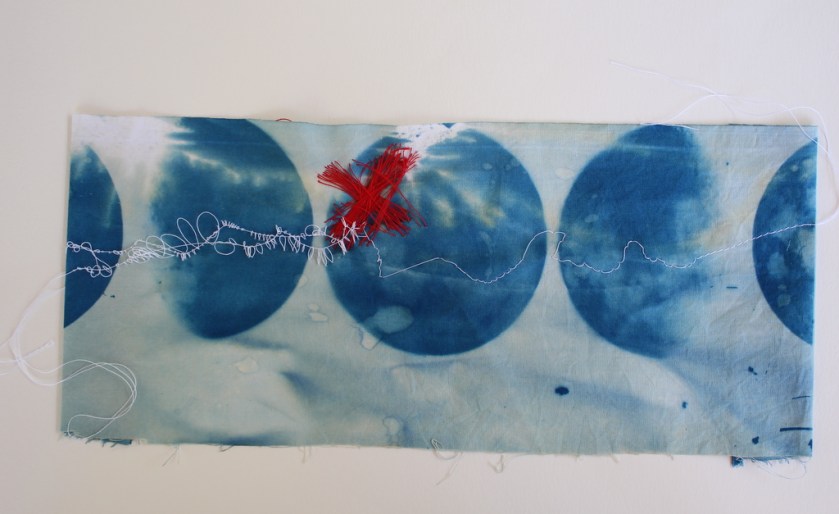
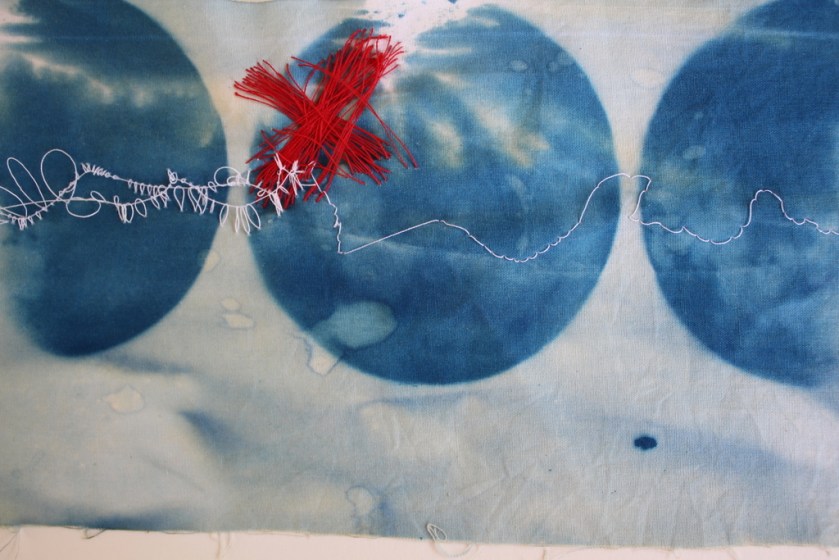
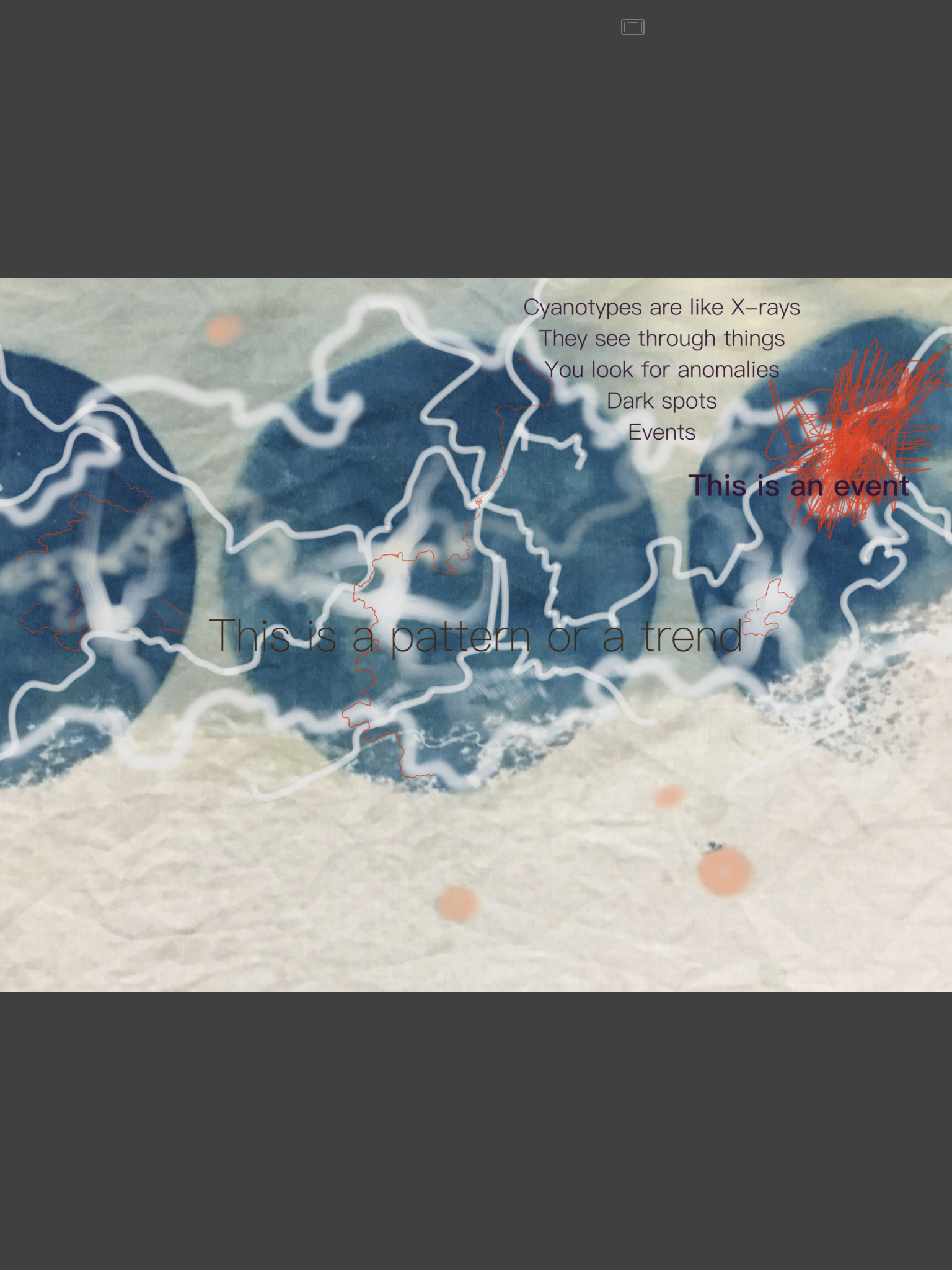
This was an experiment in using stitching as a drawing tool- in fact it was my sewing machine in Hong Kong giving up the ghost and getting into a snarl, that made me see the link between this and the project around my mother. I used thread in the images for “Book of sleep and dreaming” too, for the same reason. Loose thread is good for making almost gestural lines, but they’re more fatalistic, as the thread falls as it wants.

The thread suggests continuation, narrative- with the red stitching suggesting harm, danger, wounding, scarring- a negative event, and also a point in time and space- a point that disrupts the narrative flow.  On one side of the event, there are multiple threads with connections and loops, whereas on the other, there is a single thread, meandering, taking big leaps at times. One way of decoding it would say that the left side is “before” and the right, “after” but that need not be the case. I like the contrasts here- the soft shapes n the cloth, the marks of the thread, both harsh, bold and soft, curving, the way the stitching can evoke scribbling- violent, and frustrated, denying.  (Also referencing myself in this scribble… this time much more appropriately emotive- last time it was quite decorative.) Stitching can suggest both damage and healing, or patching. The contrast between loose and pulled thread is also emotive.

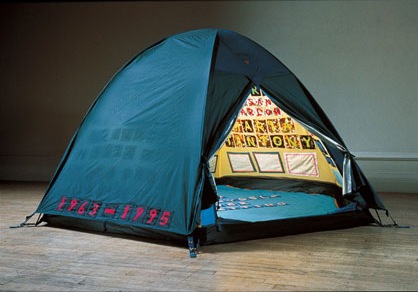
Tracy Emin’s stitched work gains emotive depth due to the use of materials of cloth and thread. There is something very considered about stitching- because it penetrates through the material, rather than being on top of the canvas or substrate, it evokes the physical sensation of making, and somehow stresses commitment to the act, which works well with her “confessional” type pieces.

emin_everyone_i_ever_slept_with_0

Enter a caption

Tracey Emin Everyone I Have Ever Slept With, 1963–95 1995 Appliqued tent,

tate.org.uk


I plan to move onto copper plate etching for the final assignment, and could use thread to make marks in soft ground.

Here is the set of sketches that showed the thinking- I was thinking about the way vascular dementia can be caused by mini-strokes, or burst blood vessels in the brain, small but seismic events that change the world, analogous to how volcanoes or earthquakes alter the landscape of planets. I am also struck by how cyanotypes are reminiscent of x-ray images- in fact they do not look through objects, unless the objects are transparent, but there is a similarity with the appearance of x-ray film, giving a sense of looking beneath the surface.

Sketchbook


Assignment 4: Book of sleep and dreaming

Assignment 4

Still continuing with the cyanotypes, and still using cloth.

This project is a set of images based on my mother’s condition. I started with some sketches based on looking at images of brains with dementia. Not a good thing to do. But what it brought into focus for me was a coalescence of neuroscience and spirituality, specifically Zen ideas of spaces beyond.

The images were made on transparencies, using a mixture of media- photographic negatives, masks, paintings on perspex

This slideshow requires JavaScript.

and cellophane, carborundum and salt, feathers, an empty pill packet and thread, and development included the use of tea, red wine, vinegar and washing soda bleach.

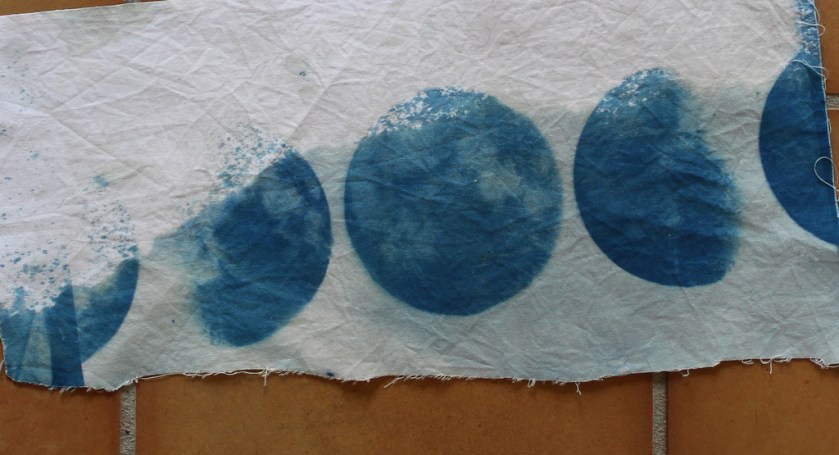
The starting point was an accidental set of images, a photograph of the phases of the moon printed onto a piece of cloth from the edge of the fabric, where the cyanotype chemical had sprayed.

IMG_6575

It created an interesting effect and set of colours, and it conjured up ideas of passing time and deterioration, as well as evoking my earlier images likening the moon and the degenerating brain. As a metaphor, the set of images also evokes a sense of the moon as a wanderer in the sky, something on a voyage, which links too with this project and its consideration on the phases and stages of life. On the other hand, the fact that we “see” the phases of the moon as a set of changes is an illusion, and a reminder of our limited perspectives, and the difficulty we have of perceiving what is beyond the evidence of our senses.

The images are meant to evoke neural networks, paths and maps- due to the colouring, they can look like water, and also the night sky, patterns and constellations. They should also evoke the physical body – veins, lungs, the brain. Masks are used to contain the images and suggest new meanings, parallel worlds ( the “two moons” reappear here)  pairs of eyes, lungs… Groups of three form a hierarchy- the third eye, the trinity of the mind, body and soul.  One image involves real objects- a feather, an empty pill packet and tangled thread- this is a composition that could be found on a seashore, washed up debris, so it metaphorically connotes remains, and endings, while its literal meanings denote surrender, confusion, medication. I had in mind my mother’s small table, on which she always keeps a comb, but of late she has less interest in it, and seems to have given up considering her appearance. I decided to use a feather instead of an actual comb, as it still has the comb-like structure, with the thread tangled around it, but has a more pleasing aesthetic and richer meanings.

This set of pieces of cloth I plan to make into a “book” but a padded one, like a pillow.  There is a sense that this is both an object and a gift for my mother, a wish that she should sleep and go beyond the present- that her loss of the here and now should become a path to a space beyond. I can’t complete the padding now, as I don’t have the materials, but this is a video of it nearly complete.


Assignment 4:I am here: Every photograph is a certificate of presence.

Assignment 4

As was reading around this topic, I came across Roland Barthes’ “Camera Lucida” (1981, NY), in which he makes the claim in the quote above.The fact that Barthes’ reflection is based on a picture of his mother gave this extra resonance.


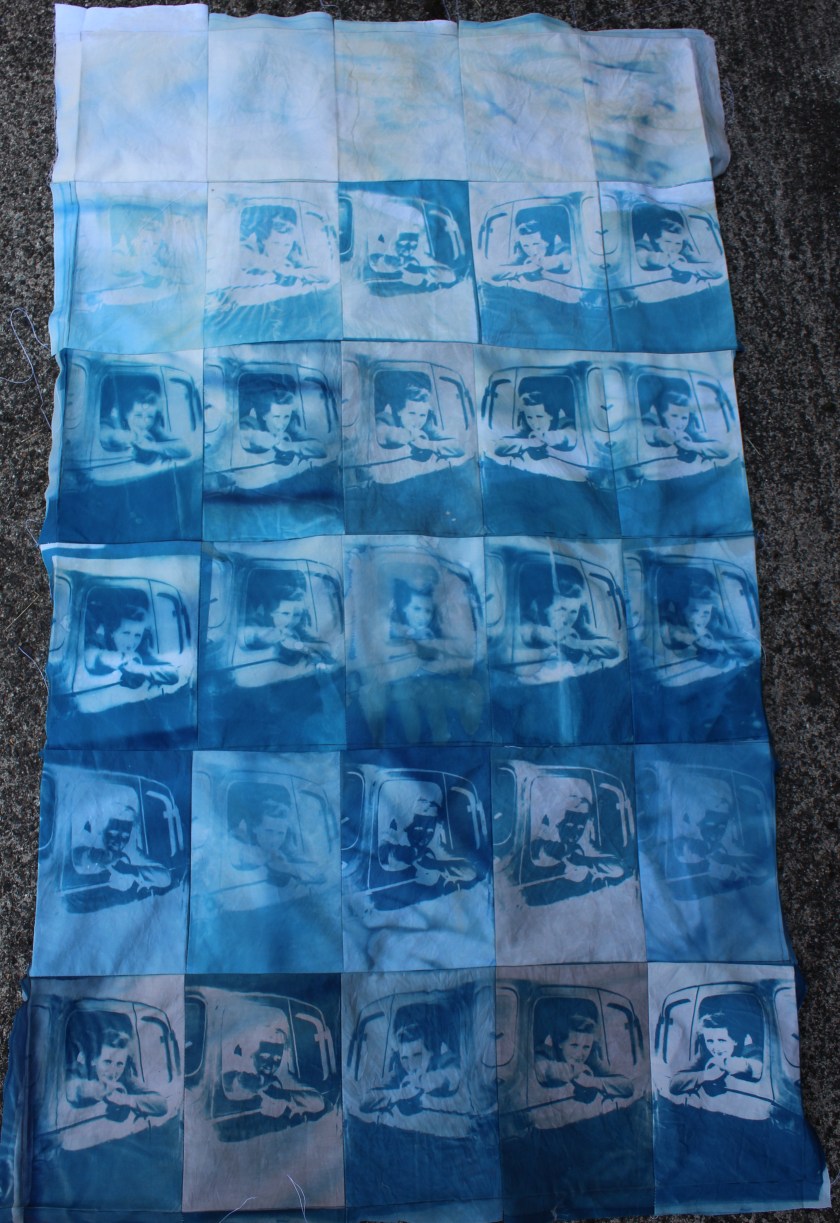
This is similar to the other patchwork piece, but it is different in mood and tone. This one starts (if we assume a top to bottom “reading”) pale and barely defined, and becomes steadily darker, going through various forms of distortion, including both positive and negative forms. Unlike the photograph that the first patchwork piece is based on, this one shows my mother self-assured, striking a pose reminiscent of a glamour shot. The photographer here is most likely my father, the car his too, and there is perhaps a sense of pride of ownership.

Barthes described a photo as the moment when the subject becomes an object. The repetitions here help to underline the process of becoming.

Suspended between subjectivity and objectivity, the image in the photo is also suspended between the past and the present, between life and death. Barthes describes how the image of his mother created insights and recognition for him that would not be available to anyone else, and likewise, this image must necessarily have such an effect on me, one that will elude anyone else. On a personal level, I am using these images for therapy, both for myself and for my mother, trying to stir recognition in her, to jolt her into memories of who she was, in order to help her remember who she is. In this connection, Barthes’ description of the photo as a “tableau vivant”, and the image within it a “Sleeping Beauty” is particularly poignant.

A photo of a person is “the return of the dead”, according to Barthes: not that the person in the image is necessarily dead, but that the version of that person is gone, and the objects, and the photographer also gone, so that the photo is not just making the subjects objects, but even making them “museum objects”. This idea is echoed in my piece, as the image is clearly recognised as one from the past, and the use of the patchwork may evoke memories of old pastimes, and preserved objects of the kind that could be found in a folk museum. There is also a reference to the idea of an image being burned into cloth such as in the Turin shroud, explained as the chemical release of energy upon death. Here, the energy comes from the chemical reaction of light- not once but twice, firstly the photograph, and then again in the cyanotype process.

I am still struggling to decide what kind of “object” to make this piece into- is it “just” a picture? Like the first one, I was not overly concerned with the actual needlework. The fact of its being a patchwork cloth suggests a function, and I wonder if I should continue the process of finishing it, to turn it into an object, a child-sized quilt. How would that alter it? If it was left as a picture, it is demanding only to be looked at, rather than handled. There is a sense that this is appropriate, as the photo itself says “look at me” with its direct gaze, and “look at my possessions” from the photographer.

Making it a quilt would stress the materiality of the cloth, its softness and texture, as well as its function- would evoke the sense of family and folk history. It might also “feminise” it, in the sense that sewing has traditionally been associated with females and domesticity.

An alternative would be to make it into something unexpected, avoid the cliche of cloth squares necessarily being translated into a quilt, to make it “strange” or surreal. I’m thinking of a cup and saucer covered in fur, and whether this type of transformation could be meaningful, given that at times, with her dementia, my mother has slipped “down the rabbit hole” into a surreal landscape.

The grid pattern of the patchwork is a reminder to me of my mother’s calendar, the grid that measures her time, and by which she attempts to locate herself in this world. It’s a sad sad document, mostly recording “got up, dressed” in shaky handwriting, some days blank, days that got away.

Our measures of space and time are merely conventions- geometry a theory that fits conveniently, units of time a handy way of synchronising our movements- a grid overlaying the flux of experience. The original unity of the image has been multiplied, fragmented, cut up, stitched together, to make a “best fit”. Perhaps if I leave this unfinished, clearly a piece of handiwork with ragged edges, it expresses this concept better. It reflects my mother’s effort to “be here.”


IMG_6545

I am here. Cyanotype on cloth, stitched.