Assignment 2: Abstraction: Materials and process: gesture

Assignment 2

The course designer suggests approaching abstraction in two ways: geometric and gestural.

The thing about being “gestural ” with printmaking is that the marks you make are indirect, so there’s not the same immediacy as there is, say, with a Jackson Pollock splatter painting, where the movements and the momentum, and the gravity are directly influencing the marks made. When it’s a transferred image, you can splatter, drop, splash, but the mark you get will reflect the fact that the paper has been pressed on to the paint. That’s to say, that in printmaking, materials and processes determine the marks you get, as much as the way you design your plate.

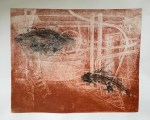
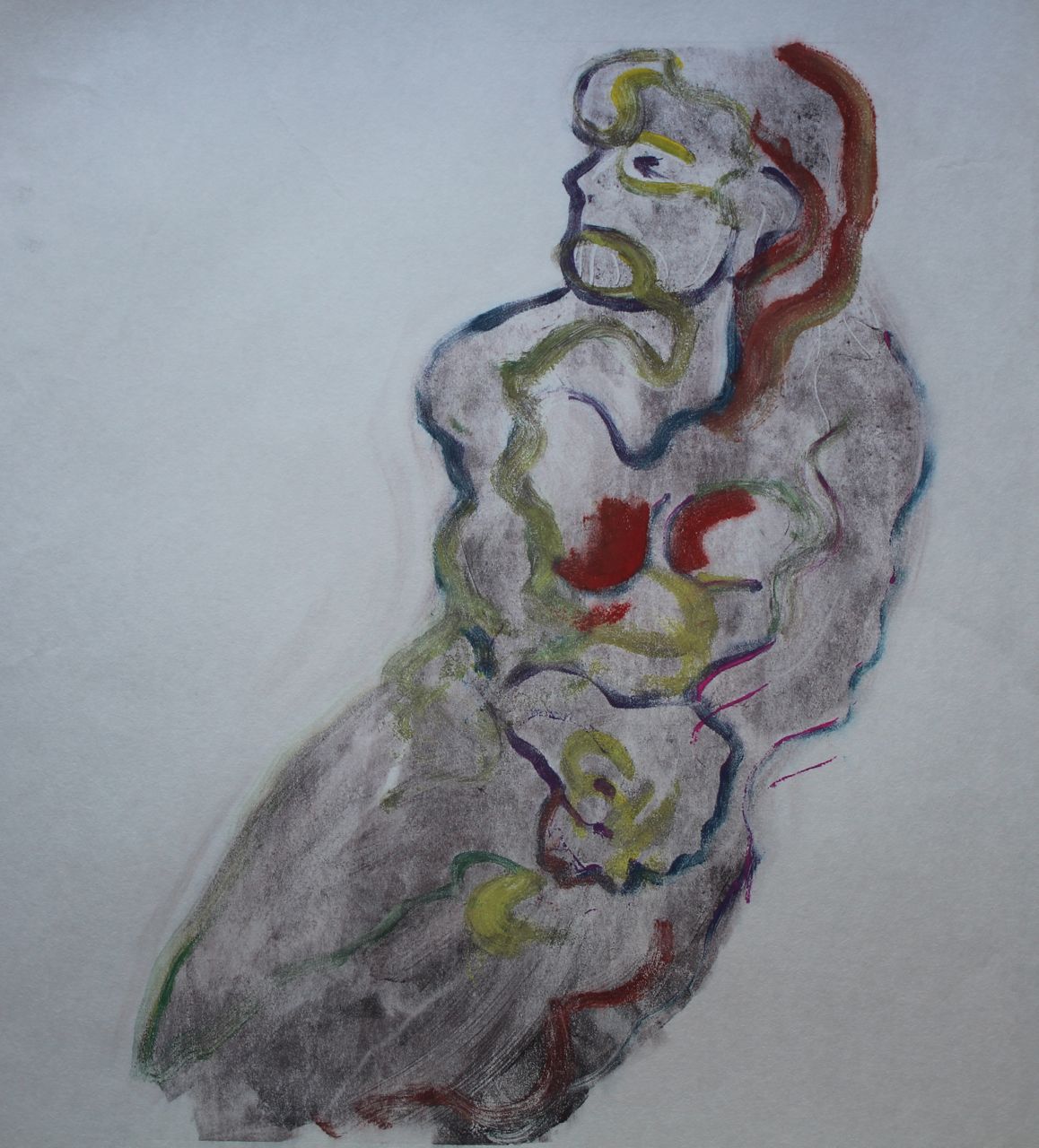
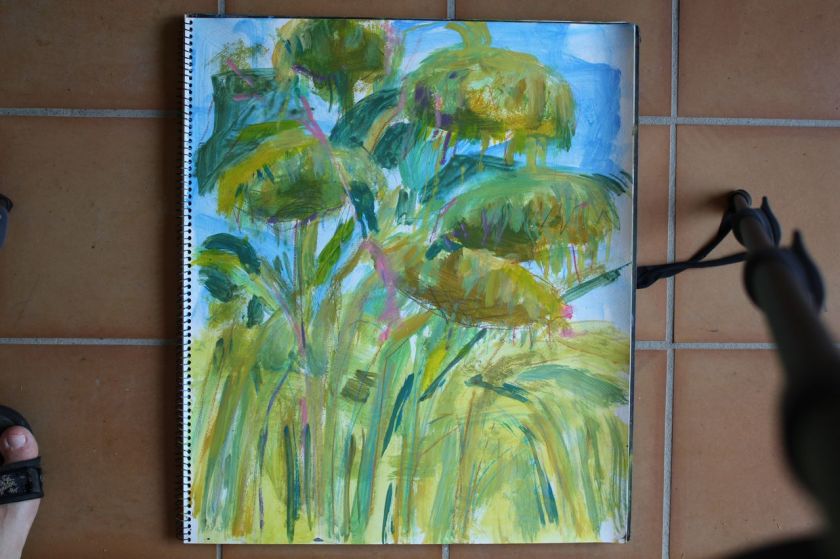
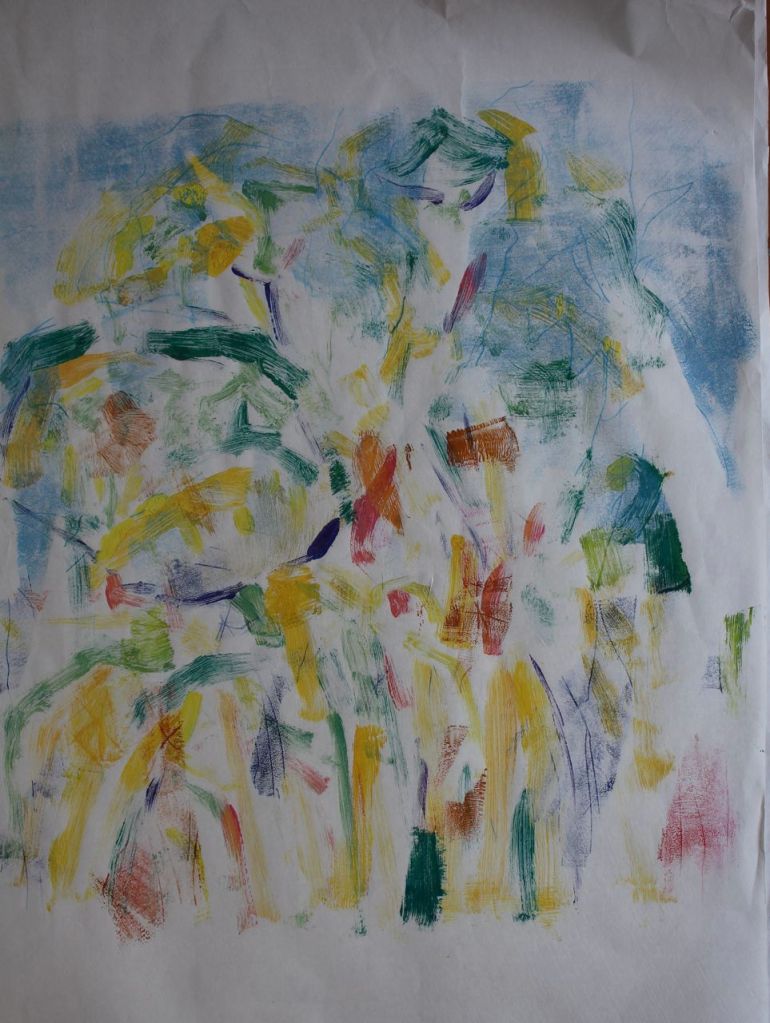
I wasn’t keen on just splattering because it’s likely I’d just get squished blobs. So I painted quickly, using a painting I’d done as inspiration. This kind of image is determined by materials and, if the ink is water-based, as mine was, by speed. I’m not sure this monoprint interpretation adds much. The range of marks is limited, even using brush marks and backdrawing, but it has to be done very quickly.
Monoprinting

Basically, with mono printing, if you want control of the finished product, you have to use materials, namely the inks, with a degree of viscosity that means they are going to remain the same when transferred. There are many examples of these “painterly” mono prints in the well known book by Jackie Newell. You have to be very convinced of the point of this.

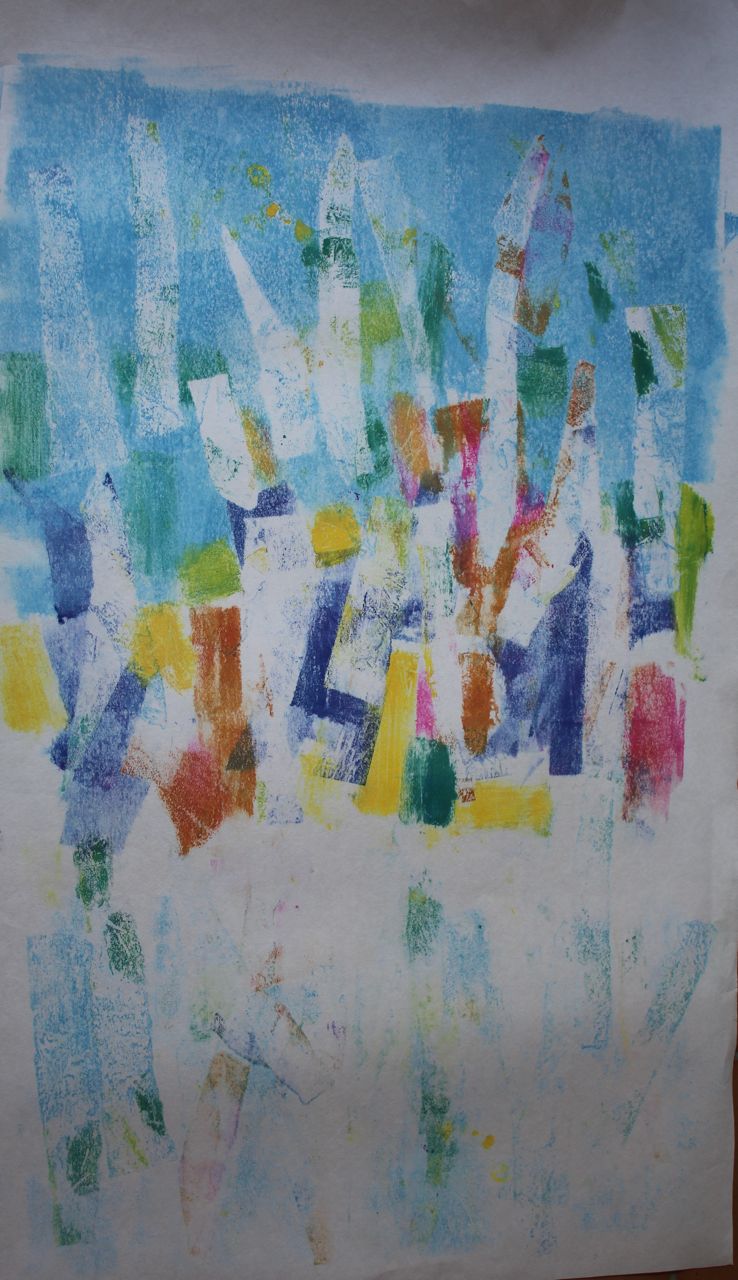
I am more drawn to those techniques which create automatic effects through the printmaking process. Maybe I am lazy. This was a pochoir technique – using torn shapes which were reversed in order to create interlocking and overlapping colours and shapes. This works better  and is “gestural” in the sense that the paper masks are torn roughly, and are positioned at random, then repositioned at random, and thus it is an action process that determines the outcome, not composition.
IMG_3822

So, to return to the materials and processes- what processes could be carried out with particular materials to create marks automatically? I have seen a YouTube video showing a print being made by burning paper and then quickly smothering it in a press, so that the resulting image is a burn mark, and each time it’s different. That’s surely an example of “gestural” printmaking.

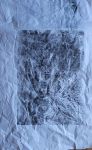
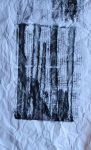
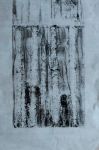
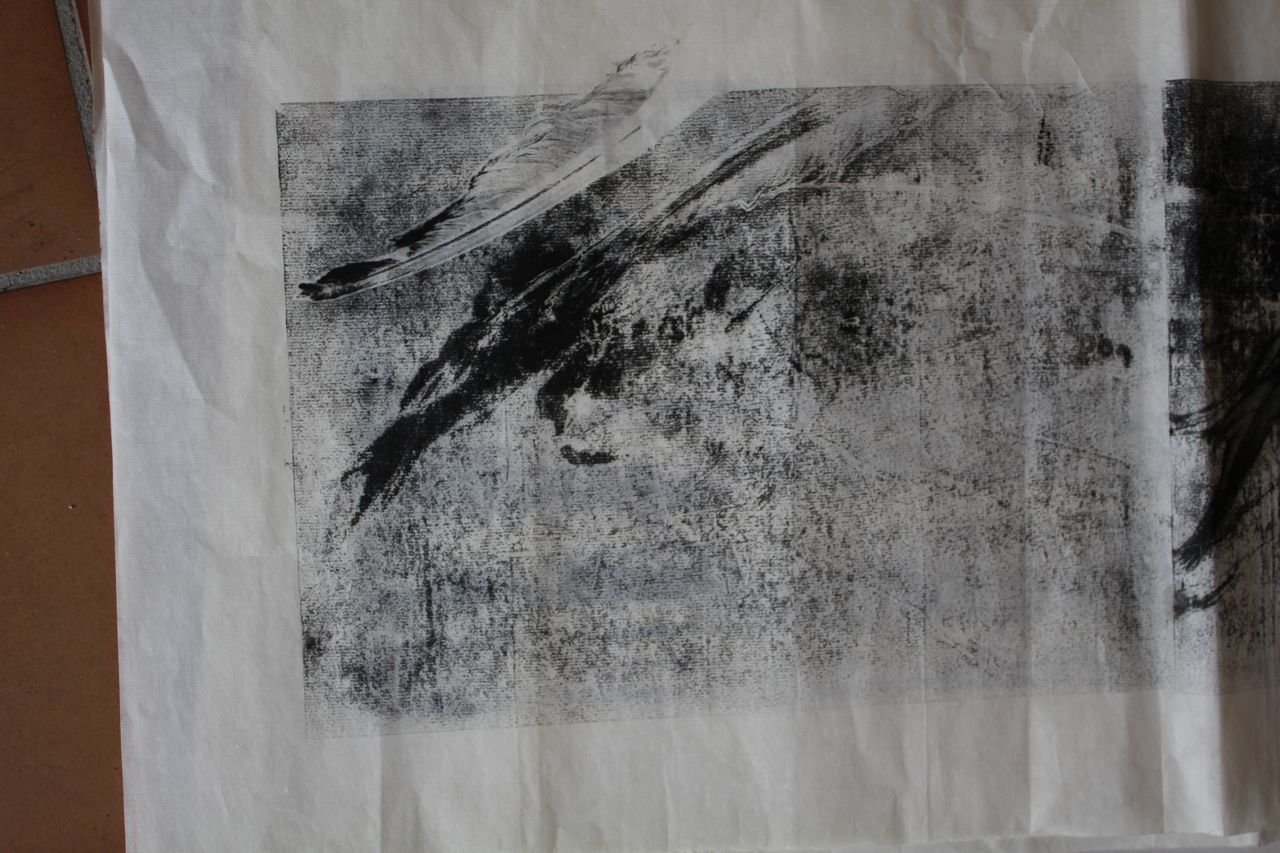
With paper: folding, scrunching, soaking and spraying with water, oil and alcohol products:
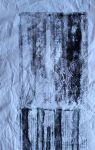
These are vaguely suggestive of wood, water, trees, or rain streaking down a window.

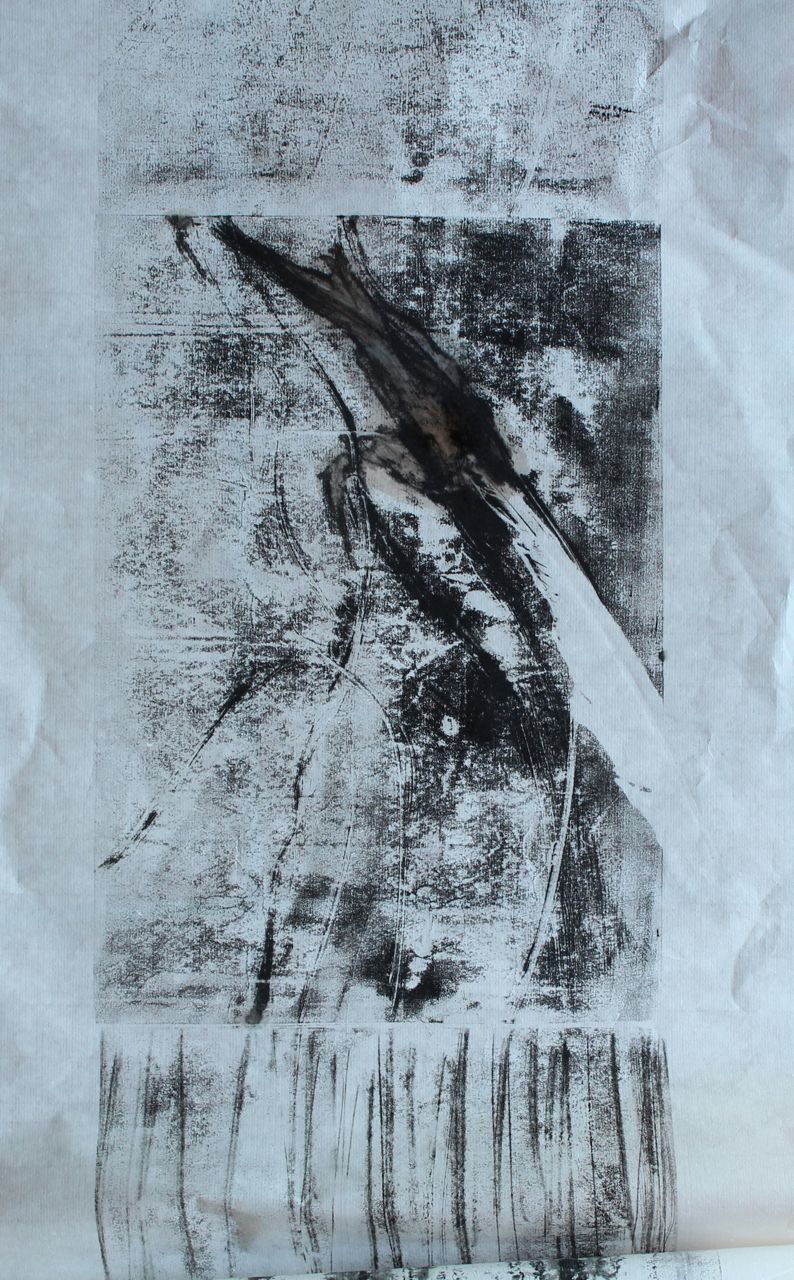
A feather laid into the ink above made interesting marks.
IMG_3535 IMG_3827


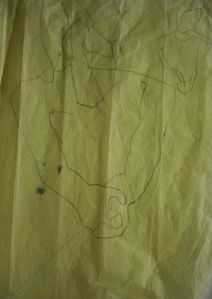
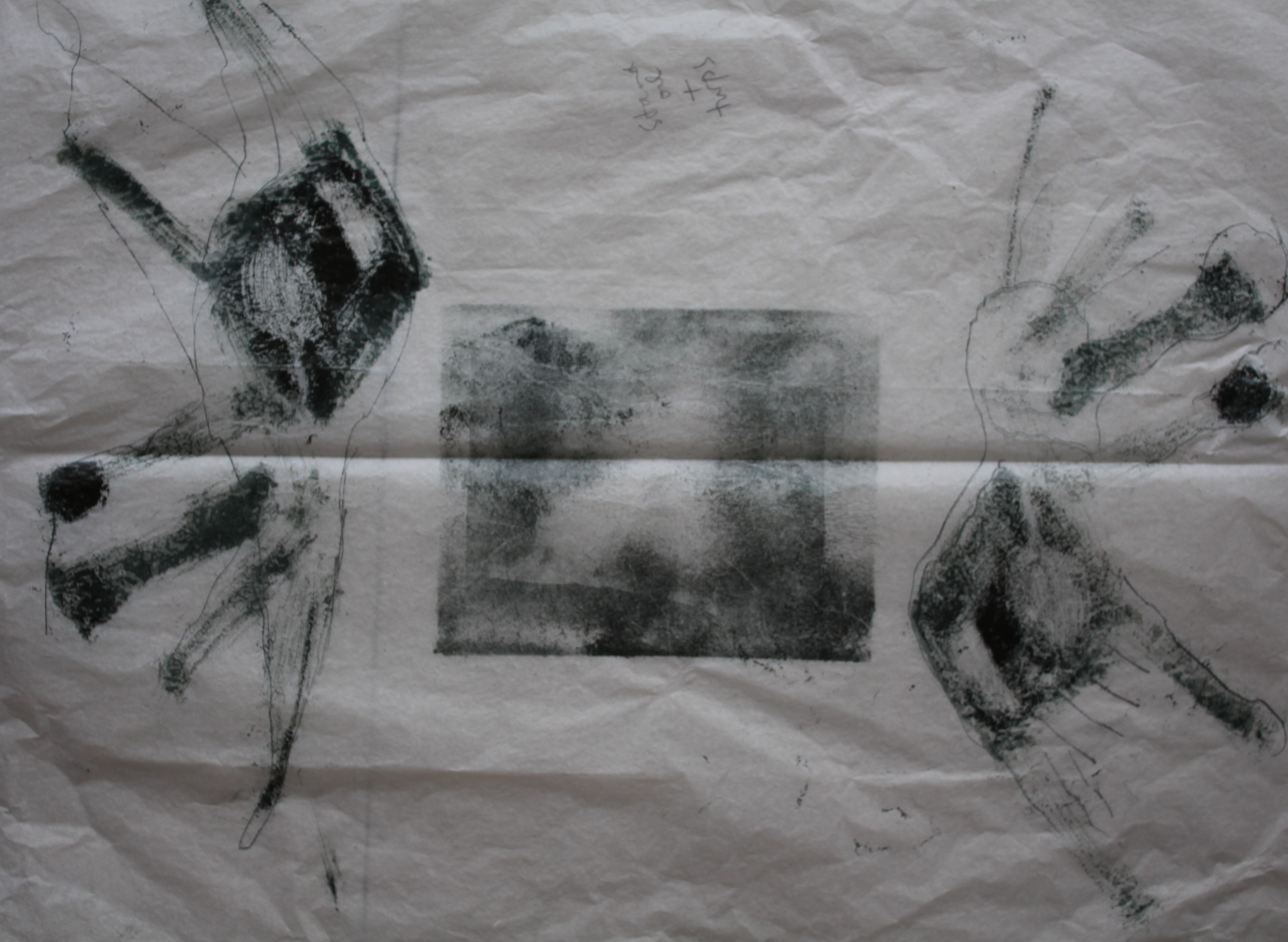
These images were made by just making intuitive childish scribbles- and also using the effects of letting turpentine and stand oil react to one another to make a bubble pattern, which is quite attractive.
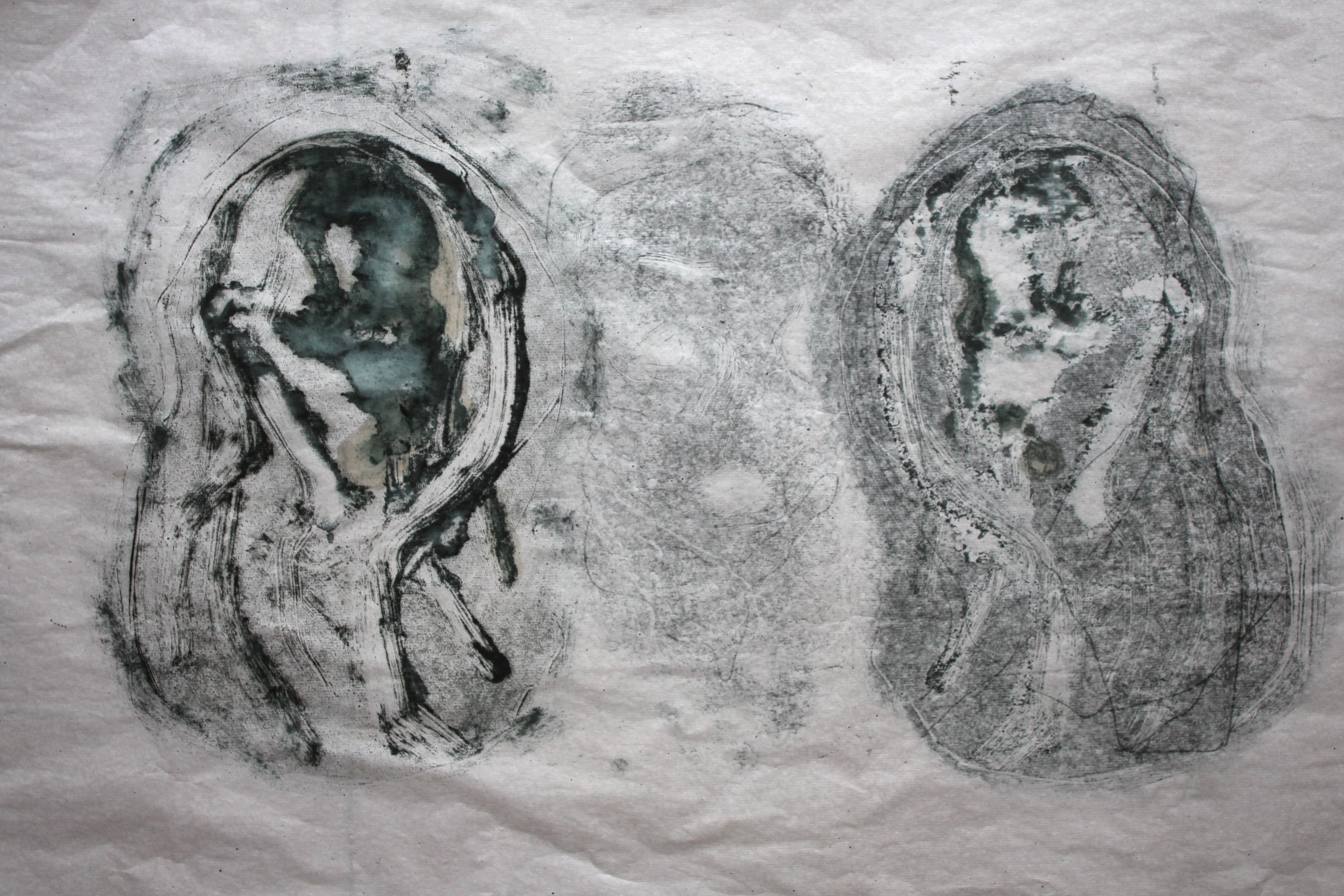
IMG_3846

IMG_3845

I feel I am not moving on much here though.

Collagraph

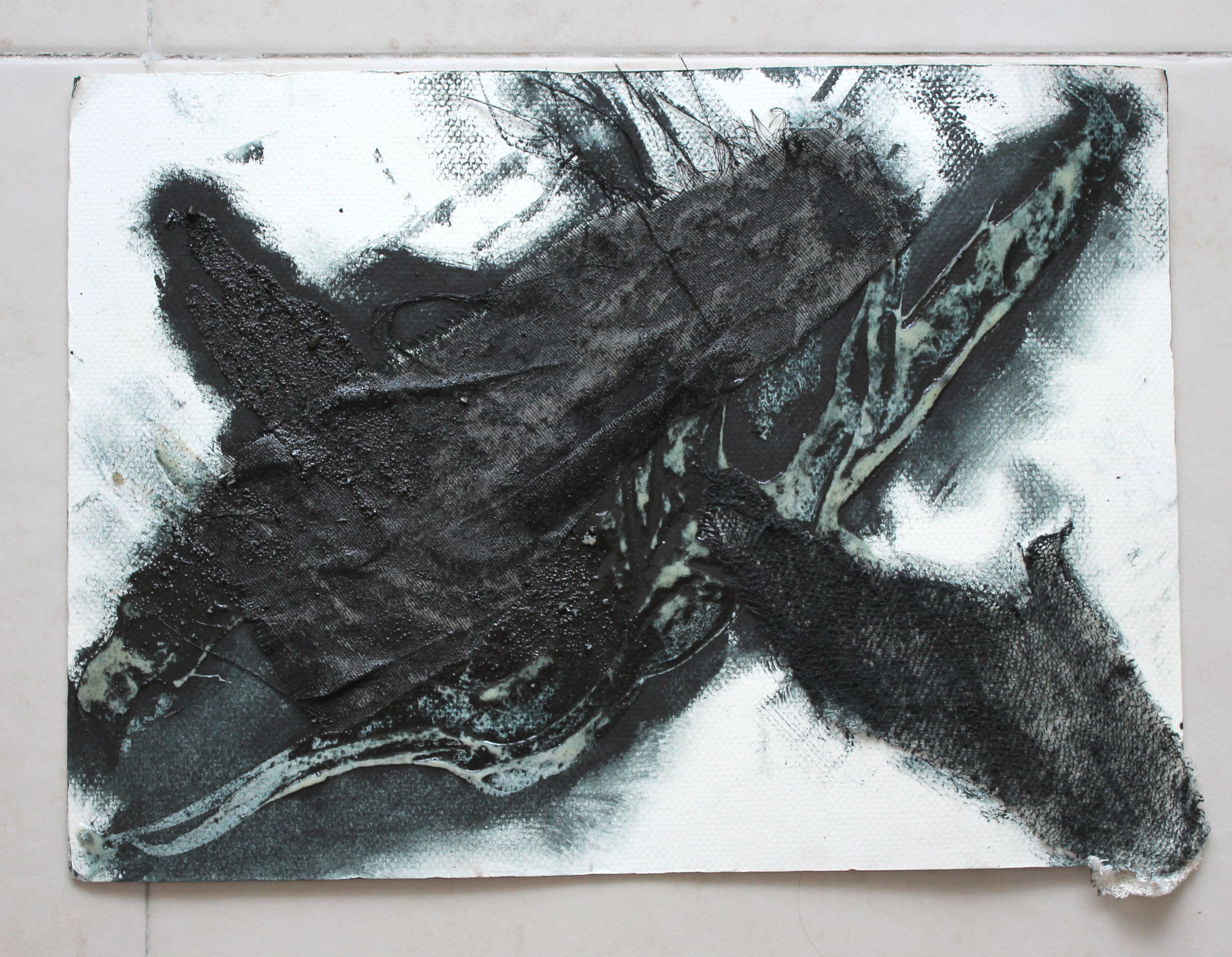
Collagraph is all about textures- the most elemental being soft and hard. I made a plate using a bandage- silkscreen fabric and sand- (I had no carborundum), with thick glue as an in between “fluid” texture: I just placed the pieces more or less randomly, trying to balance them, with a basic diagonal composition.

This is the inked up plate:
IMG_3841

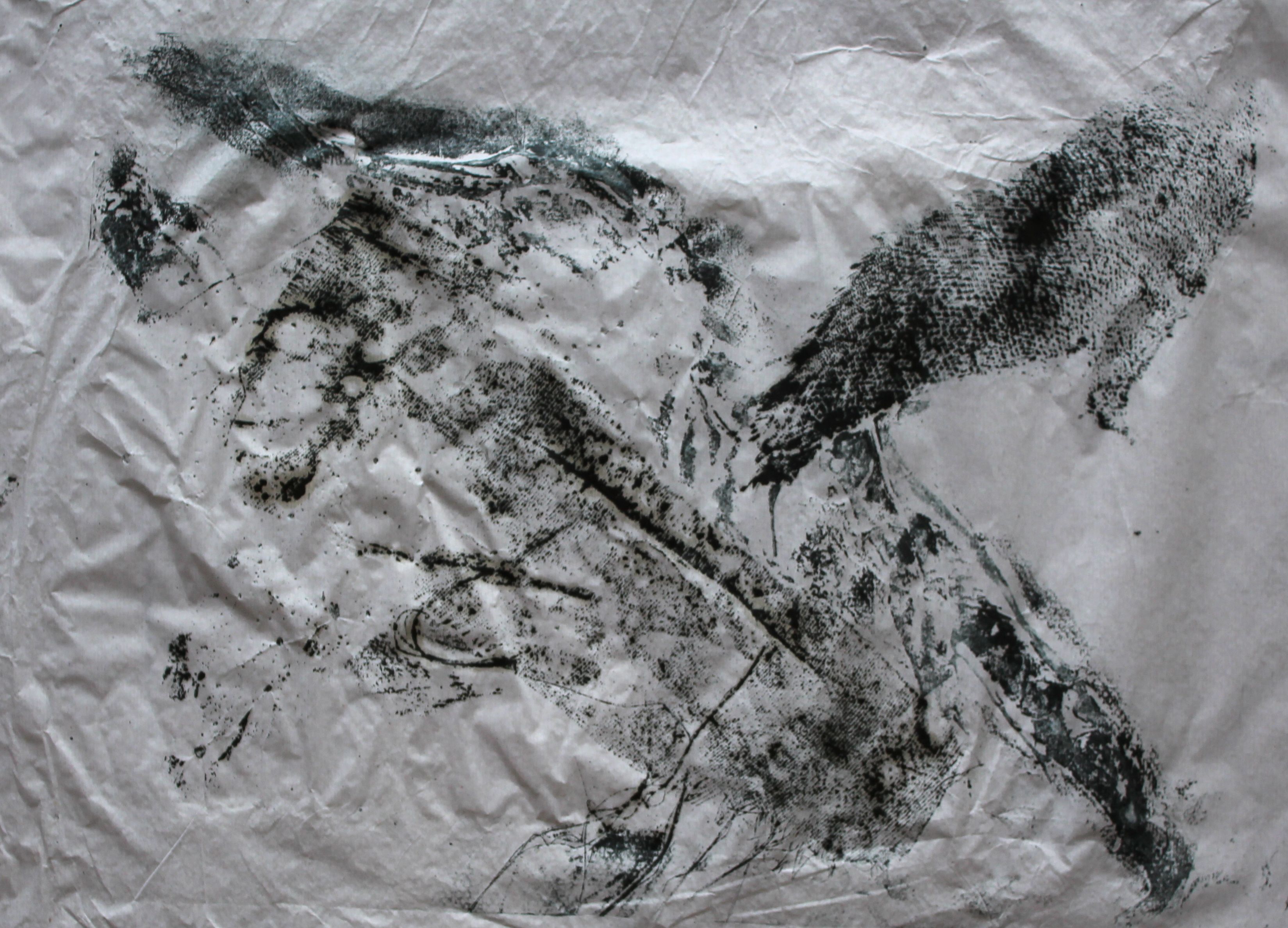
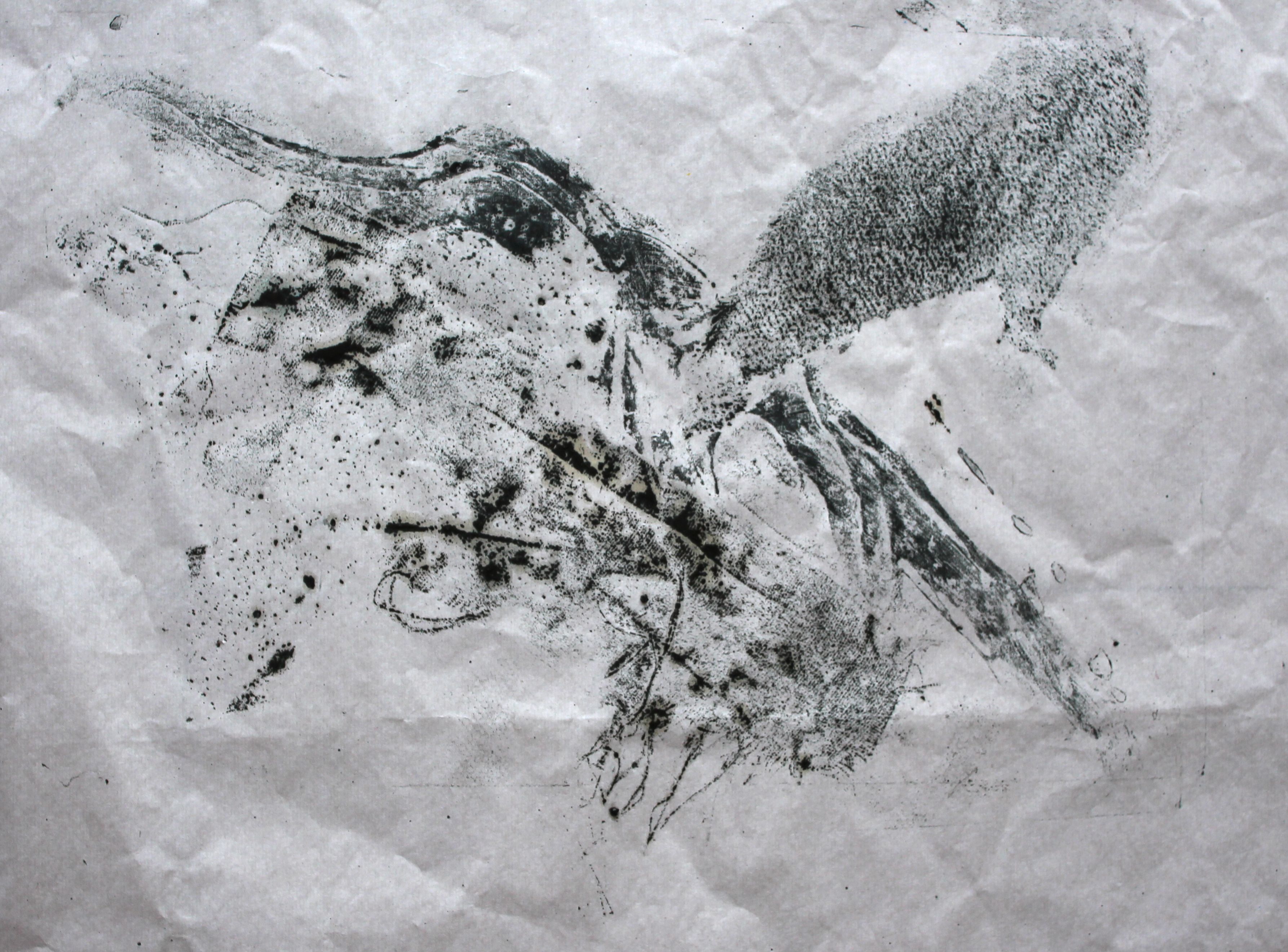
Without a press this had to be printed on thin paper, or on wet paper pressed between weights.

On thin paper, the sand was a bit destructive, but I like the shapes and textures on the right hand one.
IMG_3843 IMG_3844

On thick paper the textures are quite sharp:
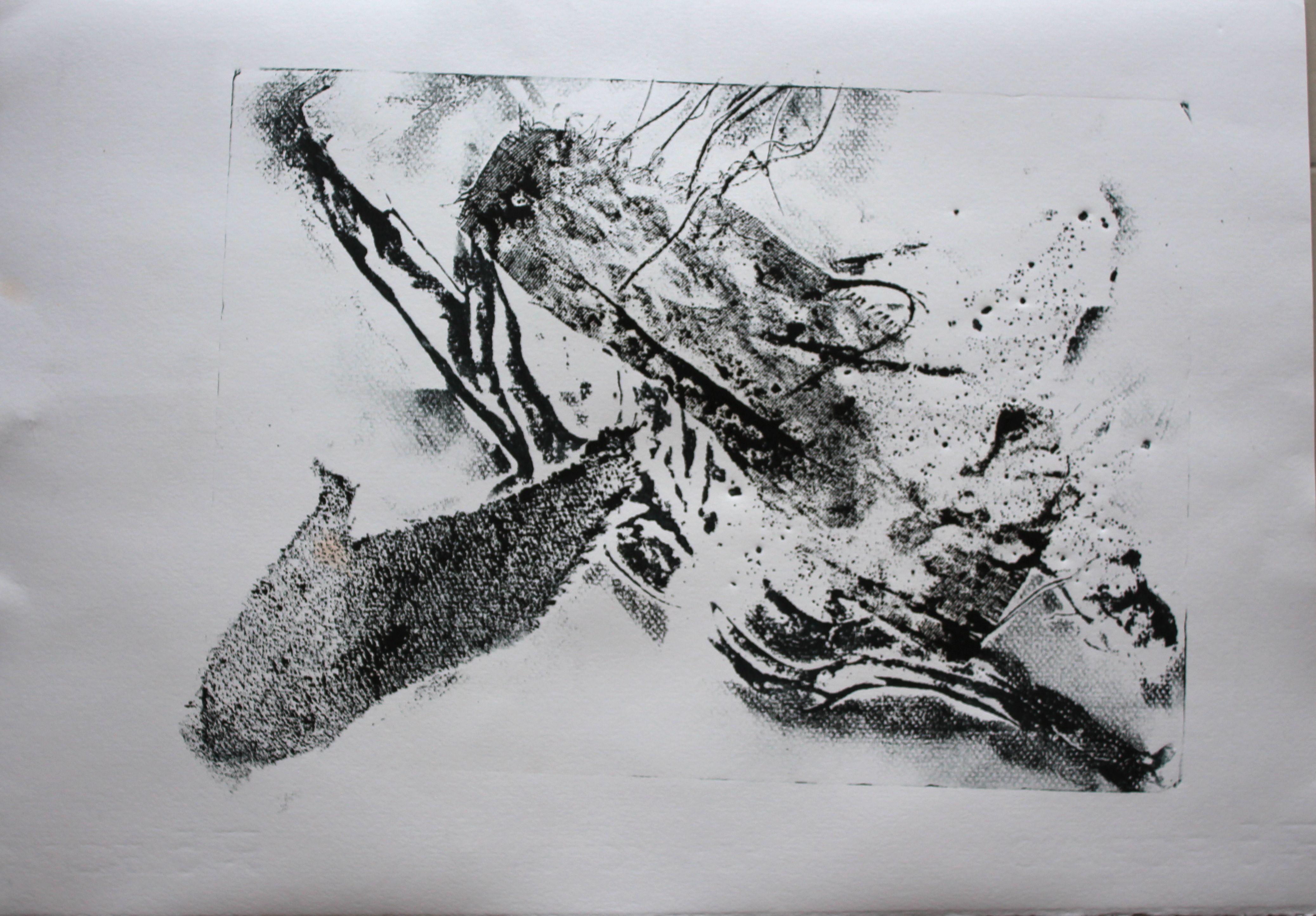
Abstract collagraph

Abstract collagraph

I should probably have used sandpaper instead of actual sand, so as not to indent the paper quite so much, but the dotted patterns are interesting, and they create a lot of space. I’m still unsure what I am trying to achieve here though.


Woodcut

With wood: burning, splitting, splintering:

This piece of wood was set alight after having lighter fluid poured on it, but I didn’t get much of a relief pattern as a result- the fluid burnt out too quickly. (Need to use different wood? petrol?) I then used a screwdriver and a knife, cut quickly, and let the plywood layers split. It’s been printed four times to make a continuous pattern, then overprinted in a second analogous colour, which again, is a technique to create a random and not representational design. This could have been planned so that the edges met up as a repeat pattern.
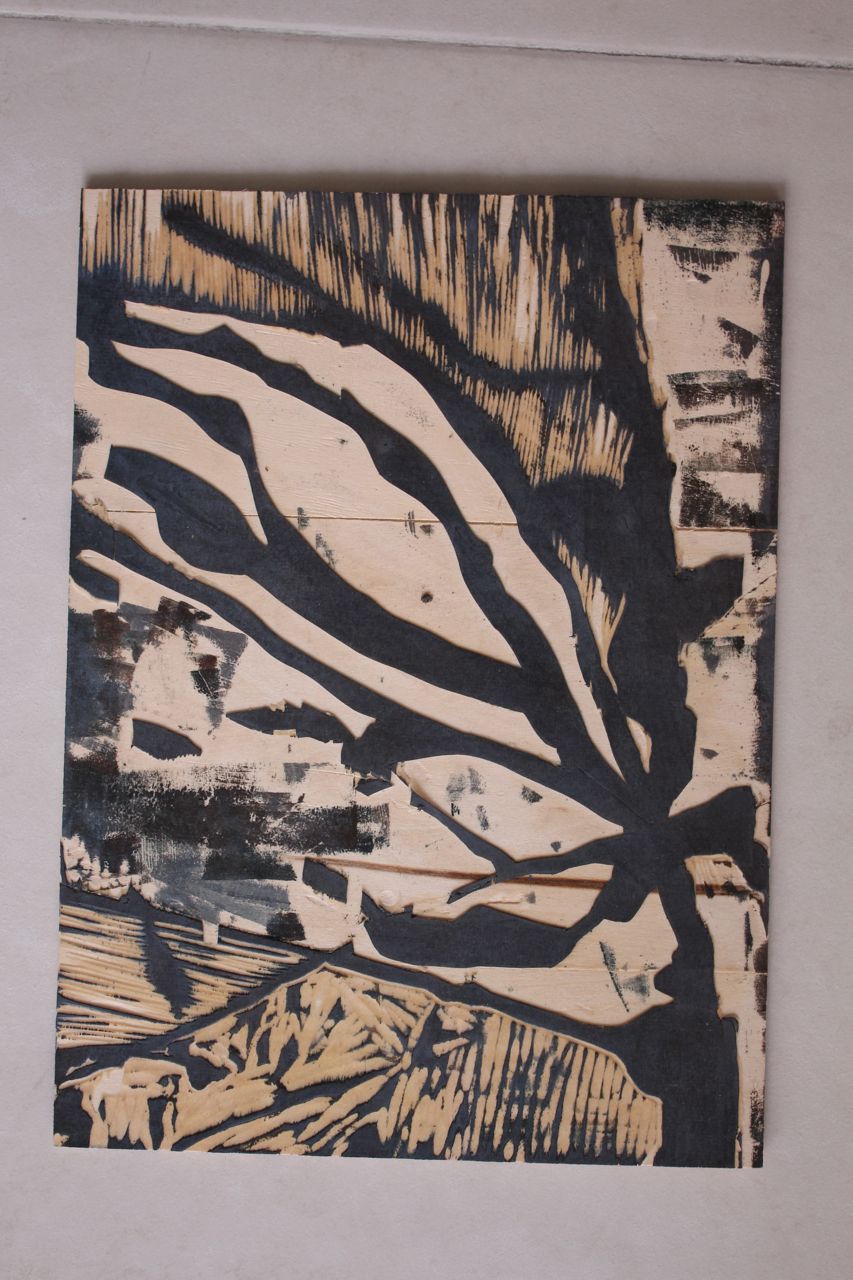
 

Plywood block
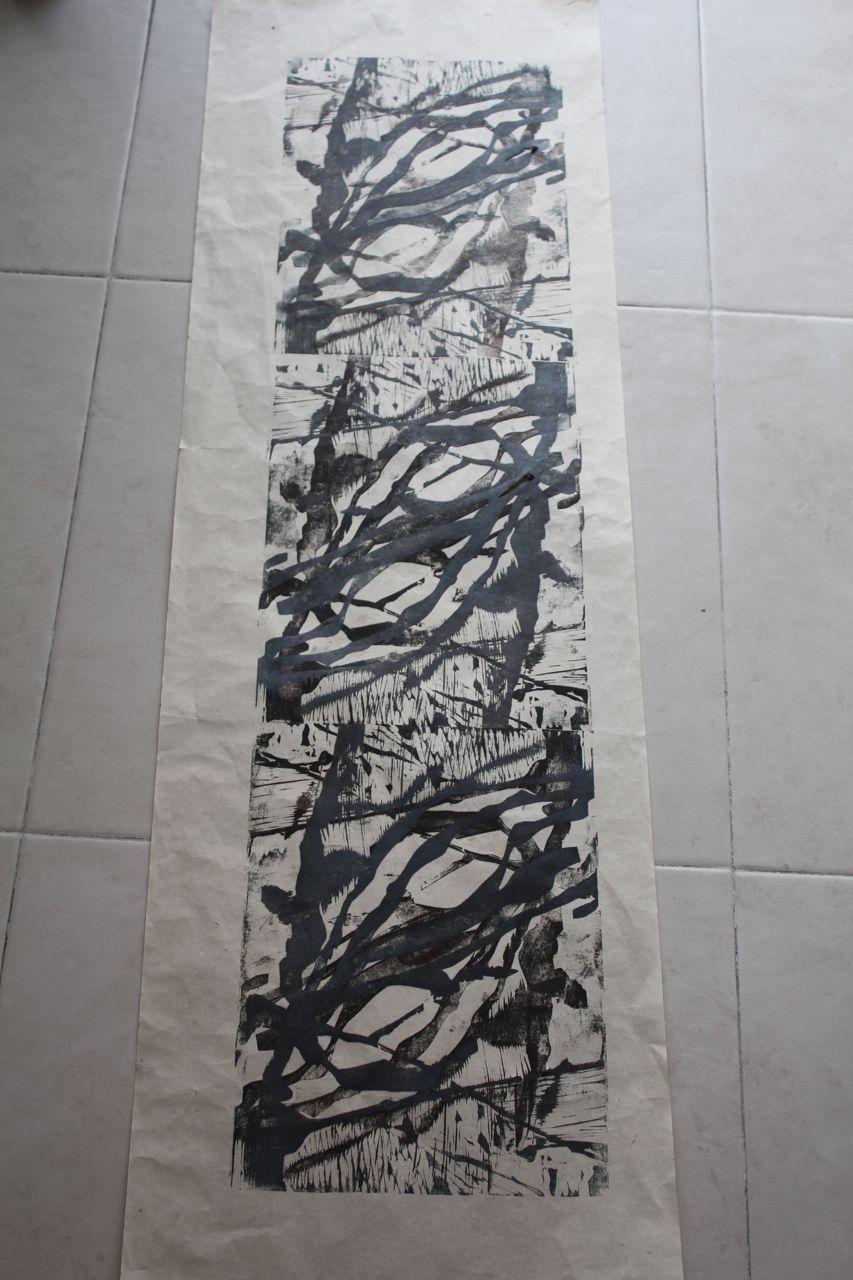
Plywood block


IMG_3833

Lino: I could make random marks with caustic soda. (But I’m not going to- I don’t have much of the real stuff, mainly vinyl, which is impervious to most random markmaking stuff.)

But when I think of “gestural” marks, I think of drawing and writing, marks made by spontaneous movement. The most direct technique I know for achieving that is intaglio, where the scratched line you make is pretty nearly the mark you get.

Intaglio

These images are made on A4 pieces of 2mm plexiglass, and have been gouged with a variety of sharp objects, including knives, etching needles, sandpaper, a screwdriver and a Dremel. Then the plexiglass was cracked  with a hammer and other sharp tools. Before that, a sheet of contact plastic was affixed to the back to hold the pieces together.

I like the variety of marks I’ve got here. The sharp engraving needles have been used quite violently in places to scratch, as have lino carving tools and knives to peel off some surface plastic. The use of a rocker engraving tool has made dotted and hatched lines, as has the Dremel used at different speeds. The Dremel is nice for the curly lines, and the engraving needle is also relatively easy to write with. The marks are made quickly, and deliberately artlessly; scribbles, random words, scratchings out, phrases that come into my head, symbols. I painted some caustic soda and left it overnight to see if the lines would get etched by that, thinking that some of the plastic in the sheet might be affected by it, but no- it looked exciting for a moment- with bits of crystal shapes forming- but it was just the dried soda on the surface and it washed off.
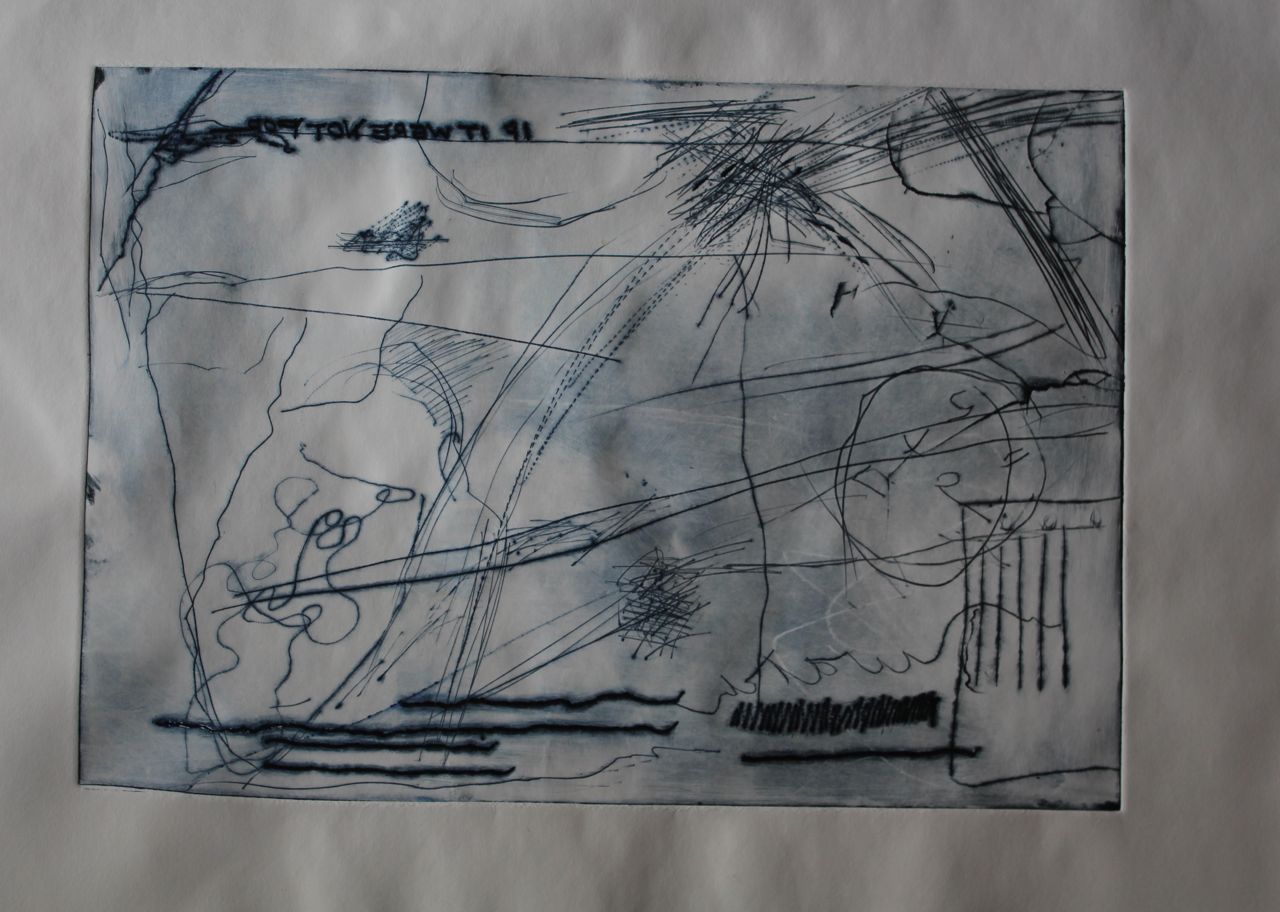
 

Intaglio on plexiglass, Akua Lamp black ink

Intaglio on plexiglass

By leaving some ink on the plate, that too can be marked, written into. Wet paper soften the deeply etched Dremel lines, and makes a contrast with the sharper ones. Where the Dremel  has bitten deeply, there’s an open bite effect where a thin line is left uninked as the pigment is held by the edges of the gouged line. The cracks though, create all sorts of different effects- they are organic in a way, that is, they make sense, as they have happened naturally as a response to pressure on the material. The ink sits in them in different ways, depending on how deep the break is and whether the plate bends at that point.

This is quite interesting.

Another sheet of plexiglass (annoyingly not cut to the same size) as a colour layer, quickly painted with inks, scrubbed, scratched into with a fingernail. Heart symbol painted, edges wiped and wetted slightly. It feels like conflict, miscommunication, love letters getting lost on the post, poignant.

I was wearing a Jean Michel Basquiat t-shirt, and may have been channelling that style: the primitive markmaking, childlike images. It could be interesting to match the layers and colour in the outlines.
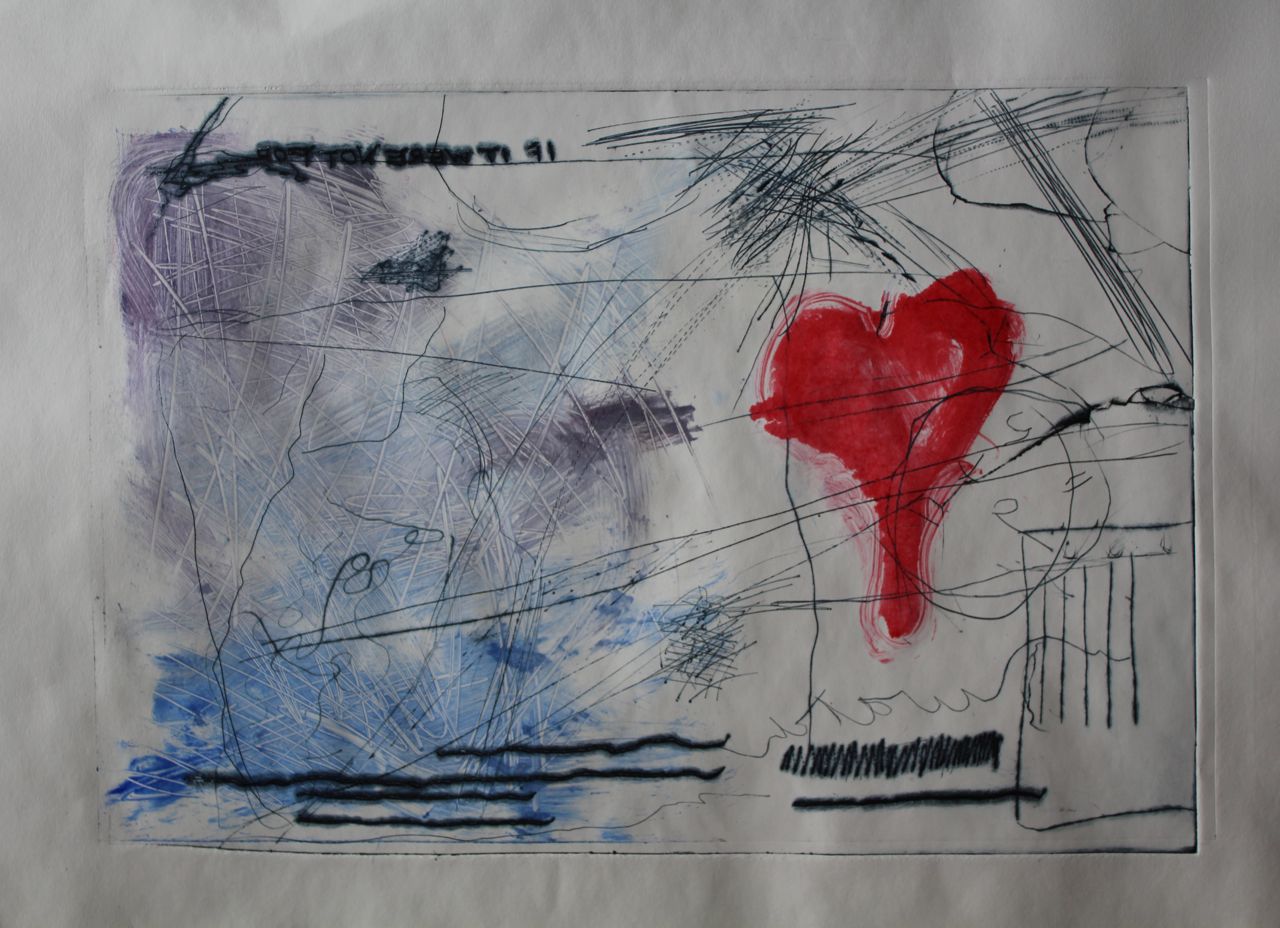
Intaglio and monoprint

Intaglio and monoprint


This is the ghost print of the intaglio, and the lines are finer. The monoprint layer has accidentally- or not, depending on one’s view of what random marks reveal- turned into a map of the world.
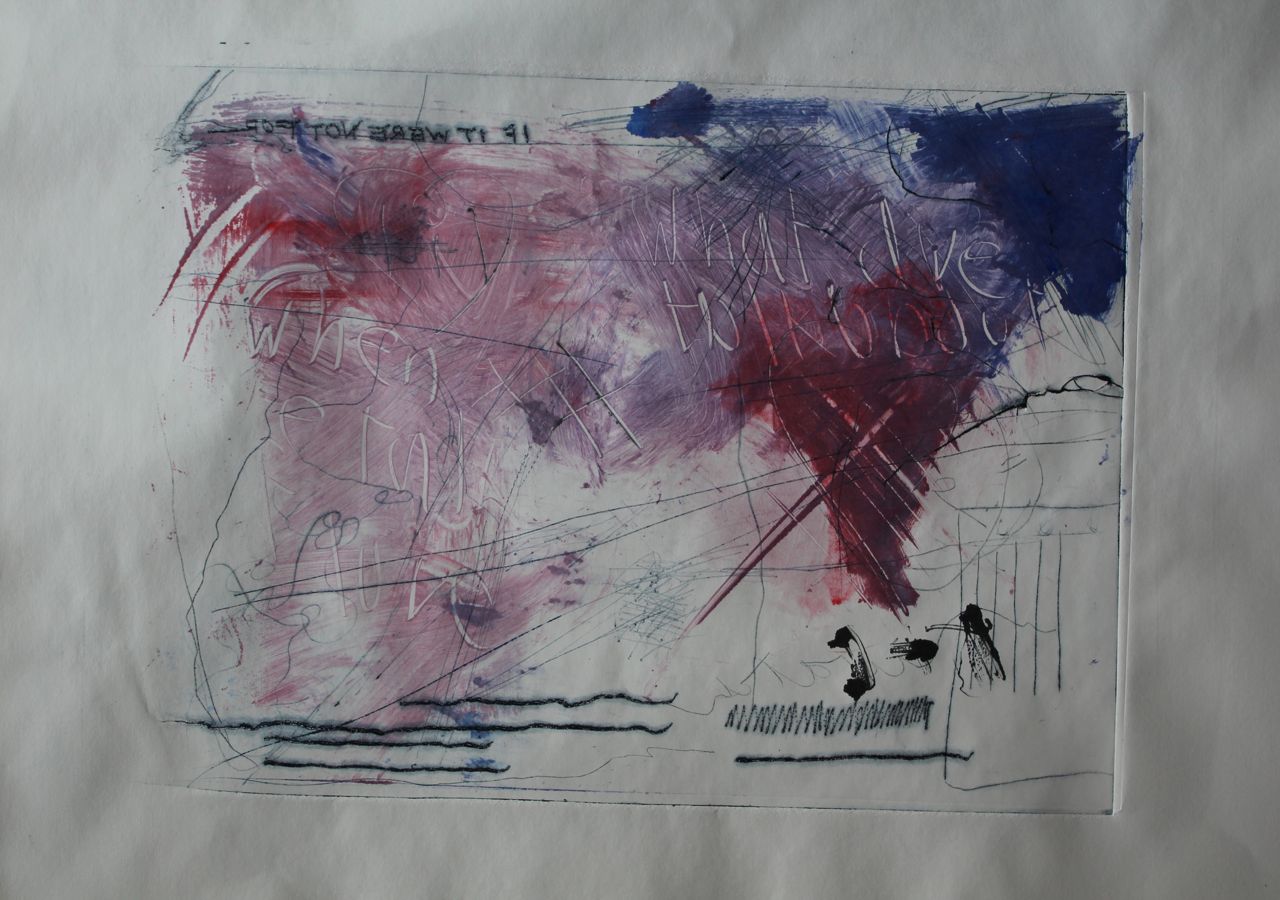
IMG_3837

This is something to come back to.


Assignment 2: Abstraction: Serendipity

Assignment 2


I’m defining abstraction rather generally. Yet, I understand abstraction as a process: abstraction FROM something… But my problem with abstraction is, what subject matter do I begin with? Or do try to come at abstraction from another route? I identify three basic types of abstraction which do not rely on observation: geometric, intuitive and serendipitous.

Obviously, if, rather than being inspired by those artists who were trying to make visual sense of their world, Cubists, Orphists, Futurists, the terms of reference are those dogmatists of “pure” abstraction- Mondrian and Plastic art, Malevich and Suprematism- then anything which seems to imitate nature would be considered mere representation. What was left to those artists as their subject matter then? The language of art- pure form: balancing shapes, colours, lines. Those elements belong only to art, and thus define its being. Renaissance art provided idealised images of man, but Plastic art paints itself in its own terms. These could become spiritual and mystical – symbols of an eternal language.  Or geometry.

The course designer suggests looking at renaissance art to identify the “pure” forms that underly its compositional structure: the triangle, the hemisphere, shapes which are symbolic of the beliefs in the holy trinity, of the dome of the heavens above. Lines of congruence which direct our eye in a painting, which tell us how to “see” what’s more important, the truth of the universe.

Personally, though, I don’t privilege maths over nature, and when Coleridge writes of “that eternal language which thy God utters”, he means the natural world, and this chimes much more with my emotional instincts. Besides, some abstraction, such as Hilma af Klimt’s, seems to have been illustrative- symbolic representations of a system of belief- or in other words, what we would now term graphics. Agnes Martin, however, is one artist who has put the mysticism back into geometric abstraction, by privileging the process of line-making as meditation. This is something I have experimented with, and find satisfying.

Influenced by the claims of psychoanalysis, painters such as Kandinsky created abstract images inspired by dreams, or music- in this case, putting on canvas images which were “seen” in the mind, not based on external observation. This is a more intuitive approach, which could be seen as the precursor of abstract expressionism, of action painting, gesture, or of colour field painting. This is an approach that puts emotion and instinct in the forefront.

Max Ernst used frottage as a way of making patterns, which he then developed into fantasy images, responses to what he saw in the patterns- the frottage process being a kind of randomising process to get him thinking out of the box. Ernst is considered to belong to the group of Surrealists, for whom random juxtapositions challenged perception and remade reality. This was serendipitous, and opens the way for seeing the familiar strangely, for repositioning and reinterpreting the world of our direct experiences.

If I consider abstraction without the capital A, though, it is a process of distancing. That may mean distancing in time, or place or space, or emotionally: it may mean generalising, or conceptualising. It may mean shaking off the normal associations that objects have. And in doing so it may create new ways of seeing, rules and laws, like those of Plasticism, Cubism or Suprematism. To that extent then, it is the process of modernisation of art at the start of the 20th century, and the forerunner of all the movements and -isms that rejected photographic realism. Which makes the topic of this assignment rather broad.

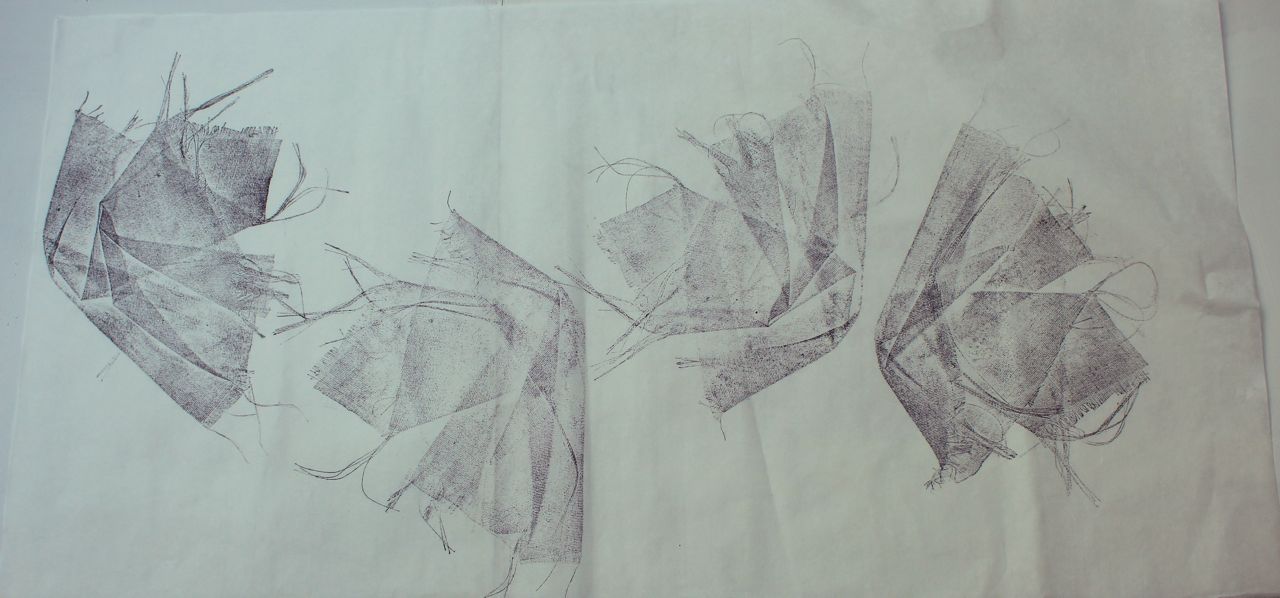
These “abstract” shapes are made by inking squares of tarlatan, and folding them, fraying the material, using a mask, duplicating- it’s a type of collograph technique in that it’s a relief made from material placed onto a surface, but the transparency of the object, and the lightness of the lines make it suggestive of something floating in space or swimming in liquid. But is this abstract? Its clear what the material is, even though the way it has been printed is suggestive of something other than what it is composed of. I could use the patterns created to make another abstract design, an arrangement of shapes. but am not sure how I could improve on it. The fine lines would be hard to achieve in any other way, but I could try something labour-intensive and  meditative. Or these random patterns could become part of another image, reminiscent of the way Ernst used frottage.

What is clear to me though, is that there is a link between process and meaning: if the lines are made laboriously, that is part of their meaning, if they are light- like these, and have touched the paper for only a brief moment, which has captured a particular arrangement that is actually temporary, then that is part of their meaning. And that, I think, is what I’m trying to work out here in this foray into “abstraction’- a match between the way the marks are made and their meaning.


IMG_3516


Assignment 2: From sketch to abstraction: looking

Assignment 2

One of the biggest challenges for me is using my own sketches to arrive at an abstract image. (I know that this is not what the coursebook suggests as a direction here, but it is recommending starting by looking, even if, this time, it is looking at the work of artists.)

If I take abstraction to mean simplification, then I try redrawing, reducing the number of lines: that may result in seeing patterns and balance of shapes, in the creation of a certain rhythm, or the identification of certain analogies between one thing and something else. But there’s a risk it will end up as a mere pattern, something predictable and repetitive, or it may end up looking like a piece of graphic design. Where’s the line between these? Early 20th century abstraction, in movements such as Cubism, Orphism, Futurism, was influenced by changes in perception of the world. The typical Renaissance landscape, single point perspective, static eye view was now outdated as a means of representing the modern world of movement and speed. Visual art could now be a moving thing, with layers beneath  the surface, hidden depths, a state of changing from one place to another, from one state to another.

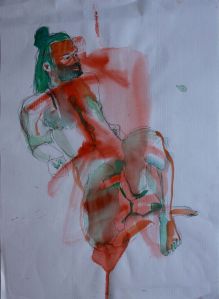
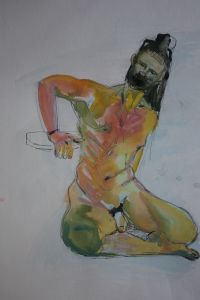
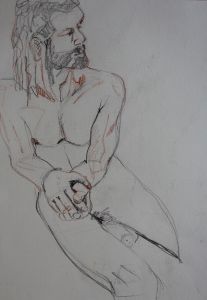
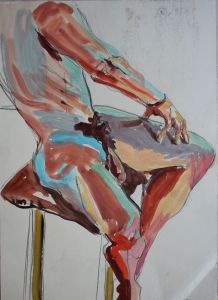
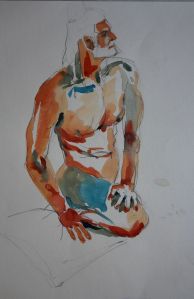
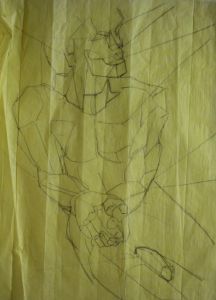
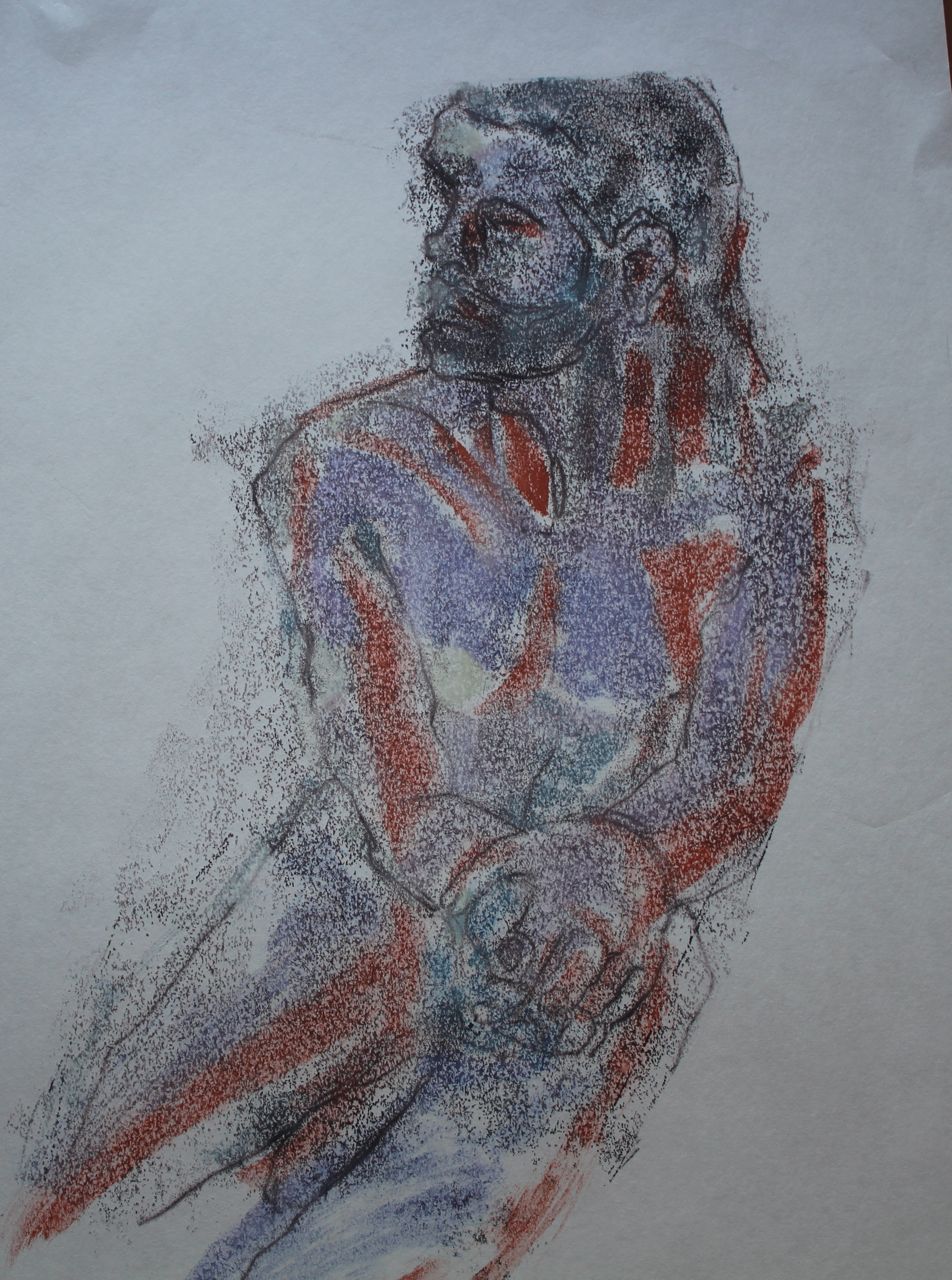
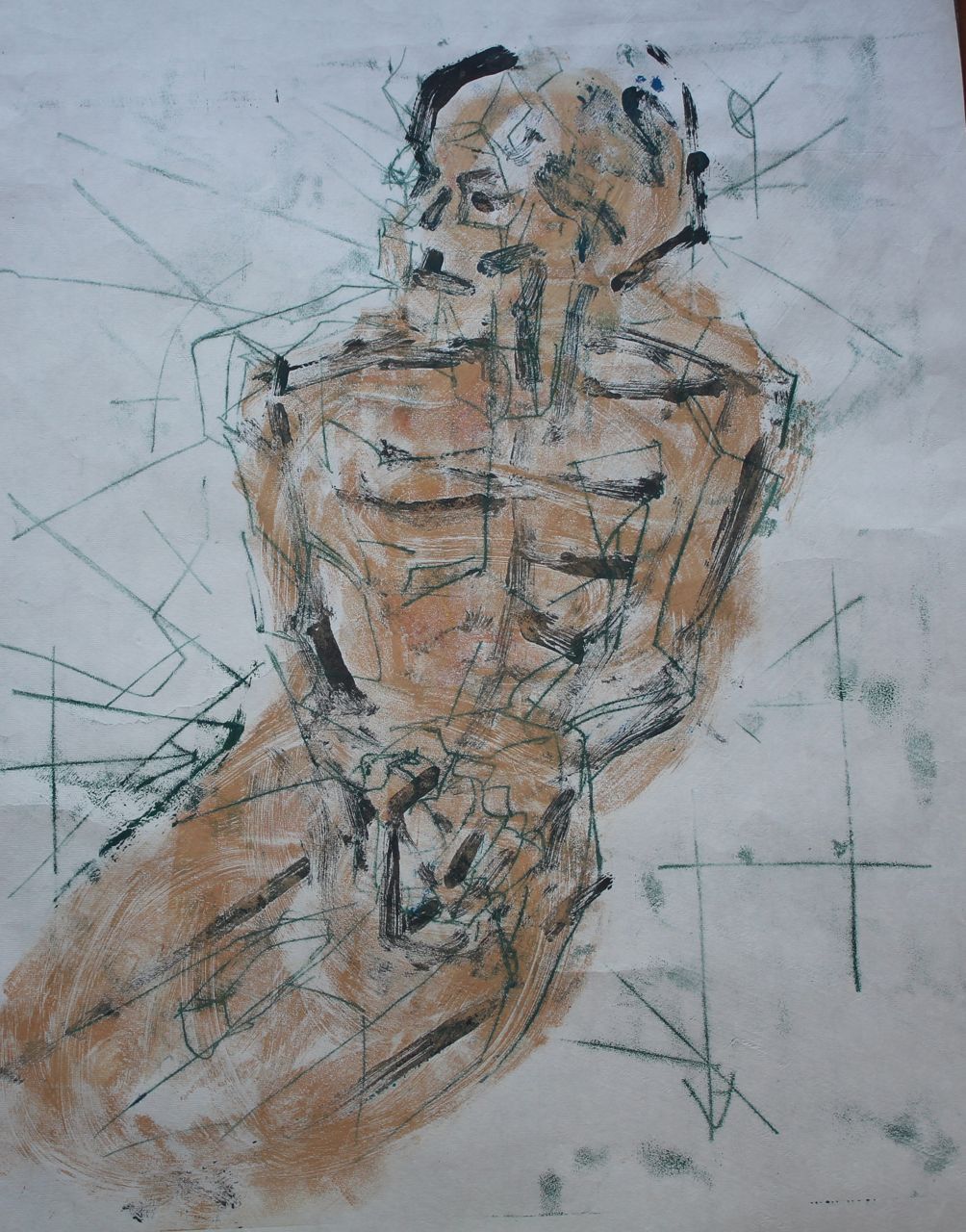
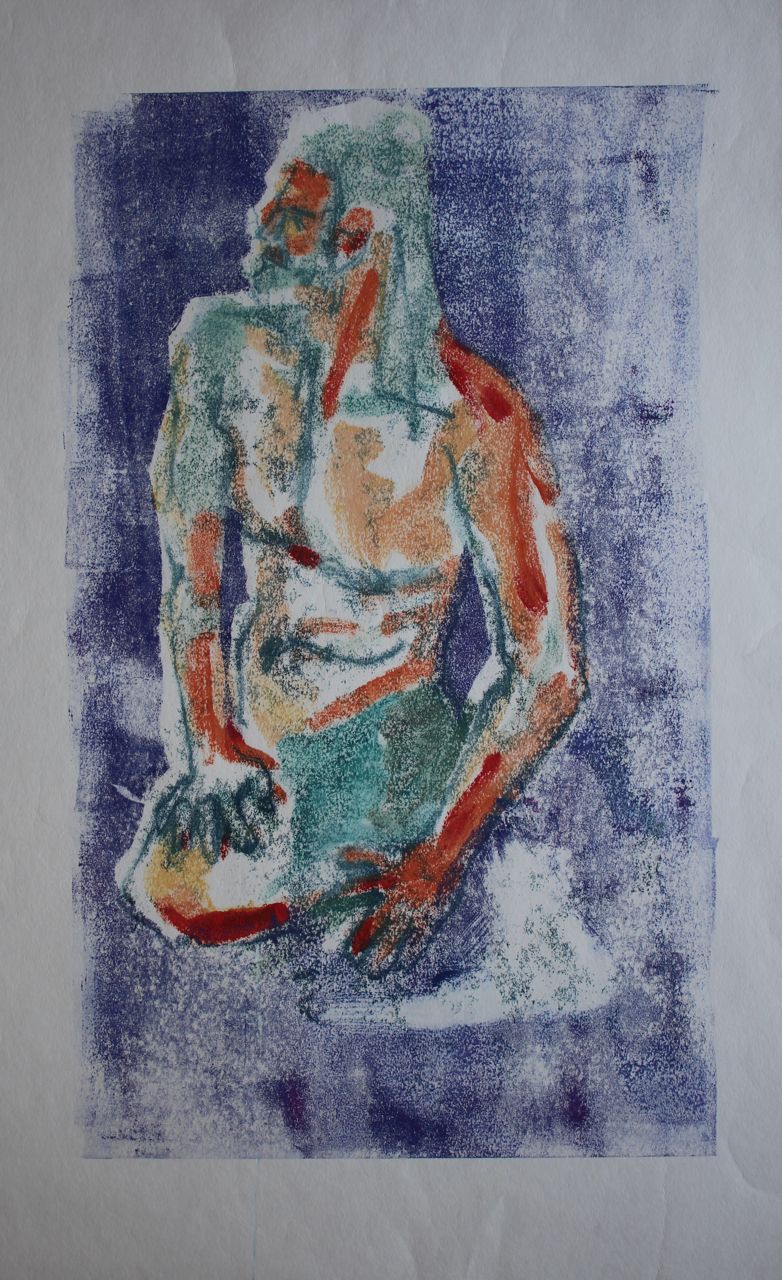
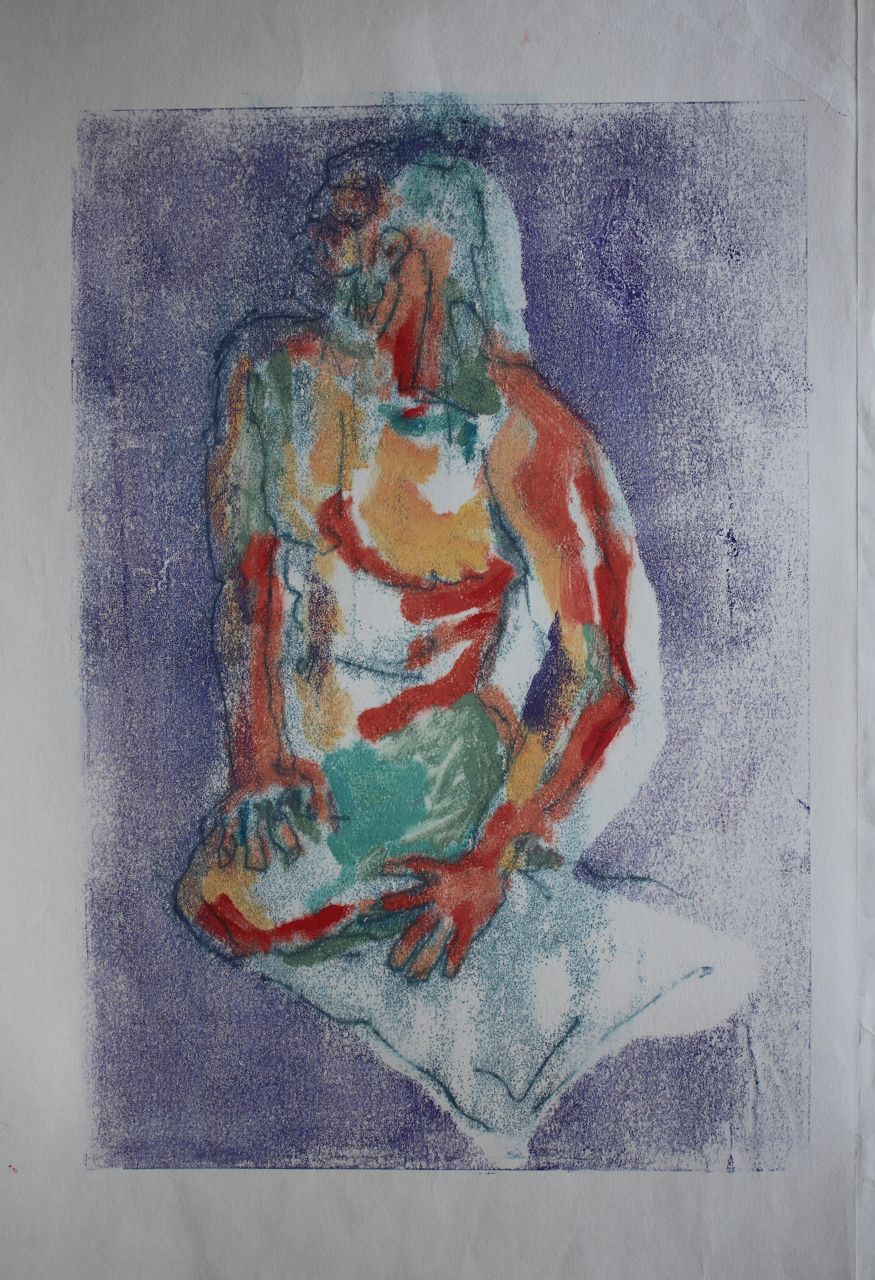
I started with a series of life drawings of my favourite model, Vangelis, who pops into HK at various times in the year. He does balletic movements which are a great inspiration for gestural drawing, but these were still poses. How could I make these more abstract? I started by tracing, simplifying the drawings into fewer lines, accentuating the sculptural shapes, making the body into blocks.

At the same time, I had to think of my resources. Monoprinting is the most straightforward when you have few specialist resources to hand. I had painting materials, ink, sheets of perspex, Chinese rice papers, tissue paper and heavier cartridge. The techniques that suggested themselves were transferred paint, masking, and backdrawing so I had my “language” of seeing in the form of shape, colour and line. At its most basic, any form of translating a solid 3D person into a pattern of shape, colour and line, is a process of abstraction.

This first image is an “abstraction” by analogy- the lines are simplified, the colours arbitrary, the naturalism is lost, the limbs are no longer articulated but are fused into the body, which now suggested an analogy of a piece of gnarled wood, something perhaps sculpted and primitive.

Analogy

Analogy: monoprint A2

The second image is using the soft mottled colours of wet paper, and backdrawn outlines, but the two layers of the print exist separately, and emphasise the artifice of both. The body seems to be a collection of atoms, barely held together by a porous outline, man as construct. Now the pose fits too, coincidently, as the image of the folded hands mirrors the idea of encapsulation.

Containment by line

Containment: Monoprint A2


This image is the most explicit and self-conscious: a reflection on the act of looking- shape as the congruence of internal structure and negative space.

Negative space

Negative space: Monoprint A2


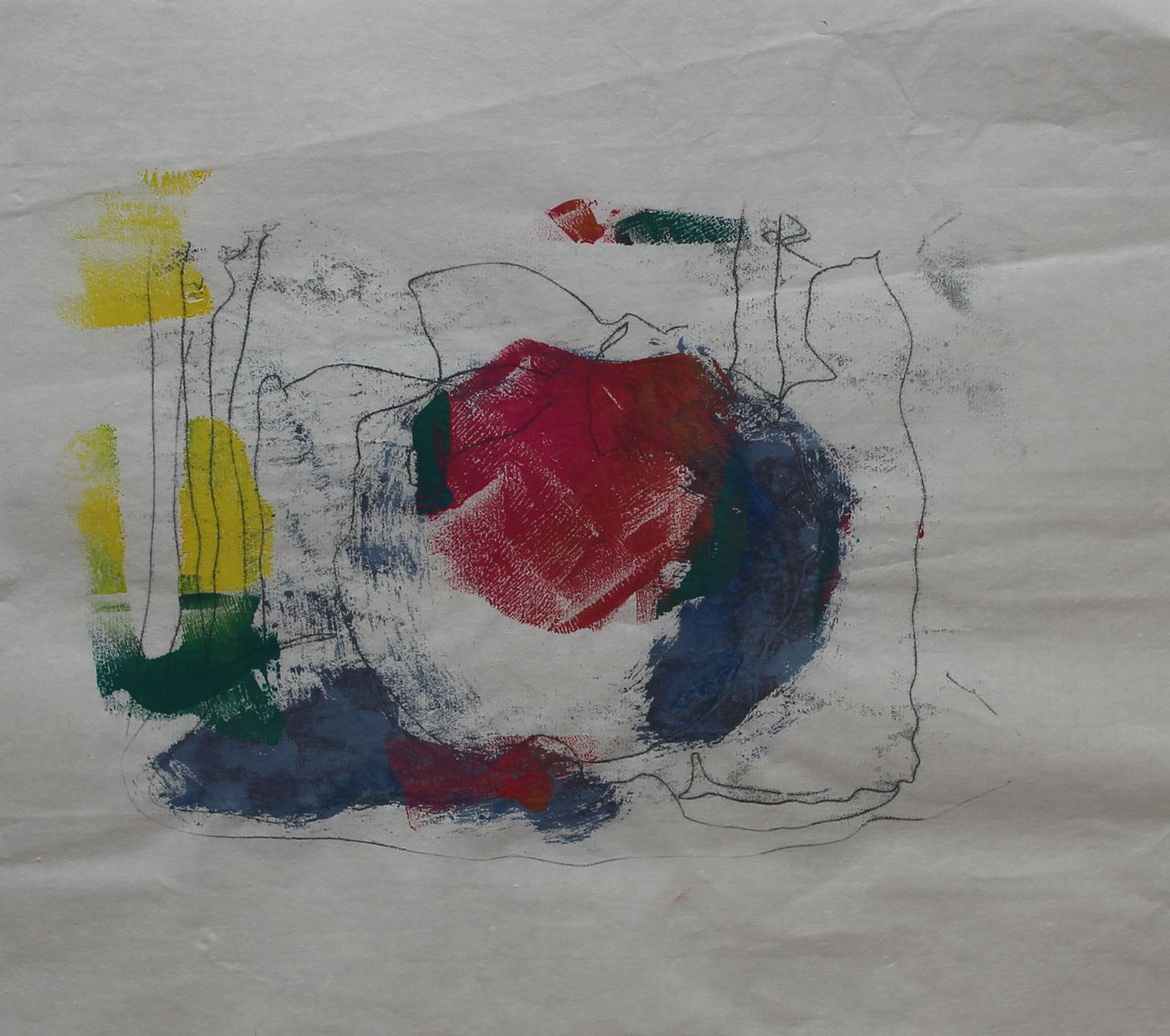
This wasn’t inspiring though. Below, this was the first print that I felt enthused by- a fast impression of a group of objects- apples, a plate, a bottle, a cloth- torn masks, blind painted and then blind backdrawn. This shows the three elements of shape, colour and line as three distinct entities. The texture of the lines, the textures of the colour and the fluidity of the shapes, suggest things trying to come into being, to form themselves using this visual language, parallel to how Cubist paintings resolve themselves from splintered planes.

Still life

Still life


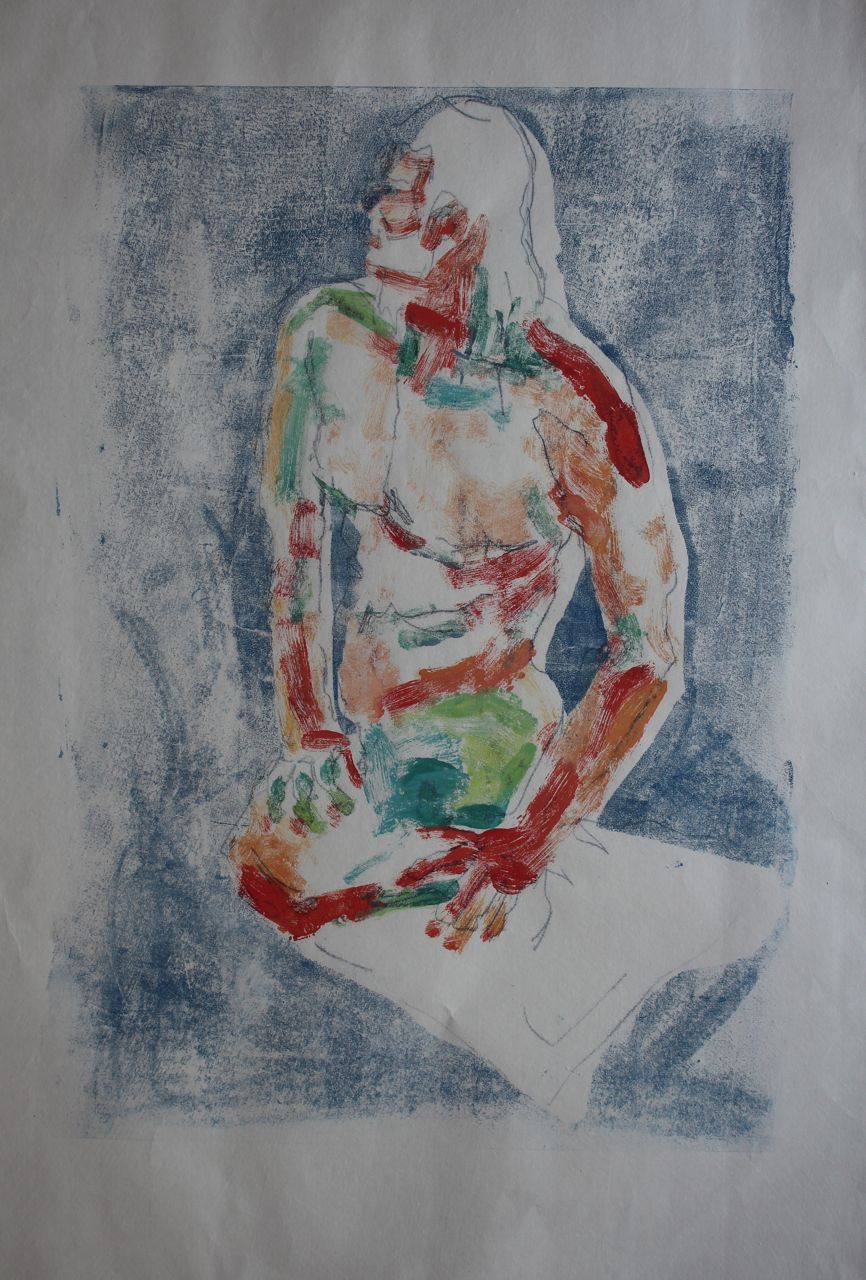
So I tried to use the figure in the same way, using a mask, painting and backdrawing,  The mask creates an empty space and a negative shape. Warm and cool colours and white spaces suggest form, and an illusion of 3 dimensions. Backdrawn lines posit an alternative space to the masked shape. Mis-registration is the element that creates the “abstraction” from life, the deliberate juncture with reality. That is to say,  the “language” of printmaking can do the job of suggesting that what we see is an unstable thing, dependent on perspective. On the other hand, the images also suggest movement, in the  same way as “Nude descending a staircase” works by showing transitions into and out of a place in time, as if the figure is getting into or out of position. The separate elements “become” a figure because we interpret it from our habits of seeing.

Technically, I used different degrees of paper moistness to get different line quality. The middle one was using wallpaper lining, very strong, and quite damp. The other two are on Chinese rice paper, dry on the left, slightly dampened on the right. The same images seem to move in different directions, away from the masked shape.


What I like about this experiment is the emphasis on the monoprinting processes, but this could go in so many different directions that I’m not feeling I have found a focus yet.

Assignment 2: Abstraction: A kind of a beginning

Assignment 2

I’m writing this up in retrospect.  I’ve done a lot of experimenting over the summer, and am only now, at the end of August, bringing things together. But it’s hard to construct a narrative out of all the different threads. The narrative I create here will to some extent be a reconstruction, a rewriting of history to fit the course.

“Abstraction” seems a rather large topic, that’s the problem. All processes of making something (seen, felt or thought, as opposed to a functional artefact) into something else are degrees of abstraction, and I’m having difficulty knowing where to go with the coursebook instructions, which seem to be dipping a toe into historical movements, but only a bit. As I started this, I was also limited to what I had to hand in the way of materials. As the summer progressed and I got more materials, so the experiments related closely to the materials I had. Craft practice then. Then reading, following trains of thought, letting some go for a while, joining some together, forgetting some altogether.

But, to summarise. For the past little while, I’ve been mainly playing with new materials, seeing where those would take me.

I’ve also been somewhat interested in Science- the history of it, the way it has influenced how we think and see, as well as the practical application of basic chemistry in printmaking processes.

Finally, I’d say I’ve interpreted “abstraction” as PROCESS. That’s to say, abstraction as a degree of separation, in time, space, material, which leads one to a concentration on the processes involved in visualising and constructing.